


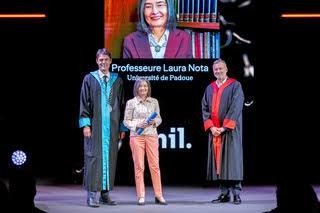
Honorary Degree awarded to Laura Nota: reflections by Jean Guichard
Thursday 28 May 2026: notes from the conference
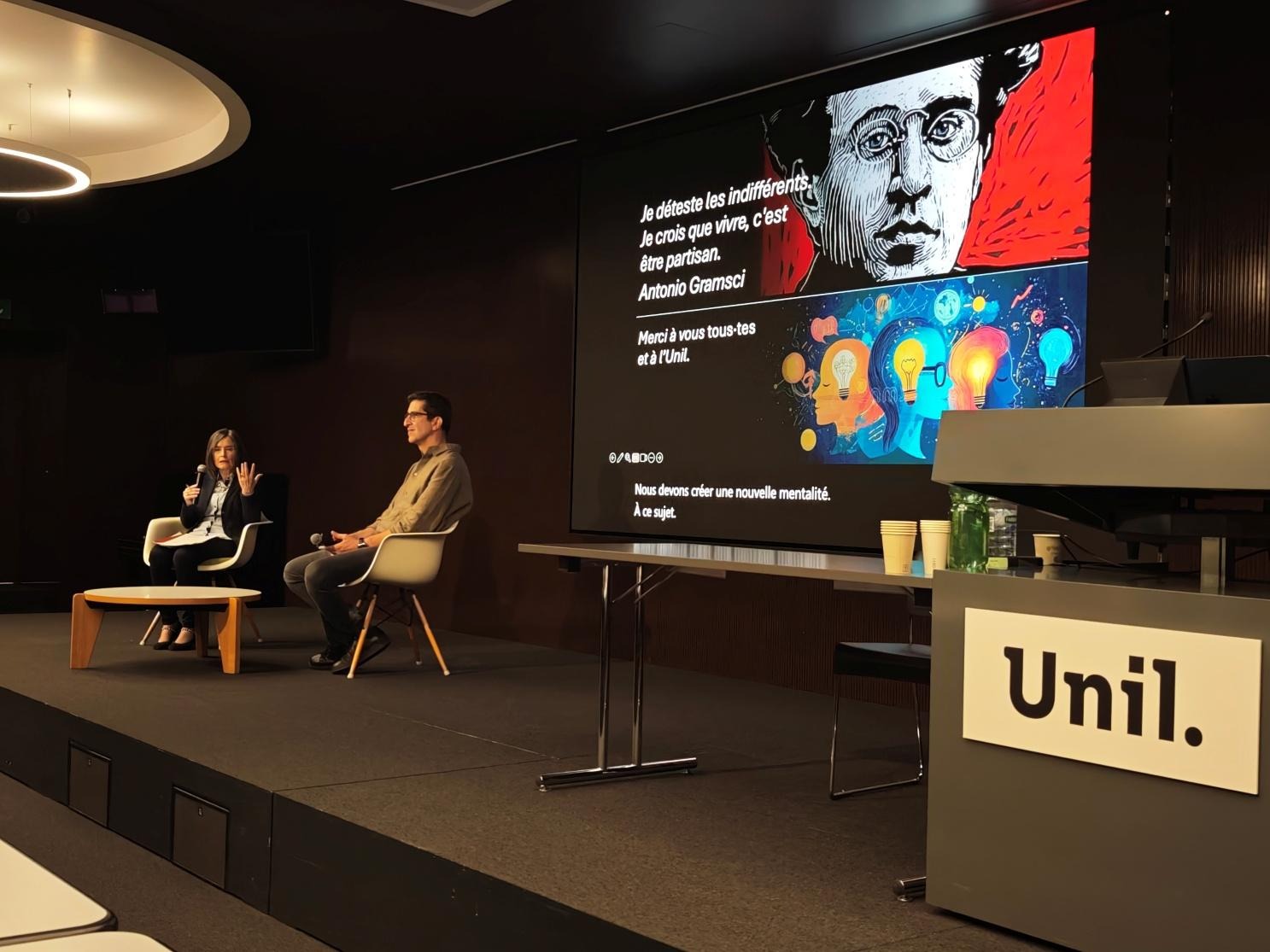
On 28 May, at 6 pm, we attended a discussion event organised by the Faculty of Social and Political Sciences of the University of Lausanne, which opened with Laura Nota’s conference entitled ‘The imagination of futures between pluralistic and complex visions of social justice, freedom and inclusion’.
The conference sought to highlight the connections between visions of the future and different understandings of social justice, freedom and inclusion. One of its strengths was the analysis of the plurality of definitions of freedom: neoliberal, liberal, democratic, social, ecocentric, and so on. As part of a pilot research project, university students were asked: “If you had to explain the concept of ‘freedom’ to someone, what would you say?” Almost all respondents provided a neoliberal definition of freedom. In other words, they described it as “doing what one wants”, combining this with the liberal concept of negative freedom: “acting without obstacles, prohibitions or constraints”.
This conception does not exclude the fact that, in the face of the undeniable reality of today’s global polycrisis, many young people express anxiety about the future. For example, a survey conducted among Italian upper secondary school students highlights a tendency towards a dystopian vision of the future itself: they believe that, in thirty years’ time (when they will be between forty and fifty years old), the world will experience both a social and an environmental catastrophe. Laura Nota emphasises that the fundamental issue is the financialisation of the economy: the capitalist system of accumulation, which developed rather slowly through the mediation of the production of goods, has progressively been replaced by a much more dynamic system based on the accumulation of non-productive investments (for example, the purchase and subsequent resale of “raw materials” on futures markets).
Laura Nota’s argumentation deeply resonates with me. The widespread adherence to (neo)liberal ideologies among Italian students (which is undoubtedly evident in most Western countries) brings to mind Herbert Marcuse’s thesis in One-Dimensional Man. In particular, it recalls his development of Karl Marx’s observation that the capitalist economic system not only produces goods to be exchanged on the market, but simultaneously produces the subjects who consume those goods. (A paradigmatic example today is the mobile phone, from which many people, walking down the street like zombies, are unable to take their eyes away). Capitalism is not simply a system of product exchange; it is also a set of psychosocial processes of subjectivation which, in technologically advanced societies, result in the production of a mass of individuals unable to imagine a form of life different from their own: human beings who are “one-dimensional”. This undoubtedly explains the failure of ecological movements to preserve “our common home”, to use the words of Pope Francis.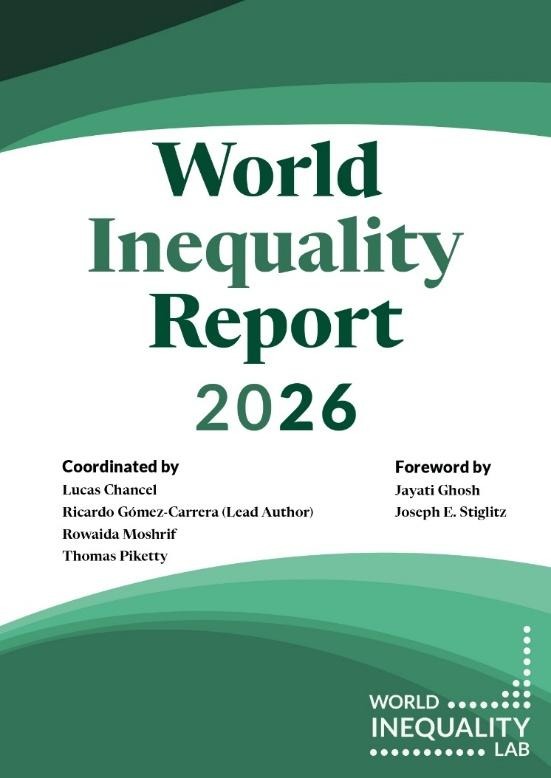
The financialisation of the economy, in turn, manifests itself through an exponential growth in inequalities between the rich and the poor (between states and between citizens within a state). This is what Oxfam studies highlight year after year. Thus, in 2024, “since 2020, the five richest men in the world have doubled their wealth, while, at the same time, the total wealth of five billion people has decreased”. Based on these observations, the global consortium of researchers – authors of the Global Inequality Report 2026 – concludes that, to address the polycrisis of the Capitalocene, it is necessary, first and foremost, to tackle the extraordinary increase in wealth inequality. With regard to the climatic and environmental dimensions of this crisis, these economists specify that resolving them requires redirecting the capital held by the world’s wealthiest individuals towards wind, solar and other renewable energy technologies, in order to accelerate the complete decarbonisation and electrification of energy supply by 2050.
Although such a conclusion is easy to formulate, its implementation is not. Throughout the world, billionaires or their representatives hold all the key political positions. They control virtually all media outlets. And everything suggests that they believe their current interest lies in promoting proto-fascist political regimes willing to engage in armed conflicts (given that arms sales are extremely profitable).
Conference link: https://www.unil.ch/news/1780058333990
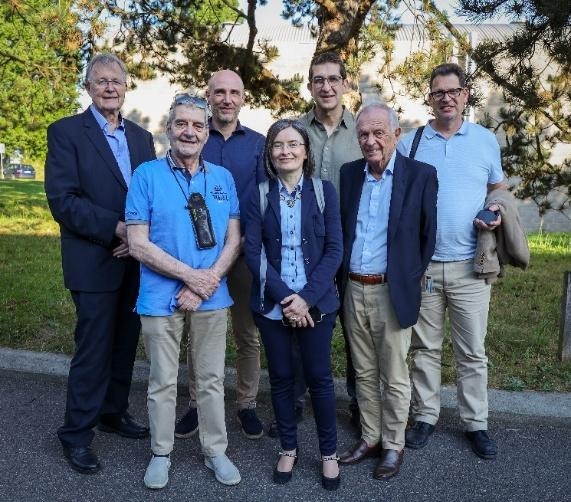 Being in Lausanne was also an opportunity to bring together several members of the “Life Design” group and to spend time together, both remembering the past and thinking about the future. After a brief aperitif, the evening ended with dinner beneath the trees of a small restaurant near the University. Salvatore Soresi recalls that twenty years ago, the “Life Design” group, founded by Raoul Van Esbroeck, met for the first time in Brussels. Five of its participants are now sitting around the table. Salvatore proposes undertaking, following the model of Alexandre Dumas, the project “Twenty Years After”. Koorosh Massoudi shares his concerns for his mother and relatives living in Tehran.
Friday 29 May: notes from the award ceremony

In the morning: the ceremony for the awarding of honorary degrees. It opened with several speeches, particularly those by Frédéric Herman, Rector of the University, who was concluding his five-year mandate, and by Frédéric Borloz, State Councillor and Head of the Department of Education and Vocational Training. Neither of them mentioned the United States or Trump by name. However, their shadows loomed over their speeches: would universities continue to enjoy considerable freedom in conducting research? Would they have sufficient budgets to welcome all the young people who would come knocking at their doors? Nothing was stated explicitly, but the memory of 10 May 1933 in Germany was present in everyone’s mind. A cartoon by Nicola Jennings, published by The Guardian, seemed to me to summarise this profound concern.
The ceremony was sober. After the awarding of honours to several members of university staff, it concluded with a reception.