


Listening Beyond Words: The Quiet Strength of Young Ukrainians Fleeing War
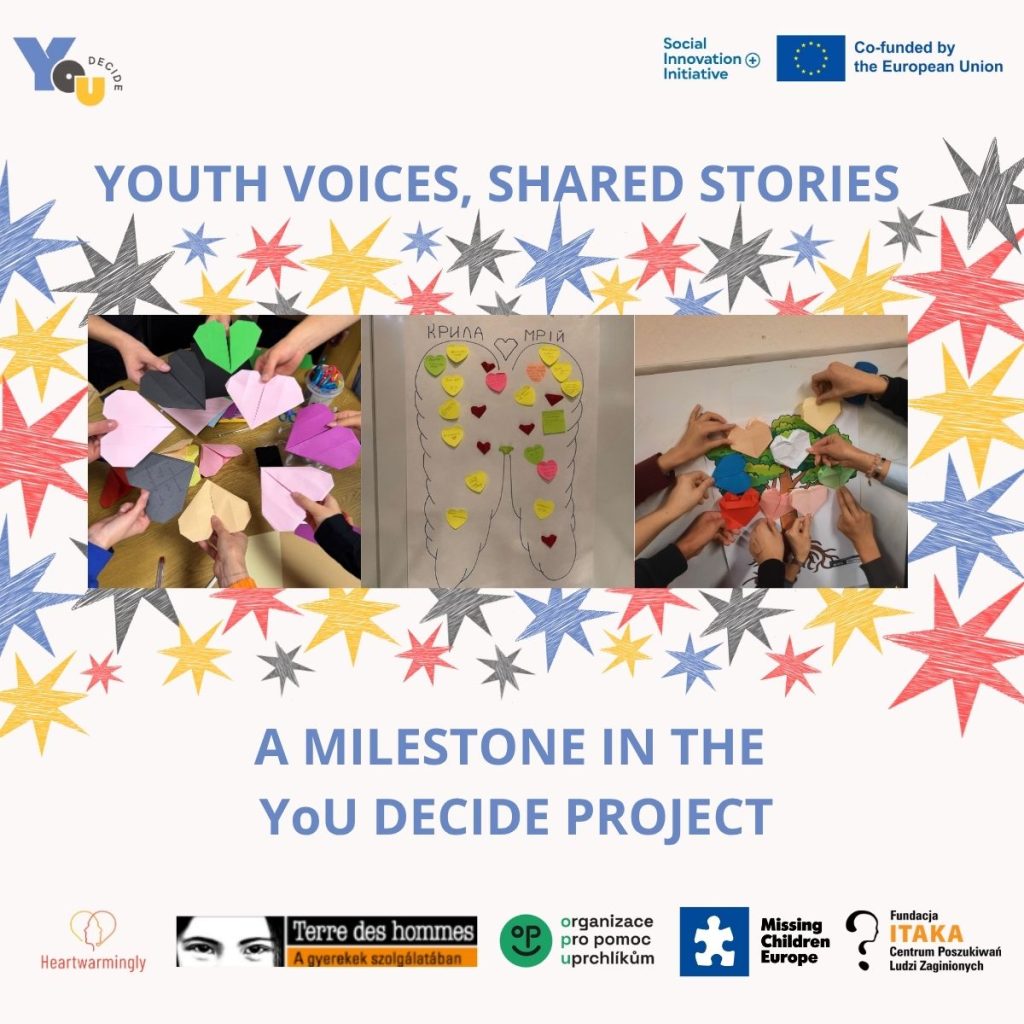
Table of Contents
- The YoU Decide project
- The importance of listening and participation
- Identity, adaptation and the meaning of belonging
- Hobbies and creativity as tools for connection
- Education, work and the burden of independence
- Home and stability
- Giving young people a voice: the importance of safe and participatory spaces
- Looking ahead
Since the beginning of the Russian invasion of Ukraine, European countries have taken swift action to support the affected population, implementing a response that is unprecedented in its speed and scope. Since March 2022, millions of Ukrainian citizens have found refuge in various European Union countries, which have introduced extraordinary temporary protection measures, school and university integration programmes, and economic and psychological support programmes. However, three and a half years after the start of the conflict, the picture has changed radically. The emergency has become everyday life, and media and political attention has gradually shifted elsewhere. But what is happening today to those young people who left everything behind? What forms does inclusion take when urgency gives way to fatigue and the initial solidarity risks fading away? Is the strong feeling of welcome that swept across Europe in February 2022 still alive, or has it faded, giving way to disillusionment and the fatigue of prolonged coexistence?
It is in this context that YoU Decide (Supporting Youth of Ukraine Making Informed Decisions) was born, an initiative that does not merely assist young Ukrainian refugees, but aims to listen to them, involve them and give them back the opportunity to make informed choices.
The YoU Decide project
YoU Decide is a social innovation project funded by the European Union and coordinated by Missing Children Europe, in collaboration with Terre des Hommes Hungary, OPU – Organisation for Aid to Refugees in the Czech Republic, Fundacja ITAKA in Poland and the Heartwarmingly Research Consultancy research team.
The project, which runs from May 2025 to October 2026, was created with the aim of supporting young people from Ukraine who have been displaced by the war. Although there are various support services in the host countries, many young people find it difficult to access information and assistance that is truly suitable for them, coordinated and designed with a young person's perspective in mind. Language barriers, institutional fragmentation and a lack of personalised guidance tools often make it difficult to make crucial decisions in areas such as education, legal status, mental health and economic independence.
YoU Decide aims to bridge this gap by creating accessible, youth-centred support networks that empower young people to participate actively and transform their experiences into useful knowledge for public policy.
The importance of listening and participation
A key element of the project is youth participation. It is not simply a matter of designing interventions for young people, but of building them together with them. With this in mind, a Youth Advisory Board (YAB) has been set up, composed of eight participants aged between 16 and 20 who contribute on an ongoing basis to defining activities, providing suggestions, sharing experiences and proposing solutions.
Using a trauma-informed methodology, which takes into account the invisible wounds left by conflict and uprooting, the Heartwarmingly Research team trained both partners and young YAB members, many of whom took on the role of co-facilitators in focus groups held in Prague, Budapest and Warsaw.
This approach has made it possible to create spaces for authentic listening, where the distance between researchers and participants is reduced to the point of almost disappearing, and the sharing of experiences becomes a collective process of understanding and re-elaboration.
Identity, adaptation and the meaning of belonging
Discussions in the three countries revealed recurring and deeply intertwined themes: a sense of belonging, the construction of new identities, the search for emotional stability and the need for meaningful relationships.
In the Czech Republic, many young people spoke of the difficulty of finding social groups suited to their age, of integrating into peer networks or participating in community activities. However, these same difficulties gave rise to forms of creative resilience: one young participant, for example, described her dream of turning her passion for knitting into a small craft business, a sign of how creativity can become a bridge between fragility and the future.
In Hungary, the dominant theme was that of spaces: the scarcity of accessible recreational areas has led many young people to construct symbolic spaces for themselves through hobbies, photography or digital activities. These personal interests become ways of redefining themselves and feeling part of a context, even when the surrounding environment remains distant.
In Poland, testimonies revealed a delicate balance between adaptation and aspiration. Several young people spoke of the difficult balance between school and part-time work, the struggle to maintain relationships with family members who remained in Ukraine, and incidents of discrimination in educational settings. Despite this, stories of resilience emerged: one girl recounted finding a new sense of belonging by joining a local swimming club; another young man explained how photography helps him to “see life with new eyes”.
Hobbies and creativity as tools for connection
A common thread running through all the focus groups concerns the role of hobbies in rebuilding oneself. After fleeing, many young people abandoned group activities (dance, team sports, theatre) to devote themselves to more individual passions such as drawing, music or running.
This shift reflects a dual dynamic: on the one hand, isolation and language barriers; on the other, the search for spaces of autonomy and continuity. In contexts where everything changes – home, school, language, relationships – creativity becomes a fixed point, a form of silent resistance through which to reaffirm one's identity.
In Hungary, several young people described how photography or writing have become strategies for managing anxiety and still feeling like “authors of their own story”.
In Poland, artistic activities have been described as tools for healing, but also as universal languages capable of overcoming language barriers.
In the Czech Republic, facilitators observed that pursuing individual hobbies encourages introspection and strengthens the ability to make independent decisions.
Hobbies, therefore, are not simply pastimes: they represent spaces of freedom where young people can experiment, imagine and redefine their lives beyond the conditions imposed by uprooting.
Education, work and the burden of independence
Another recurring theme concerns the relationship between education, work and economic independence. Many young refugees find themselves having to support themselves or their families, taking on precarious jobs, often without contracts or in irregular conditions.
In Hungary and Poland, the burden of this responsibility has a profound impact on their ability to continue their studies. Some young people have dropped out of school or university to take on temporary jobs, while others try to juggle both, sacrificing their free time and mental well-being. In the Czech Republic, the flexibility of the education system facilitates discontinuous attendance, but does not always guarantee a real path to integration.
The difficulties are not only related to access to education, but also to the lack of guidance and psychological support networks. In Poland, for example, there have been reports of a limited number of professionals able to communicate in Ukrainian. However, there are also examples of good practice: a teacher who dedicates extra time to a student, an employer who helps a young apprentice improve their language skills. These small gestures become powerful levers for inclusion and trust.
Home and stability
Housing is one of the most sensitive issues for young Ukrainians in Central Europe. Many live in shared or temporary accommodation, moving from collective shelters to social housing or rented rooms with other refugees.
In the Czech Republic and Poland, there is a prevailing sense of ambivalence: on the one hand, gratitude for the safety and protection offered; on the other, an awareness of the instability that comes from not being able to plan for the future. In Hungary, discrimination in the rental market is a significant obstacle, fuelling a sense of social exclusion.
One facilitator observed that, even in the absence of physical stability, young people often manage to build a sense of “inner home”; through objects, relationships and daily routines, they shape their own symbolic space of belonging: “Even when the walls are constantly changing, they build a home through what they create”.
Giving young people a voice: the importance of safe and participatory spaces
One of the most innovative elements of YoU Decide is the decision to involve young people as co-facilitators of the research. This breaks down the traditional hierarchies between researchers and participants, and knowledge production becomes a shared process.
The debriefing sessions showed how empathetic documentation and active participation strengthen young people's confidence and awareness. Feeling listened to, without being judged or interpreted, is in itself an act of recognition. For many, talking about their experiences within a peer group was the first opportunity they had to process what they had been through.
The method adopted by Heartwarmingly Research demonstrates that participation is not only an ethical issue, but also an epistemological one: listening changes the way we learn.
Looking ahead
The YoU Decide project will continue in the coming months with new research, training and advocacy activities. The evidence gathered in the focus groups represents an essential starting point for building more inclusive public policies and intervention practices that are truly youth-centred.
The project's participatory and trauma-informed approach offers a replicable model for other migration and crisis contexts, reminding us that young people's resilience is not infinite: it must be supported with concrete tools, continuity and spaces for listening.
As one of the researchers observed: ‘It's not just about collecting stories, but about ensuring that those stories generate understanding and real change.’
In a Europe facing new crises and tensions, listening beyond words means recognising the political and human value of young voices: those that, even in the silence of war, continue to imagine the future.