


Hungry algorithms: The hidden side of AI
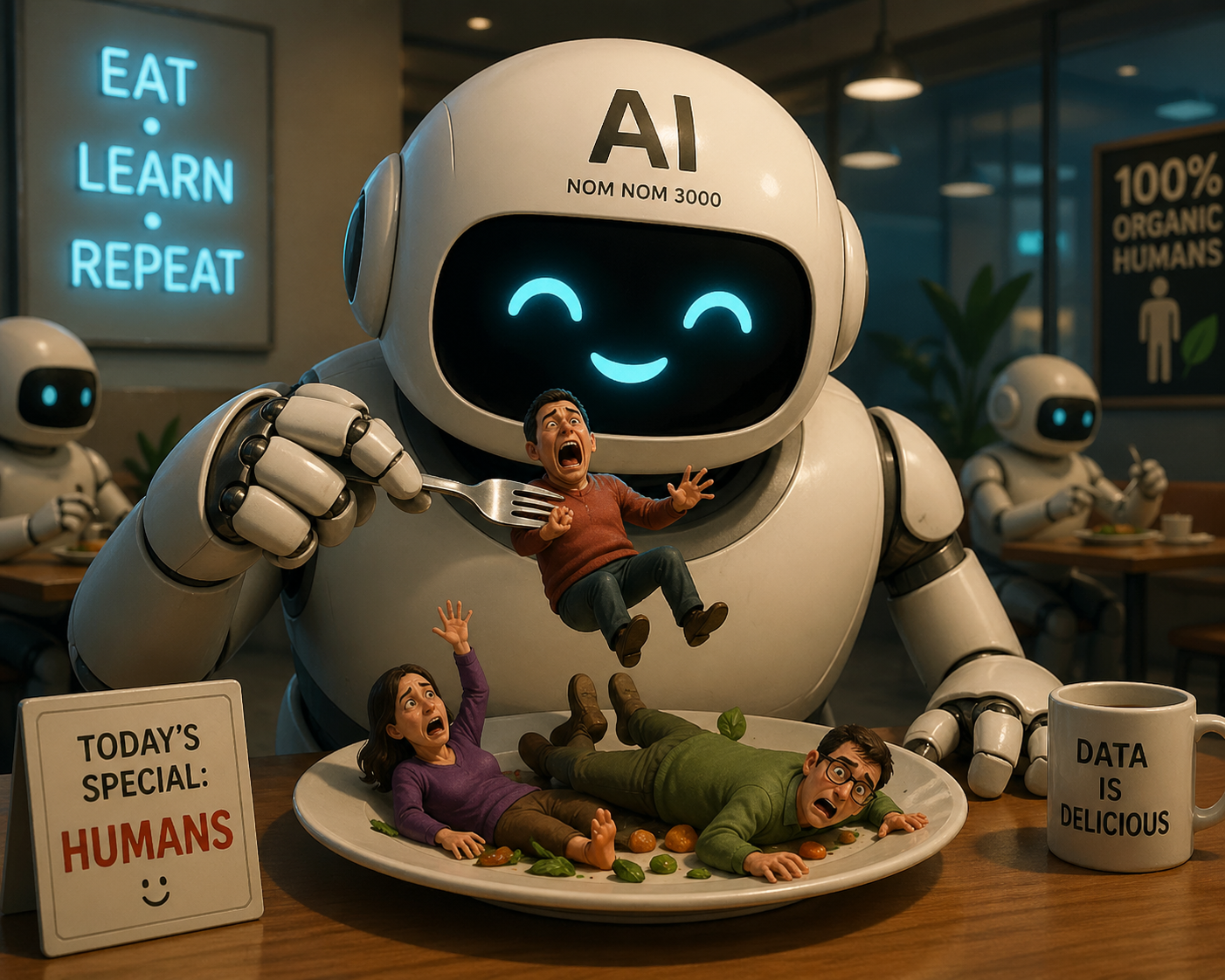
Table of Contents
- Addictive junk
- Social media, the new cigarettes
- Humans are paid to train AI
- “Rent a human”
- Almost human
The image of former US President Donald Trump (as Jesus or a doctor?) resurrecting or healing (Jeffrey Epstein or a patient?) is a recent creation produced using artificial intelligence systems, immediately sparking controversy and political repercussions due to its striking impact. Increasingly realistic or plausible creations—from videos of anthropomorphised kittens to reconstructions of life in the 1990s—are all part of a vast body of human-generated content that feeds large language models (LLMs).
As Cole Stryker from IBM Think explains, “LLMs represent a major step forward in how humans interact with technology because they are the first AI systems capable of handling unstructured human language at scale, enabling natural communication with machines. While traditional search engines and other programmed systems rely on algorithms to match keywords, LLMs grasp context, nuance and deeper reasoning. Once trained, LLMs can be adapted to a wide range of applications involving text interpretation, such as summarising an article, debugging code or drafting a legal clause. When endowed with agent capabilities, they can perform—with varying degrees of autonomy—tasks that would otherwise be carried out by humans.
Addictive junk
This “natural communication with machines” is largely one-directional: humans provide the “food” that models require in order to generate the structured responses we seek. AI consumes a wide range of inputs, often—like humans—junk content, reinforcing the well-known “garbage in, garbage out” effect. The saying “you are what you eat” applies equally to AI, yet what is most striking is its method, which is also unilateral. Models collect data wherever possible, in both transparent and opaque ways, often in violation of rules that are increasingly difficult—if not impossible—to enforce, such as copyright law.
However, the central issue lies elsewhere: the most effective way to feed LLMs is to foster dependency among human users, who willingly contribute, particularly through social networks (from TikTok to Instagram). This seductive mechanism echoes long-standing stereotypes of “enchanting” figures capable of captivating—and metaphorically consuming—others.
Social media, the new cigarettes
In two recent trials in California and New Mexico, CNN reports that juries found Meta (owner of Facebook, WhatsApp and Instagram) and Google “liable for the harmful, addictive design of their products” and also responsible “for failing to protect children from their apps”, which are known to be accessible from the age of 13.
According to the judges, there is a clear causal link between social media use and addiction. As CNN notes, this “could be a ‘Big Tobacco moment’ for social media, and the full significance of these cases has yet to emerge”.
Meanwhile, the BBC reports that Meta has “removed from its social platforms advertisements by law firms seeking clients for future lawsuits related to social media addiction”. The company founded by Mark Zuckerberg stated, “We will not allow litigation-focused lawyers to profit from our platforms while claiming they are harmful.”
Humans are paid to train AI
Are we destined to become a commodity for technology, rather than the other way around? Journalist Massimo Cerofolini reports in his radio programme Eta Beta (Radio1): “Thousands of precarious American workers are already being recruited to film themselves carrying out domestic tasks, paid only a few dozen dollars for hours of first-person footage. These videos become valuable raw material for training the machines of the future: humanoid robots, autonomous systems, and intelligences that will need to operate in the physical world.”
At times, our sense of humanity leads us to assist robots voluntarily and without compensation, as seen in Turku, Finland, where passers-by help small wheeled delivery robots get back on track. Yet the opposite also occurs: delivery robots are insulted by pedestrians at crossings. In both cases, indifference is absent—we remain human.
“Rent a human”
Robots can perform certain tasks, although their capabilities are still in early development. Artificial intelligence, however, cannot independently collect a parcel, enter a shop or interact directly with the physical world.
To bridge this gap, a young engineer, Alexander Liteplo, working in Argentina, created RentAHuman.ai, a marketplace platform where AI agents can pay human beings to carry out physical tasks. Launched in February, the platform already has over 740,000 registered users available to perform tasks on behalf of AI. Some have described the marketplace on Instagram as “deeply dystopian”, to which Liteplo responded: “Haha, yes”.
“This case clearly illustrates both the opportunities and the ambiguities in the relationship between artificial intelligence and human labour,” comments Pierluigi Paganini, a computer engineer and well-known cybersecurity expert. “On the one hand, Liteplo’s idea is ingenious: it bridges the gap between the digital capabilities of AI systems and physical actions in the real world. AI agents can plan and decide, but they cannot directly ‘act’: humans are still required. In this sense, platforms like RentAHuman could create new forms of employment, including flexible and immediate opportunities.”
However, there are also concerning implications: “The fact that humans are ‘hired’ by AI agents for often trivial or symbolic tasks—such as counting pigeons or holding signs—suggests an increasingly fragmented and potentially devalued form of labour. Moreover, there is the risk that this model is merely transitional, likely to be replaced once humanoid robots become sufficiently advanced and cost-effective to perform the same physical tasks. The danger is that the human role may be reduced to that of a temporary executor, awaiting replacement, without genuine autonomy or professional development,” Paganini adds.
Liteplo’s ironic response to accusations of dystopia is telling: it suggests both awareness of the issue and a degree of acceptance. “Ultimately,” concludes Paganini, “we are witnessing a preview of a future in which AI and humans collaborate, but in which it will be essential to establish rules, safeguards and limits to prevent dehumanising outcomes. After all, if humans are still necessary today to ‘close the loop’ between the digital and physical worlds, they may not be so tomorrow.”
Almost human
“At present, a handful of companies are deciding how the most powerful technology in the world will shape the future of humanity. They are accelerating, with no one at the wheel. If we continue like this, we will crash. The crash is not inevitable, and we can still change course. Artificial intelligence is shaped by human decisions, human incentives and human choices. Humanity can take control,” writes the Centre for Humane Technology, referring to this critical turning point.
“It is up to us, as citizens, to decide what artificial intelligence should and should not be developed for—or whether it should be developed at all,” adds the platform Panodime: Fight Back with Tech. Yet, ultimately, might our persistent desire to place ourselves at the centre of the universe be the true cause of our failure—even in relation to technology?
“Part of the reason we have reached this troubling point is our human supremacism,” comments a social media user. “Is it not time for our language and discourse to reflect this and become far more humble?” The algorithm did not prioritise the comment. Perhaps humility is not a form of nourishment appreciated by large language models.