


Italy’s First National Action Plan on Youth, Peace and Security (2026-2029): Institutionalizing Youth Participation in Peacebuilding and Foreign Policy
Table of Contents
- Introduction
- Background information
- Methodology and YPS Awareness in Italy
- Pillar I: Meaningful Participation and the Civil Peace Corps
- Pillar II: Protection of Vulnerable Youth
- Pillar III: Prevention through Education and Mediation
- Pillars IV & V: Partnerships, Demobilisation, and Reintegration
- Cross-Cutting Themes: Climate, Digitalization, and the WPS Nexus
- Expanding the Intersectional Approach: Disarmament, Food Security, and Heritage
- Governance, Monitoring, and Evaluation
- Conclusion
Introduction
The transition of the Youth, Peace and Security (YPS) Agenda from a set of international guidelines into actionable domestic policy represents a critical step in multi-level governance of human rights. Adopted by Italy to ensure a targeted commitment at national, local, regional, and international levels, the First National Action Plan on YPS (1st NAP YPS) translates the global UN mandate into a strategic-programmatic national document. The premise of the plan is foundational: there can be no future without security, and there is no security without peace and dialogue. By involving younger generations in decision-making processes, crisis management, and post-conflict reconstruction, the Italian government acknowledges that investing in youth is intrinsically linked to investing in tomorrow's security. The Plan operates in a complex international scenario, aiming to strengthen the youth dimension in national policies and foreign policy action across Europe, the UN, and the G7. As the second plan of its kind in Europe, it signifies an institutional shift away from viewing youth demographics solely as a vulnerability in conflict zones, and instead positions young people as vital agents of change.
Background Information
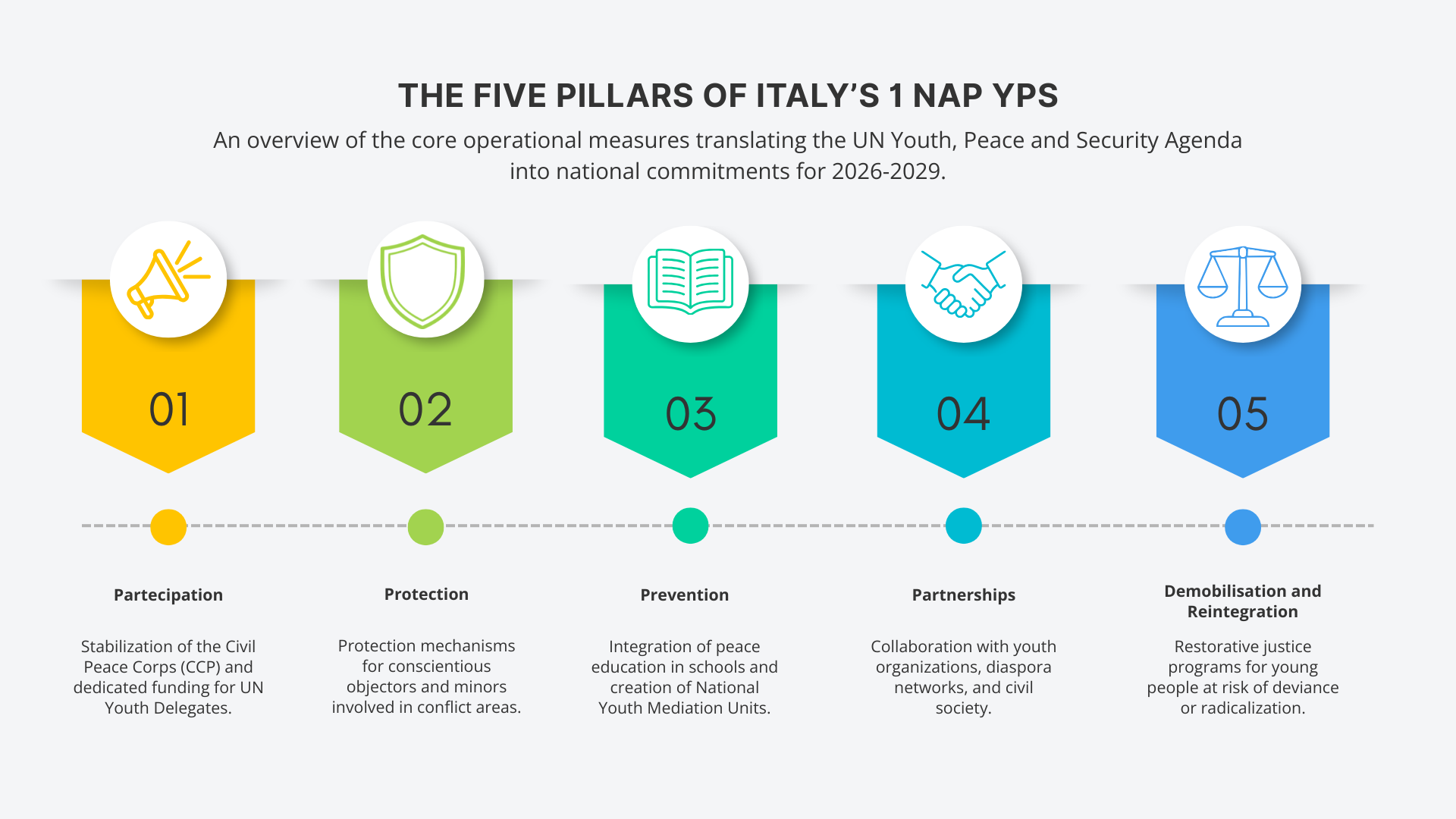
The United Nations legal and programmatic framework for the YPS Agenda was established with the adoption of Security Council Resolution 2250 on 9 December 2015. For the first time, this resolution placed young people at the center of conflict prevention, resolution, and post-conflict rebuilding scenarios. The framework relies on five fundamental pillars: participation, protection, prevention, partnerships, and demobilisation and reintegration. Subsequent UN Security Council Resolutions, e.g. 2419 (2018), 2535 (2020), and 2807 (2025), further consolidated these pillars, emphasizing the need for active youth involvement in peace processes, the protection of public spaces for civic debate, and the creation of national action plans by Member States. In alignment with these international mandates, Italy has formalized its commitment through the adoption of its 1st NAP YPS for the 2026-2029 period.
Methodology and YPS Awareness in Italy
The developmental trajectory of Italy's NAP YPS was rooted in inter-institutional dialogue and public consultation. The process began in 2024 through a Working Group coordinated by the Directorate General for Political and Security Affairs (DGAP) of the Ministry of Foreign Affairs and International Cooperation (MAECI). This group fostered shared approaches among institutional actors, civil society, academia, and youth-led networks. To verify baseline awareness, the National Youth Council (CNG) conducted a public survey in March 2025 involving a representative sample of the Italian population. The data revealed a significant gap: while knowledge of the United Nations was extensive, awareness of the YPS Agenda and the national Civil Peace Corps was severely limited. Furthermore, the survey highlighted that youth place strong importance on protection and prevention, yet perceive participatory components and disarmament as less relevant. A critical finding was the limited confidence young people have in the impact of their participation in decision-making, stemming from a perceived lack of trust from institutional actors and a scarcity of financial resources enabling active participation.
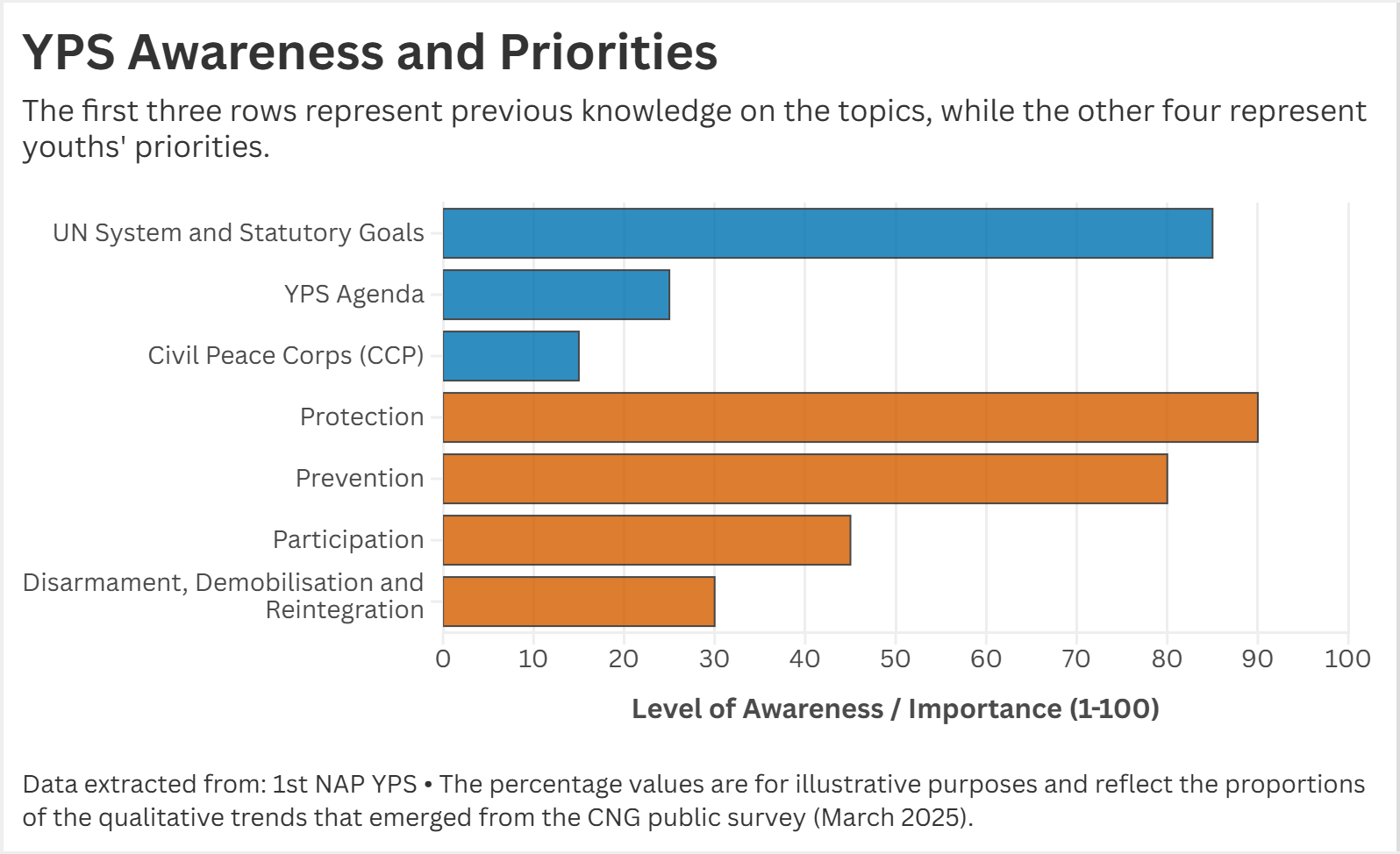
These qualitative insights, corroborated by data on youth distress from the 2025 Youth Report compiled by EU.R.E.S., underscored the necessity of an educational dimension and targeted structural reforms to bridge the gap between youth activism and institutional policy-making.
Pillar I: Meaningful Participation and the Civil Peace Corps
The first pillar of the Agenda focuses on the intentional and genuine involvement of young people in decision-making processes, addressing the shortage of structured spaces where youth can influence public policy. A cornerstone of Italy’s operationalization of this pillar is the stabilization and deployment of the Civil Peace Corps (CCPs). The CCPs represent a collective dimension of youth engagement, mobilizing volunteers in conflict or at-risk areas to promote human rights and non-violence. Action 1 of the NAP seeks to enhance the role of senior peace workers, extend junior projects to three years, and expand the participation age up to 35 years. It also secures dedicated financial resources (2 million euros annually for 2025-2027) to ensure field interventions are viable. To eliminate economic and institutional obstacles, Action 2 mandates the integration of youth representation into official Italian delegations in multilateral peace processes and establishes a dedicated funding line at MAECI to support youth representatives internationally. Furthermore, Action 3 institutionalizes the discourse on structural inequalities by establishing a dedicated body at the CNG to study and discuss social justice and peace, ensuring the presence of youth representatives experienced in these sectors. Action 4 expands this into youth diplomacy, activating a permanent Youth Forum in foreign policies and increasing the number of Italian Youth Delegates to the United Nations.
Pillar II: Protection of Vulnerable Youth
The protective dimension of the YPS Agenda acknowledges the specific vulnerabilities young people face in crisis situations. In the national context, the lack of specific guidelines previously left young people aged 18 to 30 inadequately considered in protection mechanisms. Action 7 addresses a highly vulnerable subgroup: young conscientious objectors, deserters, and conscription evaders from conflict-affected countries. The NAP mandates a dedicated mechanism for their identification and protection, advocating for access to simplified asylum procedures and the recognition of conscientious objection as a valid ground for international protection. Simultaneously, Action 9 focuses on strengthening Italy's international engagement for the protection of minors directly and indirectly involved in hostilities. This aligns with international frameworks like the Optional Protocol to the UN Convention on the Rights of the Child, requiring robust data collection and coordinated multilateral interventions. The NAP also aims to enhance the Universal Civil Service abroad as an instrument of peace, launching new initiatives in conflict and post-conflict territories with ad hoc financial resources.
Pillar III: Prevention through Education and Mediation
Prevention requires an advanced assessment of the factors contributing to youth vulnerability and the proactive creation of environments that foster peace and stability. Recognizing that peace education is currently scarcely present in school curricula, the NAP prioritizes educational reform. Action 11 demands the inclusion of peace education pathways starting from primary education, covering nonviolent conflict management, restorative justice, human rights, and diversity. Alongside formal education, the plan operationalizes community-level prevention through Action 10, which calls for the creation of National Youth Mediation Units. As a permanent body within the Italian Network for International Mediation (RIMI), these units will consist of trained, certified mediators under the age of 35 operating in schools and fragile territories, officially institutionalizing the role of Young Mediators.
Pillars IV & V: Partnerships, Demobilisation, and Reintegration
Effective peacebuilding relies on mixed, multi-sectoral partnerships equipped with accessible financial resources. Action 12 aims to strengthen Italian youth organizations by promoting transnational advocacy and networking with youth entities from diaspora communities, bridging the gap between domestic and international cooperation. Action 14 further facilitates this by implementing a national mapping process to consolidate networks among youth organizations active in peacebuilding.
Regarding demobilisation and reintegration, the national context requires pathways for young people at risk of deviance, crime, or radicalization, as well as young migrants and refugees lacking structured support. Action 15 heavily promotes restorative justice programs based on accountability and community dialogue. The plan outlines measures to assess restorative justice in detention centers, provide vocational training, and offer post-release mentoring to facilitate multidimensional social and community reintegration.
Cross-Cutting Themes: Climate, Digitalization, and the WPS Nexus
The NAP embraces a comprehensive, inter-sectoral approach by defining critical "nexus" points that intersect with all YPS pillars.
- Environment-Climate-Peace Nexus: The dual impact of environmental crises and conflict disproportionately affects younger generations. The plan highlights the necessity of integrating YPS principles into national climate plans and funding youth-led climate initiatives, heavily utilizing platforms like the Youth4Climate initiative co-led by Italy.
- Digital Challenges: Acknowledging the digital space, the plan emphasizes protecting youth from online violence and disinformation, promoting digital literacy, and funding youth-led technology for conflict prevention.
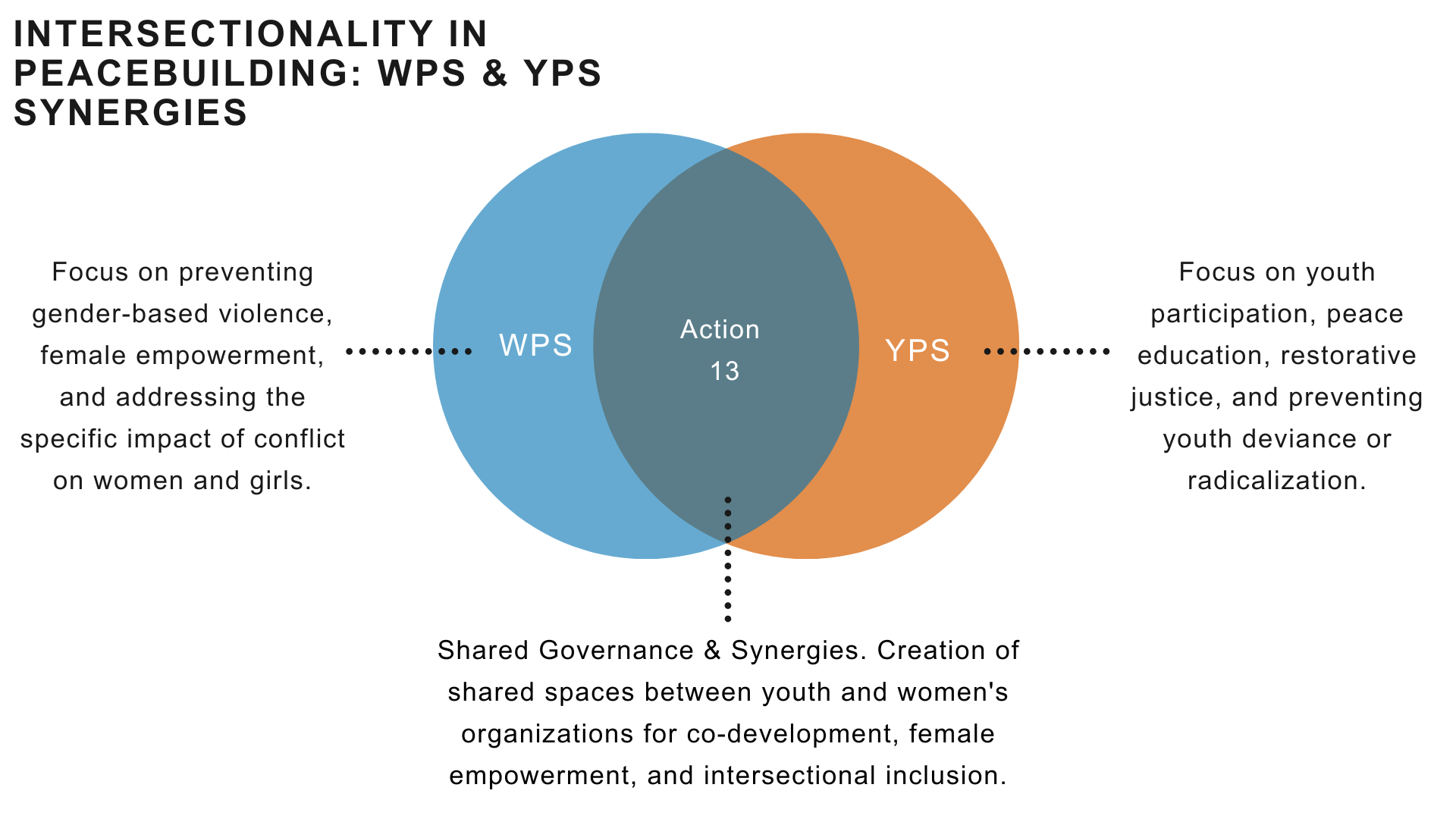
- WPS/YPS Synergies: Crucially, the plan recognizes the profound interconnectedness of the Youth, Peace and Security Agenda with the Women, Peace and Security (WPS) Agenda. While distinct, both agendas seek to empower historically marginalized groups in peace processes. The NAP mandates an intersectional approach to capture dynamics based on both age and gender. Action 13 operationalizes this by building spaces of shared governance between youth organizations and women's organizations, aiming to ensure an effective synergy that focuses on co-development and female empowerment.
Expanding the Intersectional Approach: Disarmament, Food Security, and Heritage
Beyond climate and digitalization, the NAP broadens the scope of the YPS Agenda by integrating several novel cross-cutting themes into its strategic vision. Firstly, the plan underscores the critical nexus between food security and peace. In fragile contexts, agricultural access is fundamental for stability; thus, the plan advocates for investing in youth within the agricultural sector and supporting youth-led food initiatives that promote social cohesion in post-conflict areas. Secondly, the preservation of cultural values and rights is framed as a tool for peacebuilding. The NAP encourages youth participation in heritage governance and the use of digital tools to protect intangible cultural heritage. Finally, the plan aligns with the United Nations Office for Disarmament Affairs (UNODA) to promote disarmament education. By supporting initiatives like Youth4Disarmament and the #StepUp4Disarmament campaign, the Italian framework empowers younger generations to actively participate in non-proliferation dialogues, equipping them with the necessary leadership skills to champion sustainable security.
Governance, Monitoring, and Evaluation
To ensure the transition from theoretical policy to concrete implementation, the NAP establishes a robust national governance system. A National Steering Committee on the YPS Agenda will be created, functioning as a multi-stakeholder mechanism that includes institutional administrations (via the Interministerial Committee for Human Rights, CIDU) and civil society networks. This committee is tasked with continuous monitoring and evaluation over the 2026-2029 timeframe. Assessment metrics will include the impact of field projects, the level of active youth involvement, the transparency of financial resource allocation, and the promotion of multi-level dialogue. The process mandates the publication of sequential reports to ensure accountability and to critically analyze the translation of commitments into concrete results.
Conclusion
Italy’s First National Action Plan on Youth, Peace and Security is a comprehensive policy instrument that officially recognizes young people as essential stakeholders in multi-level governance and human rights frameworks. By addressing structural deficits in participation, institutionalizing peace education and restorative justice, and creating dedicated funding mechanisms, the plan attempts to bridge the gap between institutional decision-makers and the younger generations. The ultimate success of the NAP will rely heavily on the diligent execution of its multi-stakeholder governance mechanism and the steadfast commitment to applying an intersectional lens to peace and security across both domestic and foreign policy.