


The International Zero Evictions Marathon: A Common Platform for the Right to Housing
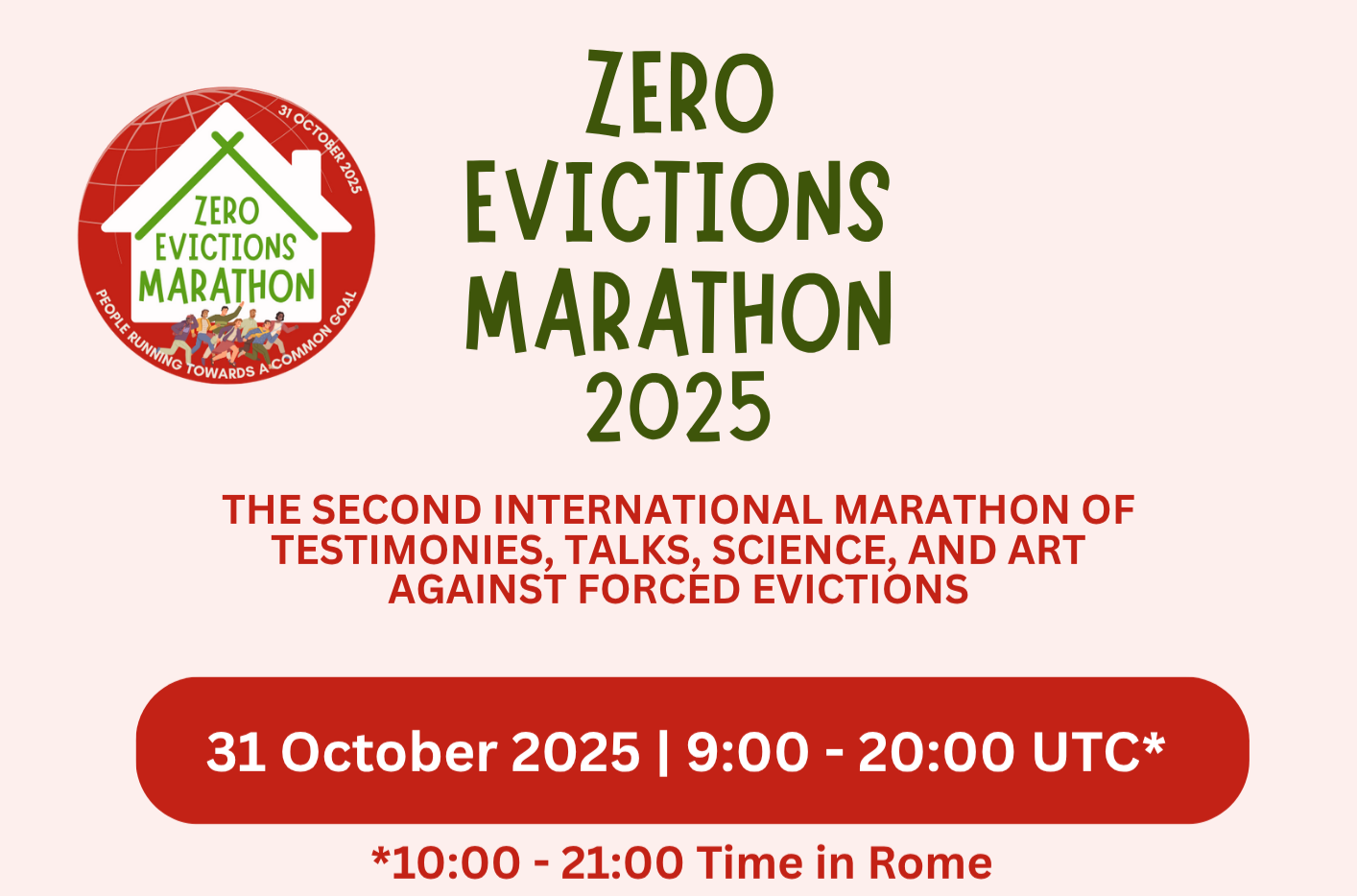
Table of Contents
- Beyond the Numbers: Evictions as Human Drama Violating Rights Ratified by States
- A Global and Systemic Housing Crisis
- The World Zero Evictions Days: A Collective Response
- The International Zero Evictions Marathon: A Global Megaphone
- Themes Addressed by the ZEM 2025
- The Contribution of the UN Special Rapporteur on the Right to Housing and the Role of Institutions
- A Collaborative Platform Looking to the Future
- Continuity and Shared Commitment
The International Zero Evictions Marathon (ZEM) represents a well-established initiative within the global landscape advocating for the right to housing. Originating from the collaboration between the International Alliance of Inhabitants (IAI) and the Human Rights Centre of the University of Padova, the ZEM has emerged as a stable collaborative platform capable of linking local struggles, academic engagement, and global reflections. The commitment of the IAI's volunteer interpreters serves as an effective tool that has enabled communities, activists, academics, and human rights defenders from every continent to express themselves, engage in dialogue, and build shared proposals. The participation of the UN Special Rapporteur on the right to housing has bolstered its legitimacy and effectiveness, also serving as a civil society response to attacks on the United Nations. The second edition in 2025 confirmed the maturity of this process and the shared commitment to pursue it in the years to come.
Beyond the Numbers: Evictions as Human Drama Violating Rights Ratified by States
The eviction crisis is not just about statistics, but speaks of shattered lives, insecurity and loss of dignity. With the arrival of winter, the need for safe housing becomes vital, yet in nearly all countries, forced evictions are not suspended. Notices on the doors of homes reveal a violence that often remains silent, that strikes families, the elderly, children, and already vulnerable individuals.
Forced evictions are executed worldwide with increasingly rapid and traumatic procedures, often in the absence of solutions that respect the human rights protected by international treaties ratified by States, meaning without prevention policies or the provision of adequate alternative housing when evictions are unavoidable. Increasingly frequent and violent evictions are observed in the Global South, but also in countries of the Global North. Also in Italy, recent episodes of individuals who have taken their own lives or even killed law enforcement officers sent to carry out an eviction proceeding, while destroying their own home, add fresh horrors to the initial injustice, compounding tragedies that are unbearable. The lack of adequate public policies generates despair and tragedies that could have been prevented through support from public institutions and social organisations, and by activating solidarity networks. Evictions, as clearly highlighted by the testimonies collected by the ZEM, are not an individual failure, but the product of structural injustices rooted in violations of the law by states that are meant to uphold it.
A Global and Systemic Housing Crisis
The phenomenon of evictions is embedded in a global housing crisis of dramatic proportions. Over 1.6 billion people worldwide, across all continents, live without adequate housing, while by the end of 2024, more than 123 million are reported to be displaced due to wars, conflicts, environmental disasters, and climate crises. To these causes are added structural processes of rent extraction from territories: chaotic urbanisation, financialisation of the real estate market, ineffective public policies, mortgage crises, large infrastructure projects, mega-events, gentrification, touristification, and the transformation of cities into consumer spaces.
The increasing role of Artificial Intelligence in real estate markets and urban planning is amplifying discrimination, precariousness, and housing insecurity. Forced evictions and the rise of homelessness thus appear as direct consequences of development models that ignore the right to housing, demonstrating the inability or unwillingness of many States to comply with their international obligations.
The World Zero Evictions Days: A Collective Response
In this context, the World Zero Evictions Days represent a moment of global mobilisation and collective awareness-raising. Part of "Urban October," which opens with the United Nations World Habitat Day, they highlight local and international initiatives centred on the right to housing.
Since 2003, the IAI has coordinated these Days as part of the global Zero Evictions Campaign, strengthening the connection between social movements, tenant unions, NGOs, progressive local authorities, universities, and researchers. The shared objective is to defend the right to safe and dignified housing, as enshrined in the International Covenant on Economic, Social and Cultural Rights (ICESCR), and to support individuals threatened or affected by evictions. In 2025, hundreds of initiatives took place across all continents: from the fifth anniversary of the Zero Evictions Campaign in Brazil to mobilisations in Peru, the Dominican Republic, Argentina, Nepal, and India, just to name a few.
In Italy, associations and unions, including the Tenant Union, have organized at least twenty initiatives, among which the “Rome Calling Europe” conference (Rome, 27 October 2025), featuring Balakrishnan Rajagopal, UN Special Rapporteur on the right to housing, alongside demonstrations in various cities advocating for the housing rights of students and residents.
The Days have proven to be a powerful tool: they help eviction-affected people understand that they are not alone, recognise the injustices they face, and build pathways of resistance and change. The International Tribunal on Evictions (ITE) also plays a role by giving voice to victims and holding accountable those who violate human rights.
The International Zero Evictions Marathon: A Global Megaphone
Within the framework of the World Zero Evictions Days, the International Zero Evictions Marathon (ZEM) has consolidated itself as an innovative and inclusive tool. Entering its second edition in 2025, the ZEM was hosted at the University of Padua thanks to the collaboration between the IAI and the Human Rights Centre. This partnership has been strengthened over the years through seminars featuring testimonies from those affected by violations of the right to housing across different continents, training on the use of international instruments for the protection of rights, particularly the Optional Protocol to the ICESCR, and the examination of concrete cases.
Over ten hours of online and in-person presentations, the Marathon brought together 53 organisations spanning the Philippines, Latin America and North America, Europe, Africa, and the Middle East. This space enabled affected communities, activists, academics, and human rights experts to share first-hand testimonies, analyses and proposals. The contribution of the IAI's volunteer interpreters was a crucial factor in ensuring that all participants could speak their language and be heard in the language of the listeners, overcoming language barriers and reinforcing equality among them. The ZEM was not merely an event but a genuine process of mutual listening and collective building.
Themes Addressed by the ZEM 2025
The Marathon tackled a wide range of central themes regarding the right to housing, including:
- Structural causes of evictions, analysed by jurists, sociologists, economists, and urban studies experts;
- Tenants' rights and legal tools to oppose forced evictions;
- Good practices and resistance strategies employed by organisations and communities;
- Urban planning and sustainable development concerning the availability of affordable housing;
- The impact of gentrification and touristification on residential areas in cities;
- The use of Artificial Intelligence in real estate markets and the risks of new forms of discrimination;
- Satellite mapping of neighborhoods at risk of eviction (carried out by the Permanence Observatory) as a tool for prevention and advocacy;
- Involvement of youth and university students affected by precarious contracts and unsustainable housing costs;
- The connection between the housing crisis, climate crisis, and environmental degradation.
These themes were addressed in an interconnected manner, highlighting the systemic nature of the crisis and the need for comprehensive responses.
The Contribution of the UN Special Rapporteur on the Right to Housing and the Role of Institutions
A central moment of the ZEM was the intervention of Professor Balakrishnan Rajagopal, UN Special Rapporteur on the right to housing. Starting from the condemnation of wars and the destruction of homes, particularly focusing on the "domicide" in Gaza, he recalled States to their obligations under the ICESCR, emphasising the need for coherent and inclusive policies.
Providing virtuous examples such as Barcelona, Vienna, and Singapore, the UN Rapporteur urged institutions to prevent evictions in the absence of adequate housing solutions, to promote public housing, to regulate rents, and to ensure sufficient funding. He also denounced how laws that accelerate evictions or criminalise activists constitute violations of human rights.
Early, the Rapporteur visited the former Bastogi residence and Quarticciolo, working-class neighbourhoods of Rome facing eviction. He also took part in a conference on the right to housing at Roma 3 University, a symposium co-organised at the University of Padua by the Association of Democratic Jurists on the role of the judicial system from a multi-level perspective, a meetings with activists from the Social Desk (Sportello Sociale) of Via Bajardi in Padua, a discussions with researchers and PhD students from the PhD Programme in Human Rights, Society, and Multi-Level Governance at the University of Padua, and a Lectio Magistralis on current challenges on the right to housing.
His participation reinforced the legitimacy and effectiveness of the ZEM and was also understood as a response from civil society to the attacks on the United Nations, especially by States that violate international human rights treaties.
A Collaborative Platform Looking to the Future
The ZEM stands out as a stable collaborative platform, founded on a partnership between the IAI, social organisations, and the Human Rights Centre of the University of Padua. Professor Paolo De Stefani, Cesare Ottolini, global coordinator of the IAI, and Soha ben Slama, ITE coordinator, have animated a working group capable of creating a shared learning space, strengthening local initiatives and influencing public debate.
The link between the global dimension and local policies, made visible by the ZEM, represents a concrete response to the challenges of the right to housing. Planning, awareness-raising, alliance-building and monitoring emerge as strategic axes to increase the impact of the initiative.
Continuity and Shared Commitment
In light of the positive evaluation of this edition, the Human Rights Centre and the IAI will continue their joint commitment towards the third edition of the ZEM within the framework of the World Zero Evictions Days in October 2026. Participants are already called upon to contribute actively, starting with a shared evaluation of the experience, to make the ZEM even more inclusive and effective.
The International Zero Evictions Marathon thus confirms itself not only as an event, but as a collective and ongoing process, capable of strengthening struggles for the right to housing and of building, step by step, fair and sustainable alternatives to the global housing crisis.