


Navi Pillay Nobel Peace Prize 2026
The Human Rights Centre “Antonio Papisca” at the University of Padua warmly congratulates the awarding of the 2026 Nobel Peace Prize to South African lawyer and judge Navanethem "Navi" Pillay for her efforts to promote peace and international law. The motivation states that the Nobel Prize has been awarded to a person who “with exceptional courage and integrity, has paved the way for a more comprehensive global legal order,” played “a decisive role in ensuring that war crimes, crimes against humanity, and genocide are prosecuted,” called “on states and national leaders to be accountable for their actions,” and brought hope to victims.
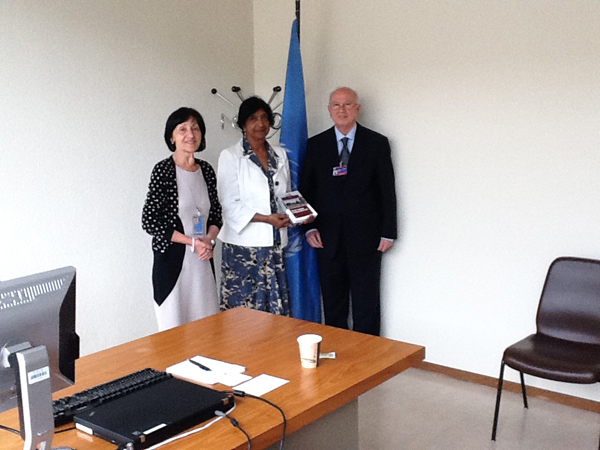
Navi Pillay has served as a judge at the South African High Court, the International Criminal Tribunal for Rwanda, and the International Criminal Court. She has been the United Nations High Commissioner for Human Rights and, until recently, presided over the United Nations Independent International Commission of Inquiry on the Occupied Palestinian Territories, which unequivocally concluded that the armed forces and government of Israel committed genocide against Palestinians in Gaza Strip between 7 October 2023 and 31 July 2025. Today, Navi Pillay is a judge at the International Court of Justice. In June 2012, during her tenure as UN High Commissioner for Human Rights, Navi Pillay hosted and presented in Geneva at the Palais des Nations the first issue of the Italian Human Rights Yearbook published by the Centre for Human Rights of Padua, under the direction of Professor Antonio Papisca.
Navi Pillay is a human rights defender who fought against racial segregation and apartheid alongside Nelson Mandela and to defend international legality and the rights of peoples to existence and self-determination. It is a Nobel Prize awarded to a person who has made the opening words of the UN Charter’s Preamble their life’s purpose: “We, the peoples of the United Nations, determined to save succeeding generations from the scourge of war (…), to reaffirm faith in fundamental human rights, in the dignity and worth of the human person, in the equal rights of men and women.”
It is a Nobel Prize in defence of multilateralism, international human rights law, and international criminal justice, at a time when these principles are under heavy attack from governments seeking to impose the law of force over the force of law.
It is a Nobel Prize in defence of the International Criminal Court, a cornerstone in building a fairer, more peaceful, and democratic world, at a moment when the United States has launched a new, criminal campaign to “dismantle brick by brick” the Court. An instrument of international justice grounded in the UN Charter and the Law of Human Dignity. Its legitimacy and capacity to act must be defended at all costs, alongside international human rights law.
It is a Nobel Prize against rampant impunity, the main obstacle to justice for victims and survivors of human rights violations, war crimes, and crimes against humanity, and a source of delegitimisation of political institutions and the principles of the rule of law at both national and international levels.
With this Nobel Prize, a strong and clear message has been sent to political leaders: the responsibility to investigate and punish crimes is a legal obligation for states. Neither political reasoning nor state interests can be invoked to avoid this obligation. No one is above the law.