


Analysis of the Analytical Report "Respect for the Dignity of Persons Deprived of Personal Liberty" of the Adult Penitentiary Observatory (GNPL)

Table of Contents
- Introduction
- General Overview of the Population in Penitentiary Institutions
- Prison Overcrowding
- Critical Events and Risk Factors in Penitentiary Institutions
- Prison Staff: Staffing, Shortages and Needs in Penitentiary Institutions
- Conclusion
Introduction
The National Guarantor for the Rights of Persons Deprived of Personal Liberty (GNPL), established by the Ministry of Justice in 2013, is the Italian state body responsible for monitoring places of deprivation of liberty (prisons, police facilities, immigration centers, Residences for Security Measures -REMS, psychiatric wards, etc.) carrying out, among other things, on-site visits. These visits aim to verify any critical issues within detention facilities, improve penitentiary policies and propose solutions, in collaboration with the responsible authorities.
The latest Analytical Report of the Adult Penitentiary Observatory, updated as of July 31, 2025, offers a statistical update on the Italian prison system. The report, based on official data from the Department of Penitentiary Administration (DAP), proposes a detailed analysis of detention conditions throughout the national territory and supports the institutional role of the Guarantor in promoting and monitoring compliance with and/or violation of legal norms and human rights in places of detention.
General Overview of the Population in Penitentiary Institutions
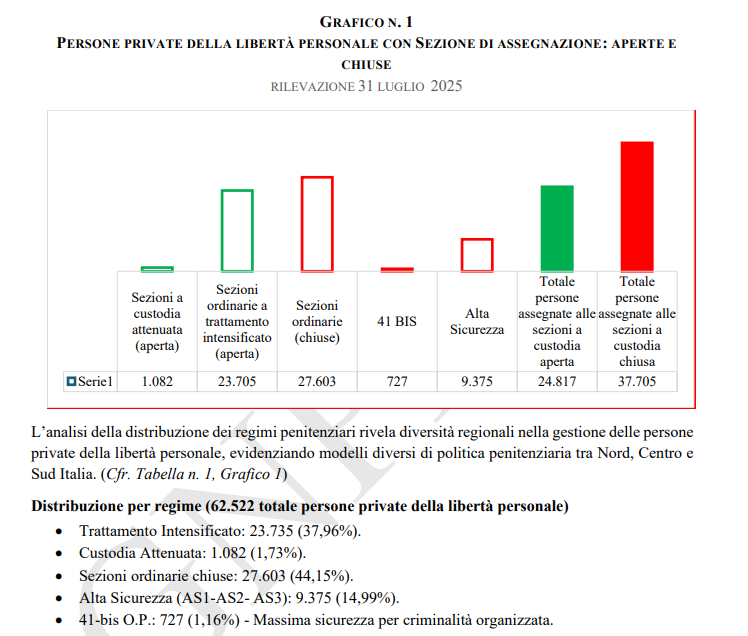
As of July 31, 2025, the total number of inmates present in the Italian penitentiary system was 62,522, of which 1.73% in Attenuated Custody Sections (Open), 37.96% in Ordinary Sections with Intensified Treatment (Open), 44.15% in Ordinary Sections (Closed), 1.16% in 41 bis Sections and 14.99% in High Security Sections.
The regions with the highest number of persons deprived of personal liberty are Lombardy (with 8,914 people), Campania (with 7,493), Sicily (with 6,986) and Lazio (with 6,756).

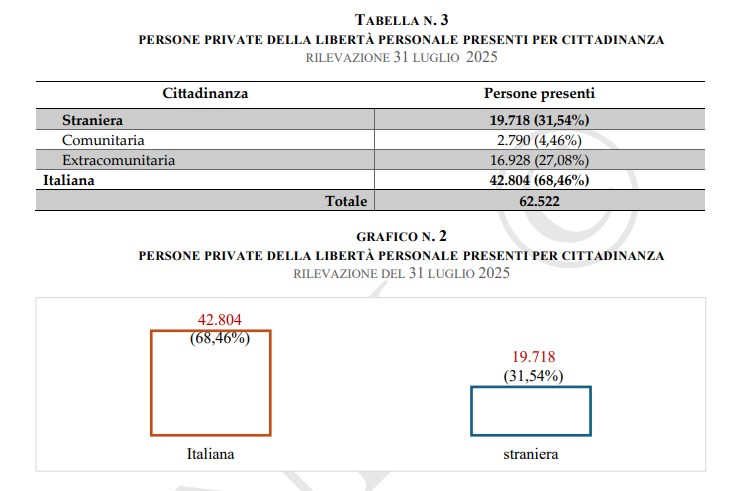
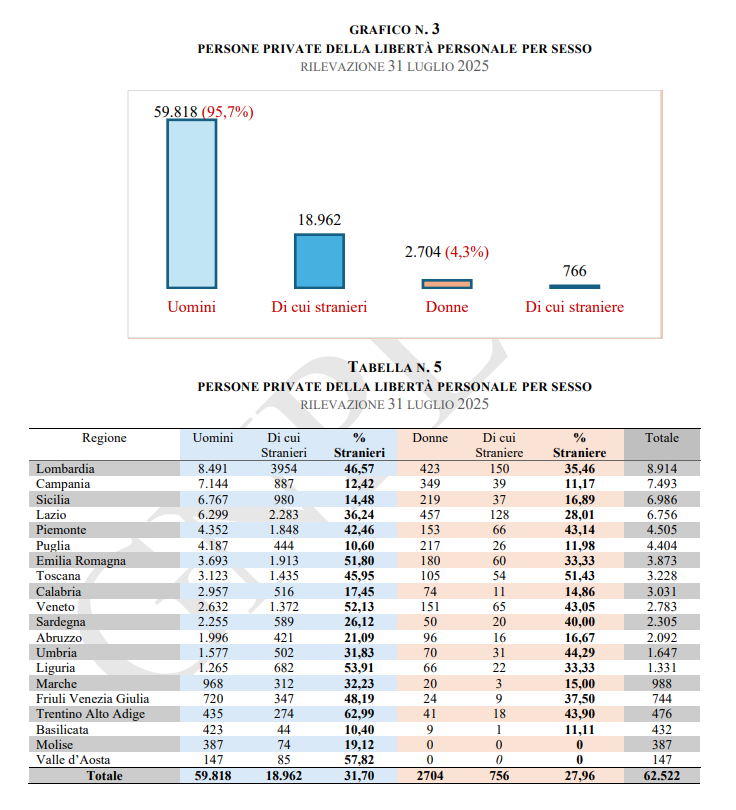
Analyzing the population of persons deprived of personal liberty from the point of view of citizenship, the Report indicates that 68.46% are Italian citizens, while 31.54% are foreign citizens. In particular, non-EU citizens represent 27.08% of the foreign population within the facilities. The Report also highlights that the number of foreign persons deprived of personal liberty is significantly higher than the percentage (8-9%) of foreigners present in the Italian territory. Probable causes of the high number of foreign persons, and in particular non-EU citizens, according to the analyzed Report, include greater socio-economic vulnerability, differences in access to alternative measures to detention, difficulties in obtaining penitentiary benefits due to lack of stable territorial ties and specific types of crime more frequent among the foreign population. The regions that present higher percentages of foreigners compared to the total population of persons deprived of their personal liberty include Valle d'Aosta (57.82%), Trentino Alto Adige (62.99%), Liguria (53.91%), Veneto (52.13%) and Emilia Romagna (51.80%). The regions, instead, with the lowest number of foreigners are Basilicata (10.40%), Puglia (10.60%) and Campania (12.42%). In addition, the Report emphasizes that a large majority of foreign persons deprived of their personal liberty (85.80%) are in "common" detention, while in special regimes such as 41-bis there are only 4 foreign persons.
The Report then proceeds with an analysis of the population of persons deprived of personal liberty based on gender: men (Italian and foreign) constitute 95.7% of the total population, while women (Italian and foreign) 4.3%.
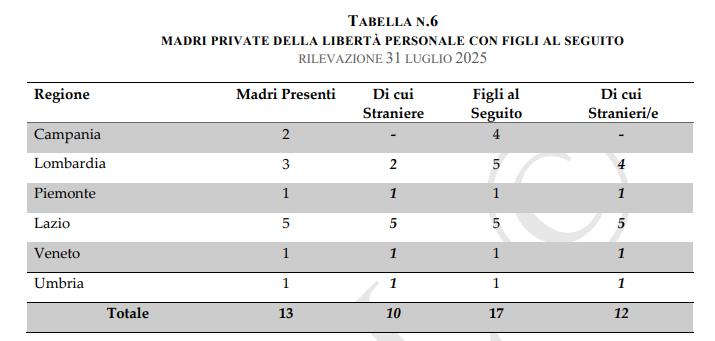
Furthermore, the section of the Report dedicated to the general overview of the population in penitentiary institutions presents an analysis of the number of mothers deprived of personal liberty with children in tow (13) and children living in prison with their mothers (17).
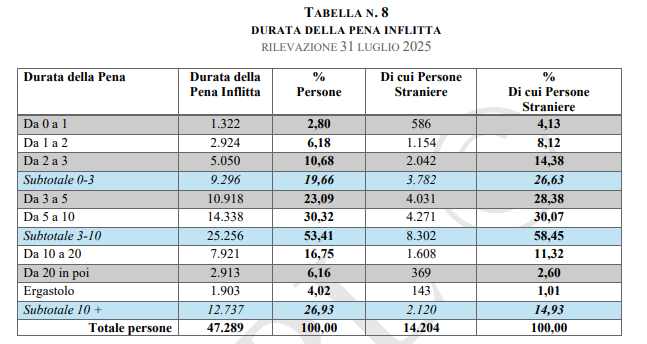
Regarding the duration of "sentences imposed" (duration of sentences for definitively convicted inmates) in the Italian judicial system, the Report states that short sentences (0-3 years) represent 19.66% of the total, medium sentences (3-10 years) 53.41% of the total, while long sentences (over 10 years) 26.93% of the total.
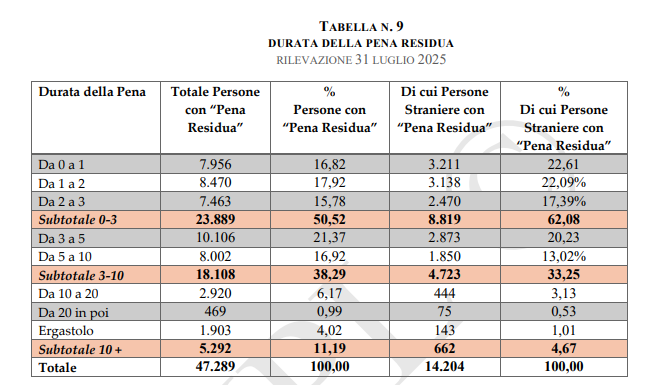
The subsequent analysis of the general distribution for residual sentences demonstrates an important turnover of the penitentiary system, in which persons deprived of personal liberty serve relatively short sentences. In fact, 50.52% of persons deprived of personal liberty have a residual sentence between 0 and 3 years, 38.29% between 3 and 10 years and 11.19% have residual sentences exceeding 10 years (including life imprisonment at 4.02%). These data demonstrate the turnover mentioned above and, through an "estimate of the potential for alternative sentences for a residual sentence from 0 to 3 years and not on 4 years", show that almost a third of the population currently in penitentiary institutions could benefit from alternative measures, alleviating prison overcrowding.
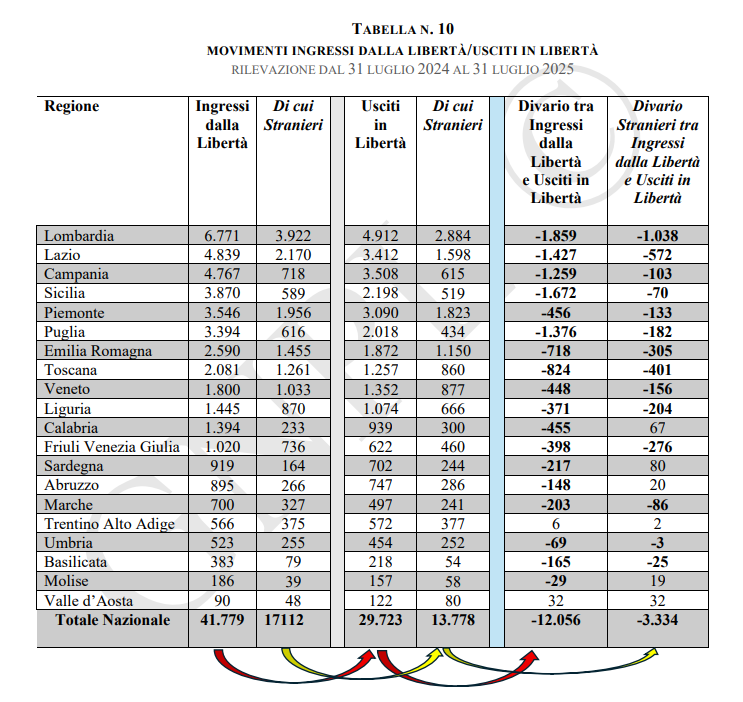
Analyzing the flow of entries from freedom (those who enter prison from a condition of freedom) of 41,779 individuals, and exits to freedom (those who leave detention to return to freedom) of 29,723 individuals, the only regions with a positive balance (with more exits than entries) are Valle d'Aosta and Trentino Alto Adige. The remaining regions, instead, all present deficits (more entries than exits), with 5 regions (Lombardy, Sicily, Lazio, Puglia and Campania) where over 60% of the national deficit (12,056 individuals) is concentrated. These data highlight a system under strong pressure, with direct effects on the phenomenon of prison overcrowding. The Report highlights a spiral effect linked to overcrowding in which the annual accumulation of about 12,000 people progressively saturates detention facilities, compromises the effectiveness of re-educational programs, reduces the possibility of social reintegration and perpetuates the cycle of overcrowding.
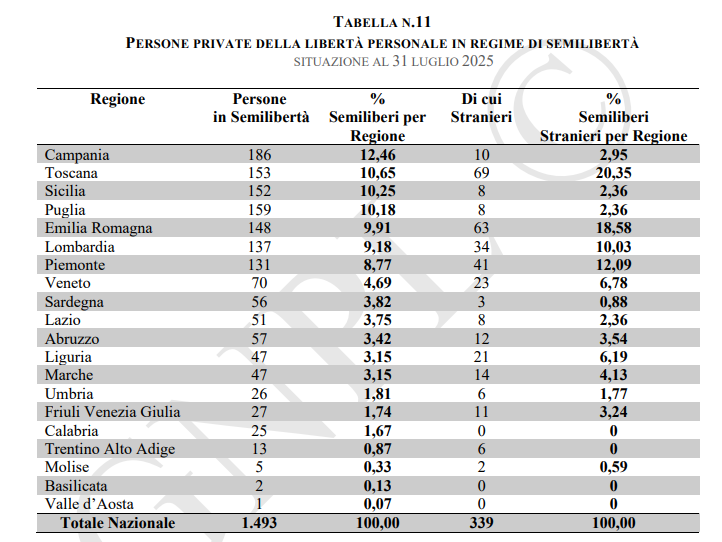
Regarding the semi-liberty regime, the Italian penitentiary system presents a peculiarity: out of 1,493 people in semi-liberty throughout the territory, only 339 are foreigners (22.7%). In addition, the phenomenon also presents a strong territorial disparity. The regions with the highest number of people in semi-liberty are Campania (with 186 people, of which 10 are foreigners), Tuscany (with 153 people, of which 69 are foreigners), Sicily (152 people, of which 8 are foreigners) and Puglia (159 people, of which 8 are foreigners). A comparative analysis of the number of people in semi-liberty in the different Italian regions shows that in the northern regions there are the highest percentages of foreigners in semi-liberty compared to the southern regions which present very low percentages. Calabria, Basilicata and Valle d'Aosta do not register foreigners in semi-liberty, due to possible application criticalities or a minimal presence of foreign population within the penitentiary institutions.
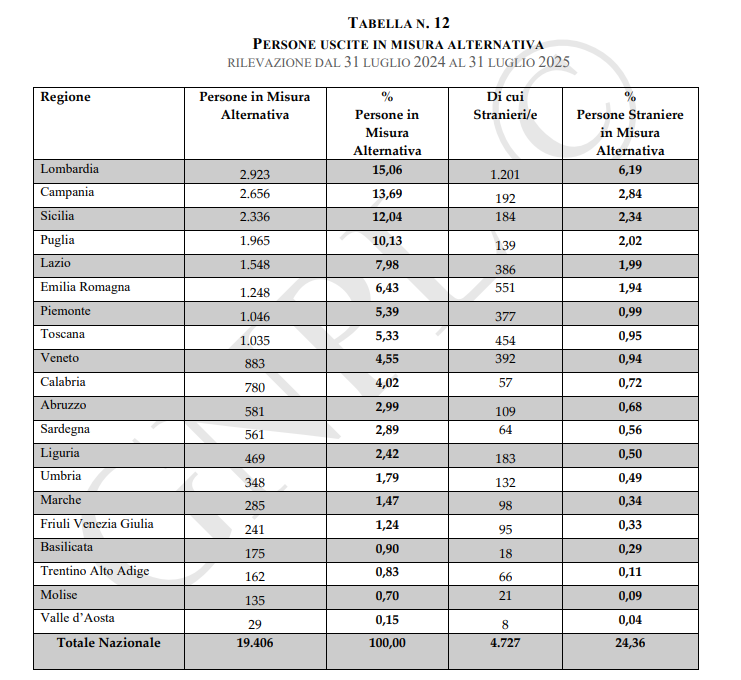
Between July 2024 and July 2025, the people who left in alternative measures were 19,406 (of which 4,727 were foreigners). Lombardy presents the best data, with 2,923 exits, of which 1,201 are foreigners. Campania presents 2,656, of which only 192 are foreigners; Sicily 2,336, of which 184 are foreigners and Puglia 1,965, of which 139 are foreigners. While the southern regions present high absolute volumes of exits, the data show very low percentages of foreigners who left. On the other hand, the central-northern regions present the highest percentage of foreigners who left in alternative measures.
The data show that alternative measures represent a powerful and effective deflation tool in managing prison overcrowding. However, important territorial disparities and substantial differences in the management of the foreign population remain.
Analyzing the crimes committed, in Italy, crimes against property represent the most numerous category of the distribution of persons deprived of personal liberty by type of crime, with a total of 35,885 persons deprived of personal liberty (23.74% of the total). This type of crime is the most widespread both among Italian citizens and among foreigners (10,445 foreign individuals, representing 26.50% of property crimes). This high number of crimes against property by foreigners can be attributed to socio-economic dynamics. Foreign overrepresentation can also be found in crimes against public administration, specific immigration crimes and prostitution. On the other hand, crimes with foreign underrepresentation include mafia association, weapons-related crimes and crimes against the administration of justice.

Prison Overcrowding
In the analysis of prison overcrowding in Italy, the Report distinguishes between "people present in the archive" (number of inmates present in the facilities at the time of writing the report), "regulatory capacity" (theoretical maximum capacity of the penitentiary institution according to technical and architectural standards) and "regularly available places" (how many places of the regulatory capacity are actually usable at a given time). Comparing a series of collected data, the analysis identifies a total national overcrowding index of 133.68%. The number of persons deprived of personal liberty as of July 31, 2025 was 62,522, with 51,300 places of regulatory capacity and 46,769 regularly available places.
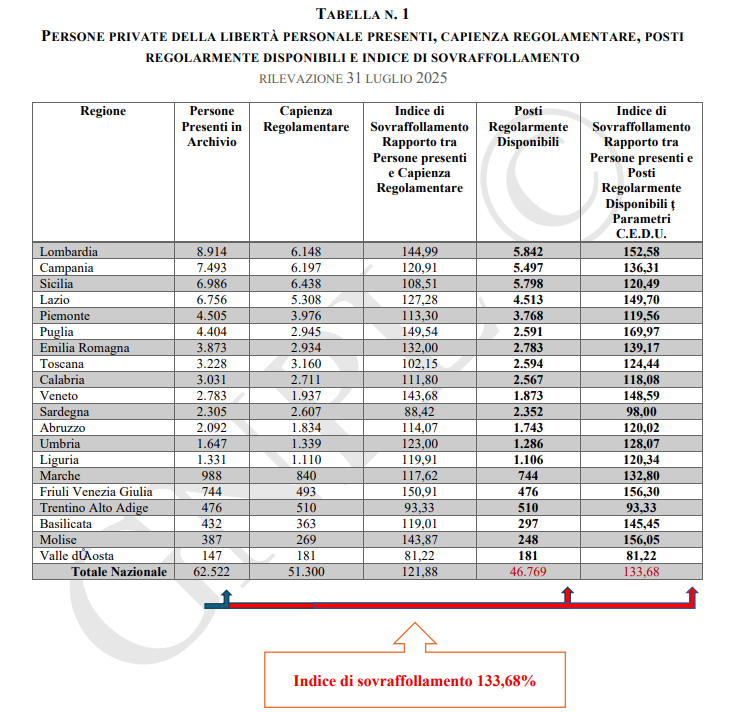
The regions with the highest overcrowding indices are Puglia with 169.97%, Friuli Venezia-Giulia with 156.3% and Molise with 156.05%. The regions that do not present overcrowding are Valle d'Aosta, Trentino Alto Adige and Sardinia.
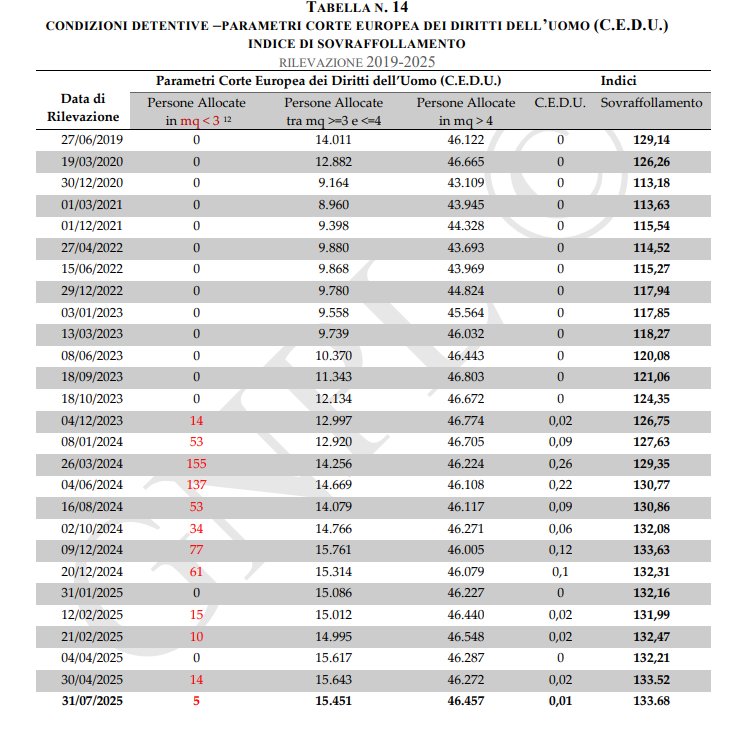
The difference between "regulatory capacity" and "regularly available places" of about 4,531 at the national level reflects the more stringent European standards on the rights of persons deprived of personal liberty, which require better spaces and conditions compared to traditional Italian parameters, together with structural problems of the institutions (maintenance, usability and safety). The data show that in 2025, the housing density per room was 2.14 per available room, with an average of 6.5 square meters per person (below European standards). However, as of July 31, 2025, 5 inmates were identified who were living in spaces less than 3 square meters. This represents a violation of Article 3 on the prohibition of torture of the European Convention on Human Rights.
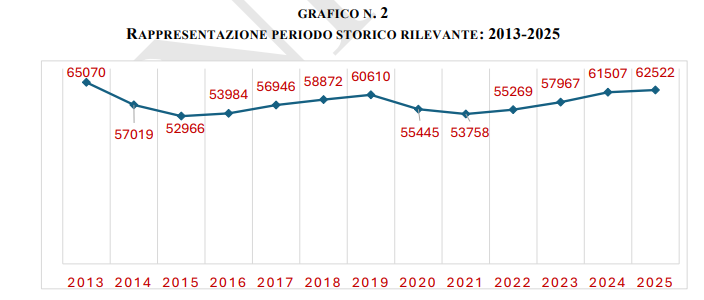
Based on a historical analysis of the trend of the overcrowding index in Italy from 2013 to 2025, it is evident that in the post-COVID emergency phase (2023-2025) there is a new sustained growth, reaching pre-pandemic levels. Within the Report, it is emphasized that reductions in the population in penitentiary institutions linked to external events (Torreggiani judgment of the European Court of Human Rights in 2013 and the COVID-19 pandemic: 2020-2022) tend to be reabsorbed in the medium term (about 3 years), suggesting structural problems in the penitentiary system. The Report suggests that changes in penal policies, variations in crime rates, modifications in access mechanisms to alternative measures and slowdowns in judicial proceedings are among the drivers of the generalized growth of the population in penitentiary institutions at the national level. It highlights the urgent need for interventions to adapt structures, develop alternative measures to detention and immediate interventions to slow down the worrying acceleration of the crime rate to end the alarming cyclical trend of overcrowding.
Critical Events and Risk Factors in Penitentiary Institutions
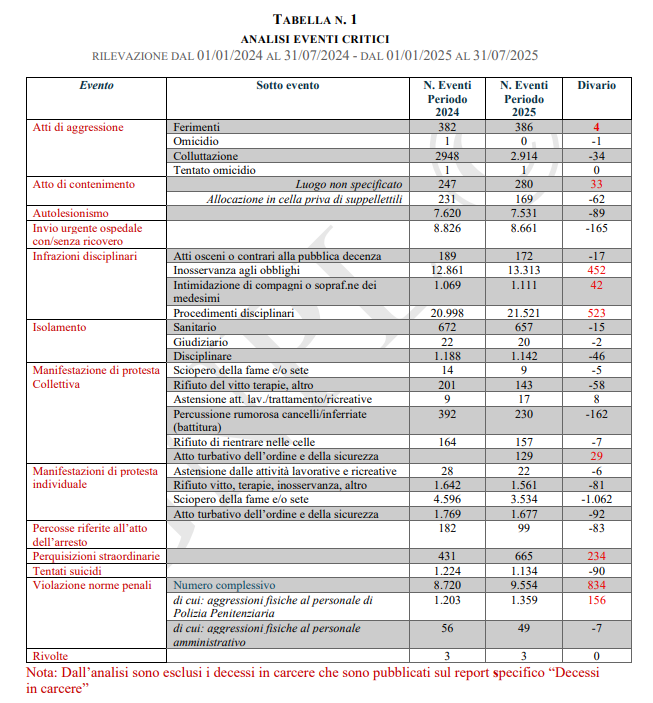
An analysis of critical events provides a detailed picture of social tension within the penitentiary system. From January 1, 2025 to July 31, 2025, 94,421 critical events occurred, underlining the constant tension with the presence of multiple daily events.
The critical events analyzed include acts of aggression, containment, self-harm, disciplinary infractions, isolation, collective protest manifestation, individual protest manifestation, beatings reported at the time of arrest, extraordinary searches, attempted suicides, violation of criminal norms and riots. The Report excludes deaths in prison from the analysis of critical events, which are instead published in the specific "Deaths in Prison" report.
Acts of violence and aggression between persons deprived of personal liberty remained relatively constant between 2024 and 2025, while aggressions against Prison Staff increased significantly, demonstrating a critical trend.
Data related to self-harm and attempted suicides demonstrate extreme psychological distress within the prison population, with an average of 20 episodes of self-harm and 3 attempted suicides per day.
Regarding disciplinary infractions, a worsening of inmate behavior is evident (2.5% increase in disciplinary proceedings) and a deterioration of discipline (3.5% increase in non-compliance with obligations).
Data related to collective manifestations show a sharp decrease in 2025 compared to 2024 regarding the so-called "battitura" (noisy percussion of gates/bars) and refusal of food and/or therapies, while there is a worrying increase in acts disturbing order and security (+29%). These 3 elements are instead all decreasing for individual manifestations.
Other worrying data concern containment acts in unspecified places (+13.4%), violations of criminal norms (9.6%), extraordinary searches (54.3%) and hospital admissions with and/or without hospitalization, with an average of 24 health emergencies per day.
Prison Staff: Staffing, Shortages and Needs in Penitentiary Institutions
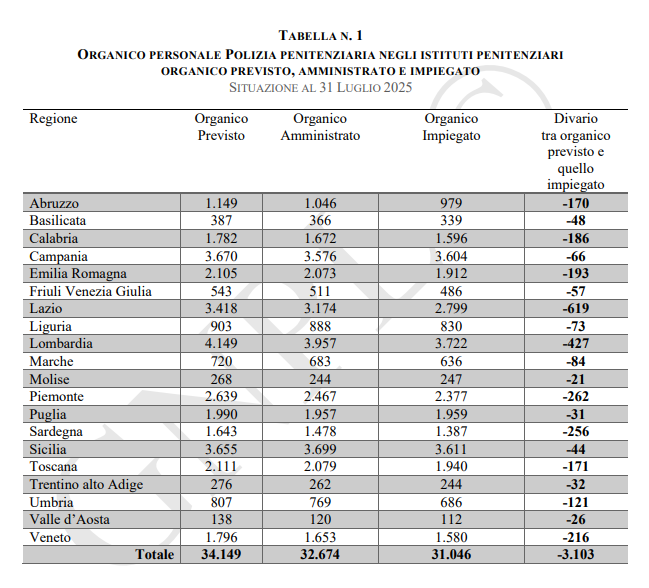
Data related to prison staff reveal a significant shortage of personnel in the Penitentiary Police operating within prison structures, with a gap of 3,103 units between the planned staff and those actually employed. The data report that the planned staff is 34,149 units, the administered staff is 32,674 units (-4.3% compared to planned) and employed staff is 31,046 units (-9.1% compared to planned). The difference between administered and employed personnel demonstrates problems in the management and allocation of available human resources. The regions with the greatest shortages are Lazio, Lombardy and Piedmont. The Center-North presents a greater shortage of personnel, probably due to the high number of persons deprived of personal liberty.
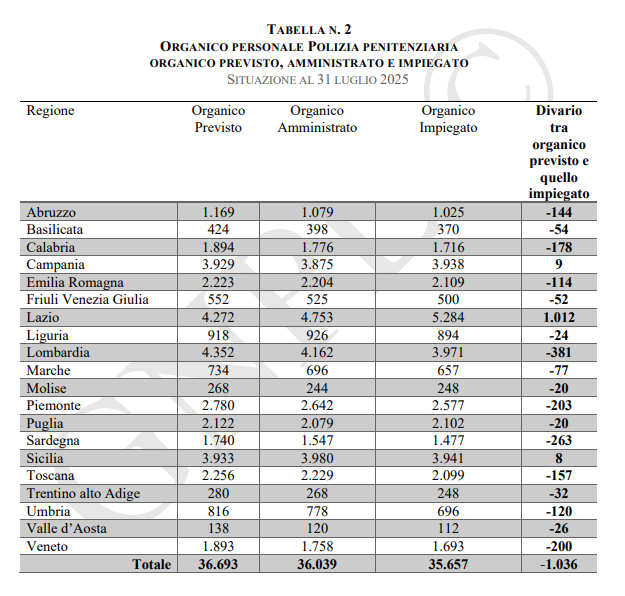
The gap of 3,103 units concerns only the Penitentiary Police personnel operating within prison structures. Considering the general total of Penitentiary Police personnel, there is a gap of 1,036 units. The difference between 3,103 and 1,036 indicates the number of people working in other services or offices of the DAP. The above analysis highlights a massive presence of personnel employed in central services, administrative offices and non-detention structures.
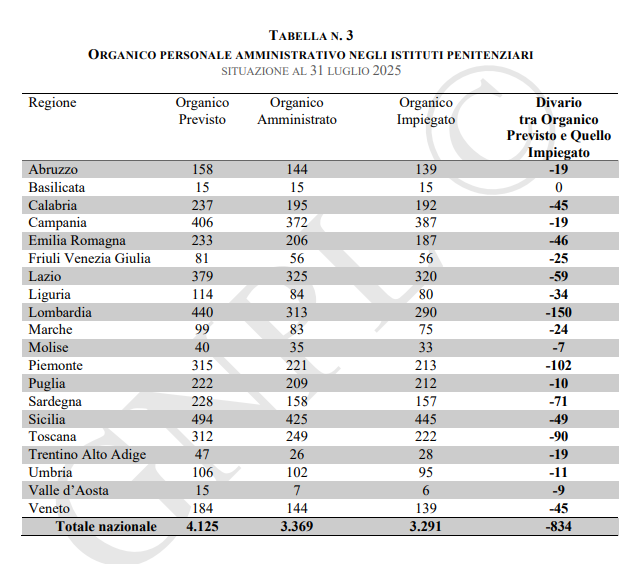
Conducting an analysis on administrative personnel in Penitentiary Institutions, there is a gap between planned and employed staff totaling 834 units (20.2% of the planned staff). A critical situation is evident that characterizes the entire territory and seriously compromises the operational efficiency of the penitentiary system. The regions with the largest deficit are Lombardy (deficit of 150 units), Piedmont (102 units) and Tuscany (with 90 units). These serious deficits compromise operational efficiency, create differences between regions creating a "two-speed" system and strong pressure on staff.
The shortage of personnel within penitentiary institutions is particularly critical and can lead to serious consequences. The shortage of personnel creates serious problems regarding shift rotation and 24/7 coverage of institutions, management of internal security, treatment and reintegration activities and work stress of staff on duty. All these elements derive from and contribute to the structural crisis and fuel a tense environment and make re-education processes difficult.
Conclusion
The 2025 Analytical Report of the Adult Penitentiary Observatory presents a complex and articulated picture of the Italian penitentiary system. The Italian penitentiary system, as a whole, reveals a reality still strongly characterized by structural, organizational and social criticalities. The data reported in the Report show how situations such as overcrowding, staff shortages and unequal management of alternative measures to detention continue to represent obstacles that prevent full respect for the dignity and fundamental rights of persons deprived of personal liberty.
The important comparison made within the Report between individuals of Italian citizenship and individuals of foreign citizenship underlines a persistent imbalance in treatment. In particular, it highlights the diversity in the possibility of access to alternative sentences to detention and criticalities in penal execution policies. Alternative measures to detention represent an important alternative to detention and a deflation tool, which would help reduce pressure on the prison system and favor social reintegration paths.
Moreover, from the picture presented by the Report, a strong territorial disparity emerges. Italy, regarding the penitentiary system, the use of resources and deficit of prison personnel is extremely inhomogeneous and seems to travel at "two speeds", where the effectiveness of institution management varies significantly from region to region.
The persistent imbalance between regulatory capacity and places actually available, with an average national overcrowding index of 133.68%, highlights a condition of systemic pressure that translates into material living conditions often in contrast with European standards and with the principles enshrined in the European Convention on Human Rights. The data, updated to July 31, 2025, report the presence of five inmates who were living in spaces less than 3 square meters. This represents a violation of Article 3 on the prohibition of torture, and inhuman or degrading treatment of the European Convention on Human Rights, which adds to the convictions of the European Court of Human Rights for Italy's violations of the same article, highlighting the existence of serious gaps in the Italian penitentiary system. The annual accumulation of about 12,000 people has led to the saturation of detention facilities, compromising the effectiveness of re-educational programs, reducing the possibility of social reintegration and perpetuating the cycle of overcrowding. It is evident that the system's capacity for self-regulation in the face of variations in inflow and outflow is insufficient, requiring targeted and urgent interventions.
In parallel, the general shortage of prison staff, particularly within the institutions, constitutes a further element of fragility. The difference between planned staff and staff actually employed compromises the daily functionality of the structures and strongly affects the quality of life of both staff and individuals deprived of personal liberty, increasing the possibility and risk of tensions and critical events.
Overall, the data from the Report reveals a picture of the Italian penitentiary system that requires a renewed and coordinated commitment between institutions, particularly between the judiciary and the penitentiary administration, and civil society. We must ensure justice and security for all while at the same time guaranteeing the re-educational function of the detention sentence, a fundamental principle of our constitution. This result requires a systemic approach that integrates the strengthening of structures, the enhancement of personnel, the reduction of territorial inequalities and the promotion of alternative paths of justice.