


Associazione Antigone: the XXII report "Tutto chiuso" on the alarming conditions of detention in Italy has been published
Table of Contents
- Introduction
- Overcrowding and living conditions
- Closed detention regime
- Juvenile justice system’s crisis
- The plight of mothers in prison
- Penitentiary policies of the Meloni Government
- Conclusion
Introduction
The XXII Report of Antigone, significantly titled "Tutto Chiuso" (“Everything Closed”), paints a picture of an Italian prison system in the throes of a crisis that is no longer merely an emergency but a structural one. Through 102 visits carried out in 2025 in penitentiaries throughout Italy, the association documents a progressive tightening of prison conditions, characterized by an increase in closed custody, from the increasing use of isolation and a progressive reduction of social spaces. According to Antigone, the Italian prison "closed itself to the outside world and closed itself inside", becoming more and more a space marked by control, segregation and compression of fundamental rights. More than 60% of detainees spend almost the entire day inside their cell, while new circulars issued by the Department of Penitentiary Administration (DAP) progressively restricted collective activities and civil society access to prisons. Added to this is the dramatic increase in overcrowding, the persistence of alarming levels of psychological distress expressed through episodes of suicide and self-harm, and the increasing use of isolation and separation practices.
Overcrowding and living conditions
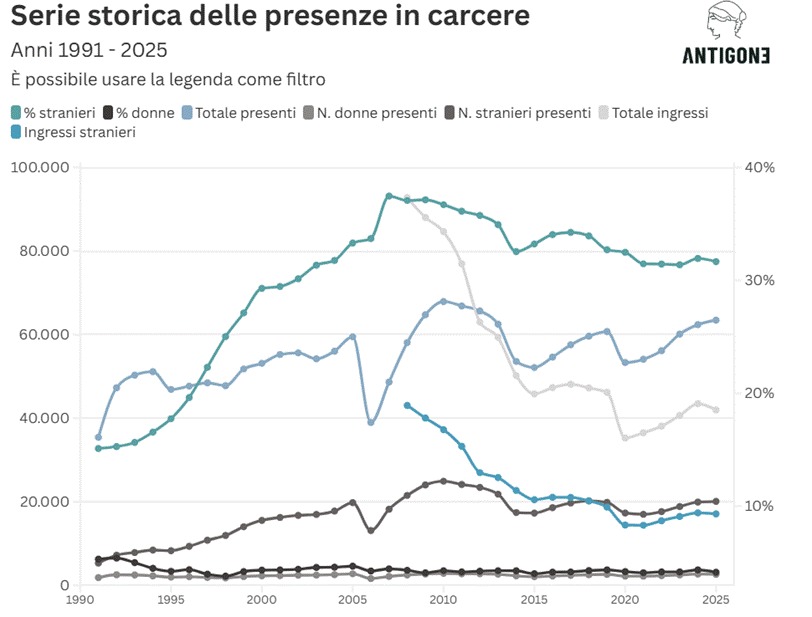
The first data that the report presents is a trend of growth in the population in prison, which has recorded an increase of 1,991 people in the last 12 months, accelerating from the 1,148 recorded in the previous 12 months. This figure is part of a dramatic context of overcrowding in prison spaces that reaches 139.1%. As of 30 April 2026, there are 64,436 people in penitentiary institutions whose capacity is 51,265 places, further reduced to 46,318 beds actually available. In 73 institutions, the overcrowding rate is 150% or more, with even 8 institutions exceeding 200%.
Although the prison population has increased, admissions have declined compared with the previous year, as has the use of pre-trial detention, which accounts for only 24.4% of the prison population. However, the number of people serving a final sentence has increased from 74.8% to 75.4% of the attendance. A modest percentage change, but consistent with the reduction of pre-trial detention: while this indicates a more limited use of a measure that in our legal system should have residual character, on the other hand does not result in any easing of pressure on structures. Overcrowding thus continues to worsen.
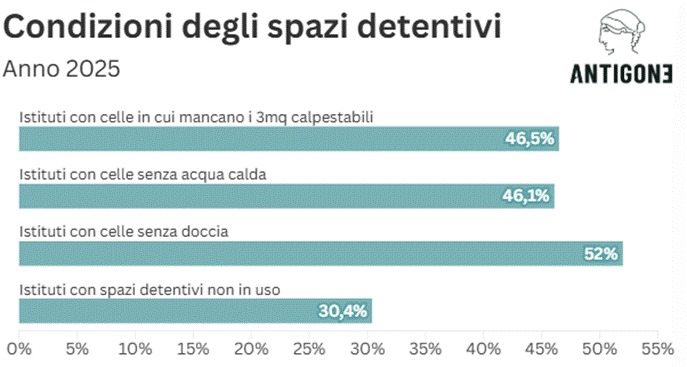
The growing overcrowding causes further critical issues in the Italian penitentiary system. Between 2018 and 2024, the Judicial Surveillance Court accepted over 30,000 appeals for inhuman and degrading treatment, especially regarding the unavailability of the minimum recognized space of 3 square meters per person. In addition, the excessive demographic pressure on space inevitably leads to the collapse of infrastructure: Antigone found that 66 of the 102 facilities contained unusable prison wings that take up living space, and that in 23 penitentiary institutions the toilet and kitchen are located in the same room. Overcrowding exacerbates the lack of hot water (in 47 prisons) and showers in cells (in 53 prisons), making it difficult for inmates to manage daily hygiene. These data fall within a broader framework of age of the institutions: only 39 of the 102 visited by the association are found to have been built after 1980. The institutes are then located far from inhabited centers, reinforcing the perception of prisons as spaces detached from the communities they serve.
All of these conditions cause acute suffering, which is often overlooked and not addressed through psychological care, and can lead to acts of self-harm and suicide attempts, a situation exacerbated by the fact that the continuous presence of healthcare staff is guaranteed in only 65 penitentiary institutions. Although declining compared to 2024, the figures for 2025 remain high: 1 out of 5 inmates has engaged in self-harm, and 13 out of 10,000 have attempted suicide (the majority of whom are women), one of the highest rates in the last thirty years.
Closed detention regime
After the restrictions linked to COVID-19 (2020-2022), 2025 marks a new phase of increasing closure of the Italian penitentiary system, no longer justified by health emergencies but by internal control needs. The current restrictive measures reflect a structural separation logic, which is used by the prison administration as a central tool to ensure internal order in an environment characterized by overcrowding. In this framework, the control of subjects deemed problematic or difficult to manage takes place mainly through measures of isolation and restriction of sociality. As of 7 April 2026, 60.25% of the incarcerated population lived in closed custody, a number that has tripled compared to 2022. The closed-prison regime takes on different forms and serves different purposes depending on the prison system in question, but it is characterized by strict control and a gradual restriction of freedom of movement, which is sometimes limited exclusively to one’s own cell. In Rachele Stroppa’s insight, the author argues that "space has a highly political significance, since its shape directly affects the rights of the detained people". If space is therefore an instrument of governance for the imprisoned population, the way it is organized produces concrete consequences on people’s lives. In this sense, it is significant that 75% of the 76 suicides that occurred in 2025 occurred under conditions of separation.
Antigone also notes a "paradox of isolation": in highly overcrowded contexts, closed sections end up being perceived by some inmates as preferable spaces to ordinary detention. This phenomenon highlights the deterioration of living conditions within institutions and the prevalence of a logic of mere containment.
The closed detention regime encompasses various situations, all of which have been influenced by political decisions made in recent years. The 2026 Kairos Plan amends the 41-bis regime by providing for the concentration of inmates in seven maximum-security facilities, three of which are located in Sardinia, where geographical and physical isolation is particularly pronounced. The Circular of February 27, 2025, prohibited inmates from engaging in social activities in the hallways of high-security units, a measure that had already been introduced by Circular No. 18 of July 2022 for medium-security units. However, these measures are contrary to the principle of "dynamic surveillance" that Italy had declared itself willing to implement following the historic condemnation by the European Court of Human Rights (Torreggiani and others v. Italy), which provided for the overcoming of mere physical containment in favor of a deeper knowledge of the prisoner, promoting an open custody model.
Juvenile justice system’s crisis
Overcrowding is also a concrete aspect of the juvenile prison system. Considering 2022 as a comparison base (the last year before the entry into force of the Caivano decree), Antigone reported a 52.5% increase in the number of young inmates in Juvenile Detention Centers (IPM) as of April 30, 2026. However, this figure does not account for young adults who have recently turned 18 and have been transferred to adult prisons, even though they are eligible to remain in IPMs until the age of 25, resulting in the interruption of educational programs they had already begun.
As for young foreign nationals, although the offenses attributed to them are less serious than those attributed to young Italian inmates, they are subject to more restrictive measures. Particular attention must also be paid to unaccompanied foreign minors, who often end up in prison after developing substance dependencies, which are then frequently managed through the indiscriminate use of psychiatric drugs.
The 2026 budget law shows a reduction in funding for juvenile detainees, with a 60.6% decrease in funds allocated for the innovation, expansion, and renovation of juvenile justice facilities. At the same time, however, there is a significant increase in resources allocated to administrative staff, judges, and prison police personnel.
The plight of mothers in prison
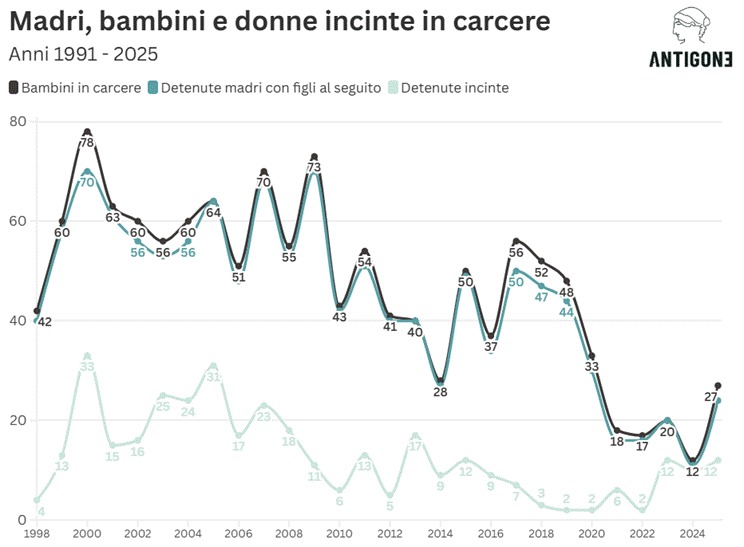
As of 31 March 2026, 27 children were living in Italian prisons with their 22 detained mothers, which is more than double the number of children recorded the previous year. According to Antigone's investigation, this increase is part of a change in the legal context following the approval of Law No. 80/2025, which made the postponement of the execution of a sentence for pregnant women or those with children up to one year of age optional rather than mandatory. The reform also introduced the possibility of transferring a mother from an Institution for reduced custody of women prisoners (ICAM) to a regular prison if her behaviour was deemed inappropriate, resulting in the removal of the child and intervention by social services. Antigone emphasises that, for the first time, maintaining the relationship between mother and child is dependent on the detainee's disciplinary conduct, and expresses concern about the growing number of children spending the first months of their lives in prison.
Penitentiary policies of the Meloni government
The government’s near-total dominance in the creation of new criminal laws (222 out of 298) through the systematic use of decree-laws and confidence votes highlights an imbalance of power in our country. Since taking office, the Meloni government has introduced over 55 new crimes and more than 60 new aggravating factors, in addition to over 65 harsher penalties—a repressive push that has also affected administrative law with the introduction of more than 30 new monetary and disqualification sanctions. The security-focused shift between 2023 and 2026 has redefined the boundaries of criminal liability through regulations enacted in the wake of media-driven emergencies. The process began with the Cutro Decree, which eliminated special protection for migrants and restricted reception capacity, and continued with the Caivano Decree, which facilitated pretrial detention and urban Daspo orders for minors. The repressive drive then culminated in the two Security Decrees (2025 and 2026), with the introduction of measures including the crime of roadblocking, the ban on “cannabis light,” and the crime of prison riot.
This trend toward centralization and security-driven policies on the part of the government profoundly alters the traditional system of institutional checks and balances: with such a powerful executive branch, Antigone expresses concern that “the role of Parliament risks being reduced to a mere exercise of passively accepting government decisions.” According to the association, the direction taken in recent years raises a fundamental question about the very meaning of justice in a constitutional democracy: if prison increasingly becomes a tool of exclusion and containment, rather than of reintegration and the protection of rights, there is a risk of straying from the constitutional and European principles that place human dignity at the center of the state’s actions. The quality of a democracy, Antigone argues, is measured by its ability to guarantee rights even to those in the most vulnerable and marginalized situations.
Conclusion
The picture painted by the report appears particularly problematic, as it calls into question compliance with the fundamental principles governing the function of punishment under Italian law. Article 27 of the Italian Constitution stipulates that punishments must aim at the rehabilitation of the convicted person and may not consist of treatment contrary to the principles of humanity. However, the data collected seem to show a growing gap between the constitutional model of punishment and the concrete reality of incarceration. Prison emerges, in fact, not as a place of social reintegration, but as a space of marginalization, inactivity, and psychological suffering, where security-oriented management increasingly prevails over treatment and rehabilitation goals, shifting toward a logic that Antigone defines as “pure social neutralization.”
It is precisely on the basis of this diagnosis that Antigone proposes a radical paradigm shift through a “Marshall Plan” for the prison system. The fifteen measures put forward by the association aim to combat overcrowding, expand access to alternative measures, strengthen educational and employment opportunities, improve the protection of physical and mental health, and reduce the isolation of prisoners. Beyond the individual proposals, what emerges is a different conception of punishment, grounded in respect for the human dignity of the individual and in the rehabilitative function of incarceration. In this sense, the plan is an attempt to align the penitentiary system with constitutional principles, reaffirming the idea that collective security should not be pursued at the expense of fundamental rights.
Links
How to cite this article
Lisa Cerchi, "Associazione Antigone: the XXII report "Tutto chiuso" on the alarming conditions of detention in Italy has been published", 12.06.2026, Italian Yearbook of Human Rights, ISSN 3035-5435, http://unipd-centrodirittiumani.it/en/topics/associazione-antigone-the-xxii-report-tutto-chiuso-on-the-alarming-conditions-of-detention-in-italy-has-been-published
