


The Italian Parliament approves law introducing the crime of “femicide” (Law No. 181 of 2 December 2025)

Table of Contents
- Introduction
- The evolution of the legal framework
- The text of the new law
- Data in Italy
- Conclusion
Introduction
On 25 November 2025, on the occasion of the International Day for the Elimination of Violence against Women, the bill introducing the offence of “femicide” (A.C. 2528) was definitively approved unanimously by the Italian Chamber of Deputies, having already been approved by the Senate on 23 July 2025 (A.S. 1433). Law No. 181/2025 was published on 2 December 2025 and entered into force on 17 December 2025. The law is set within a context in which, despite the progressive strengthening of protective measures, violence against women remains a structural and persistent phenomenon, particularly within family and intimate relationships.
The evolution of the legal framework
The reform forms part of a multi-year process aimed at recognising the specific nature of the offence of femicide and incorporates international guidelines and instruments that require States to adopt specific legislative measures to combat violence against women. These include the Convention on the Elimination of All Forms of Discrimination against Women (CEDAW), the Istanbul Convention, Directive (EU) 2024/1385 on minimum common standards to prevent and combat violence against women and domestic violence in the European Union, and, finally, the extensive case law of the European Court of Human Rights (ECtHR).
The recent evolution of Italian legislation on violence against women began with the ratification of the Istanbul Convention—adopted by the Council of Europe on 11 May 2011—on preventing and combating violence against women and domestic violence (Law No. 77 of 2013). After the ratification, Italy undertook a series of measures aimed at establishing an integrated strategy to combat violence in line with the framework set out by the Convention. Among these, particular importance should be attached to Decree-Law No. 93 of 2013, through which Italy introduced significant amendments to substantive criminal law and criminal procedure and provided for the periodic adoption of Action Plans against gender-based violence.
During the 18th Legislature (23 March 2018 – 12 October 2022), the Parliament continued to adopt measures aimed at combating violence against women, particularly in the areas of crime prevention and victim protection, while simultaneously providing for harsher penalties for gender-based offences. In this regard, special mention should be made of Law No. 69 of 2019 (establishing the so-called “Red Code”), which strengthened procedural safeguards for victims of violent crimes, introduced several new offences into the Criminal Code—including the unlawful dissemination of sexually explicit images or videos, the offence of permanently disfiguring a person’s appearance through facial injuries, and the offence of coercion or inducement to marriage—and increased the penalties for crimes most frequently committed against women, such as domestic abuse, stalking, and sexual violence.
In the current legislature, further laws have been enacted. Law No. 168 of 2023 introduced substantial amendments to the Criminal Code and the Code of Criminal Procedure, as well as to certain special statutes, with the aim of enhancing the effectiveness of prevention and enforcement measures against violence against women. Law No. 12 of 2023 provided for the establishment of a bicameral parliamentary commission of inquiry into femicide and all forms of gender-based violence. Finally, Law No. 122 of 2023 addressed one of the defining aspects of the procedure for domestic and gender-based violence offences by introducing the obligation for the public prosecutor to hear the victim, or the person who filed the complaint, within three days of the registration of the offence.
The text of the new law
The new law consists of 14 articles regulating the offence of femicide. The main innovation is contained in Article 1(1)(a), which introduces new Article 577-bis into the Criminal Code, establishing femicide as an autonomous form of homicide punishable by life imprisonment where the killing of a woman is motivated by hatred, discrimination, oppression, or dynamics of control and domination, as well as where it occurs in connection with the refusal to enter into or continue an intimate relationship or with the restriction of her freedoms. Article 1(1)(b) clarifies the criminal offence of domestic abuse by extending its scope to cases in which the perpetrator and the victim no longer cohabit but are linked by a parent–child relationship, and by introducing mandatory confiscation of the assets used to commit such offences. The law also provides for an annual reporting obligation to the Parliament by the Minister of Justice on the application of the new provisions and on data relating to femicide and homicide proceedings (Article 2).
Article 3 introduces significant amendments to the Code of Criminal Procedure, strengthening procedural protection in proceedings concerning violence against women and domestic violence. In particular, it introduces new rules on the jurisdiction of the single-judge court, which is granted competence over certain relevant offences; expands the information and participatory rights of victims, especially in plea-bargaining proceedings; extends the scope of precautionary measures; and lays down new rules for the taking of evidence, aimed at preventing any form of secondary victimisation.
Articles 4 to 14 complete the framework of measures supporting victims and preventing gender-based violence, complementing the criminal and procedural innovations with economic, welfare, organisational, and cultural protective measures. In particular, the protection of orphans of femicide is strengthened by expanding access to legal aid at the State’s expense and to compensation, including in cases involving an intimate relationship without cohabitation, with specific financial coverage.
With regard to criminal enforcement, access to prison benefits for those convicted of femicide and other gender-based violence offences is restricted, making such access conditional upon a thorough assessment of the offender’s personality and requiring that victims or their family members be promptly informed of the possible granting of such measures.
Alongside repressive measures, the law introduces prevention and training initiatives, promoting awareness-raising campaigns, establishing a permanent technical working group on sexual violence within the Ministry of Health, and enhancing the training of magistrates and healthcare professionals. Access to anti-violence centres is also facilitated for minor victims who have reached the age of fourteen, without the need for parental authorisation.
Data in Italy
Data collection represents a fundamental tool for understanding and thoroughly investigating the dynamics of violence against women and domestic violence. Its importance is expressly recognised by the Istanbul Convention, which requires States Parties to “collect disaggregated relevant statistical data at regular intervals on issues relating to any form of violence covered by the scope of the Convention” (Article 11). In this regard, Law No. 53 of 2022 is particularly relevant, as it regulates the collection of data and information on gender-based violence against women with the aim of monitoring the phenomenon and developing policies to prevent and combat it.
The Department of Public Security of the Ministry of the Interior is responsible for periodically producing statistical analyses on crimes attributable to violence against women. These analyses are published on the institutional website in the form of monitoring reports and are intended to provide an overall overview of intentional homicides, with particular focus on those involving female victims.
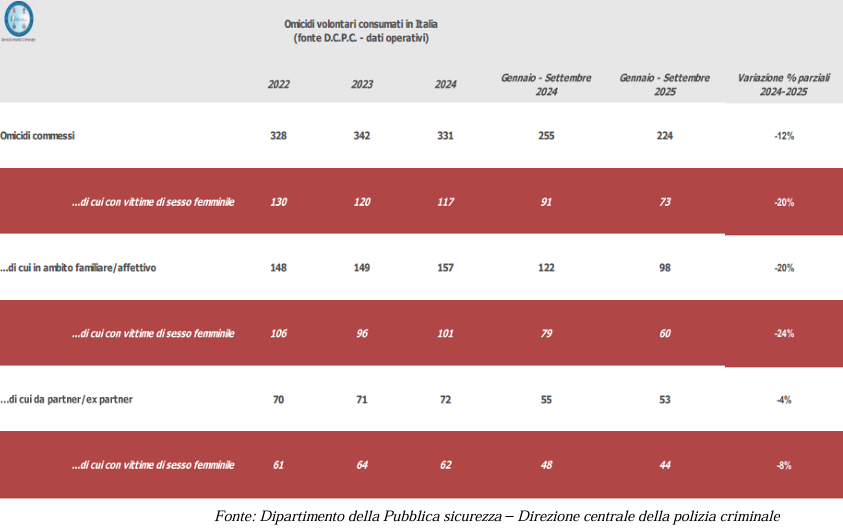
The criminological analysis published in October 2025 examines data relating to intentional homicides committed in the three-year period 2022–2024, also including a comparison between data from the first nine months of 2025 and those from the corresponding period of the previous year.
With regard to homicides involving female victims, the observed three-year period (2022–2024) confirms a downward trend, which is also evident in the comparison between January–September 2025 and the corresponding period in 2024. During the period considered, the total number of homicides decreased from 255 to 224 cases, representing a 12% reduction. At the same time, an even more significant decline is recorded in the number of female victims, which fell from 91 to 73, corresponding to a 20% decrease.
An analysis of homicides committed within family or intimate contexts shows a similar downward trend. In particular, compared with the same period in 2024, the number of incidents in January–September 2025 decreased from 122 to 98 cases (–20%), while the number of female victims fell from 79 to 60, a reduction of 24%. Despite this decrease, women continue to account for 61% of the victims.
An even more pronounced gender imbalance emerges in homicides committed by partners or former partners, an area in which victims are predominantly women. Here too, however, the 2025 data show a decrease compared with the same period in 2024: homicides attributable to partners or former partners fell from 55 to 53 (–4%), while the number of female victims declined from 48 to 44 (–8%). Notwithstanding this reduction, women victims remain overwhelmingly predominant, with percentages in previous years ranging between 86% and 90% and standing at 83% in the January–September 2025 period.
Conclusion
The introduction of the autonomous offence of femicide represents a crucial step in combating violence against women and marks a particularly significant moment in the legal recognition of violence against women as a structural, rather than episodic, phenomenon, rooted in dynamics of power, control, and gender-based discrimination.
Recent data indeed show signs of a decline in homicides involving female victims, but at the same time confirm the persistent and disproportionate prevalence of violence within family and intimate relationships, particularly perpetrated by partners or former partners.
In this context, the new legislation provides a targeted and coherent response, clearly affirming the central importance of protecting women’s lives and dignity. Its actual effectiveness in addressing the phenomenon, however, will depend on the concrete implementation of the measures provided, the coordination among the institutions involved, and the continuity of prevention and training policies.