


United Nations General Assembly: Italy’s Voting Behaviour on Human Rights Resolutions during the 79th Session
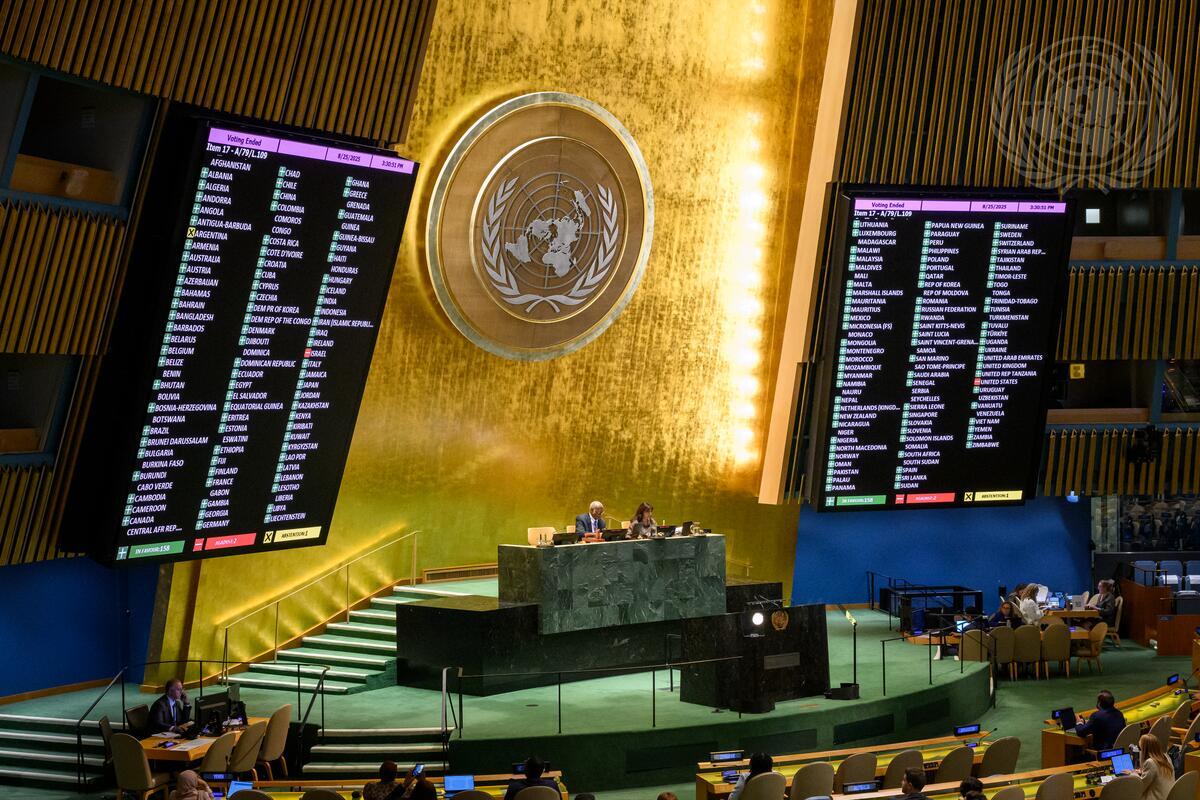
The United Nations General Assembly is the UN’s main deliberative body where Member States debate global issues and adopt resolutions. In practice, most human rights negotiations take place in its Third Committee addressing issues such as the prohibition of torture, women’s and children’s rights, and the right to self-determination.
During the seventy-ninth session of the General Assembly (2024–2025), the UNGA adopted a total of 334 resolutions. Of these, 223 resolutions were adopted without a vote, reflecting consensus among Member States, while 111 resolutions were adopted with a recorded vote, allowing for the identification of individual State positions. These resolutions include a wide range of concerns such as sustainable development, the impact of Artificial Intelligence, peace and security, self-determination, etc.
The state's participation in the seventy-ninth session demonstrates continuity with its established multilateral practice. Italy’s voting behavior on resolutions, particularly those adopted by the Third Committee, reflects long-standing priorities centered on accountability, the universality and indivisibility of human rights, and the protection of vulnerable populations.
Italy’s approach to human rights during this session was articulated through both high-level political statements and committee-level interventions. In her address to the General Assembly, Prime Minister Giorgia Meloni reaffirmed Italy’s commitment to the principles of the United Nations Charter, international law and multilateral cooperation, emphasizing that respect for human rights is a foundational element of peace, stability and sustainable development. In this context, Italy underlined the relevance of human rights to emerging global challenges, including the governance of technological innovation and artificial intelligence. Also, it stressed that innovation must be compatible with democratic values, freedom of expression, labor protections and social inclusion, thereby framing new technologies as a matter of rights-based governance rather than purely economic or security concerns.
Italy’s intervention during the general debate further clarified this normative orientation. Aligning itself with the European Union’s common position, Italy highlighted a set of substantive priorities: the abolition of the death penalty, the elimination of violence against women and girls, the protection of children affected by armed conflict, the fight against racism and intolerance, and the importance of accountability for serious human rights violations.
Although most of the General Assembly’s resolutions were adopted without a vote, a substantial number of human rights resolutions, particularly country-specific texts, were adopted with recorded votes in the Committee. The official report of the Third Committee on agenda item 71 (c), contained in document A/79/458/Add.3, records the consideration of several country-specific human rights resolutions and the results of recorded votes. Italy’s support of these texts reveals a consistent pattern of advocating for resolutions emphasizing accountability, cooperation with United Nations human rights mechanisms and the protection of fundamental freedoms.
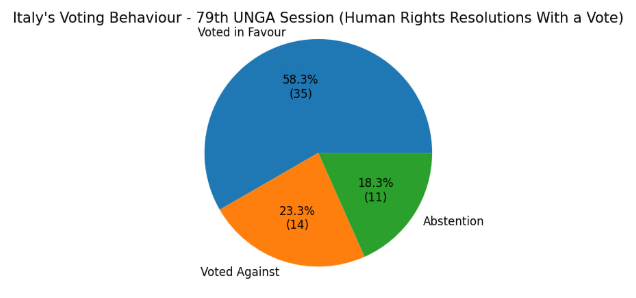
Moreover, Italy sponsored 16 resolutions concerning human rights and participated in recorded votes on 60 resolutions, casting 35 votes in favour, 14 against, and 11 abstentions. The results of these votes are illustrated below.
Overall, the resolutions considered during the seventy-ninth session indicate a relatively consistent pattern in Italy’s approach on human rights debates. Here is a comparison between this session and the last one:
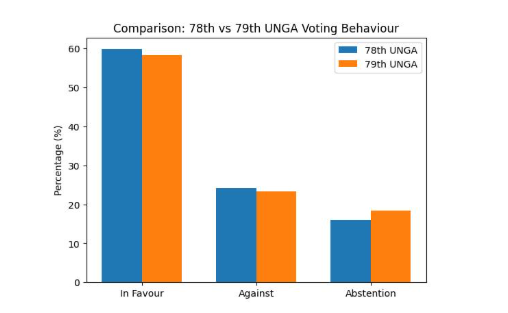
79th UNGA:
- In Favour: 58.3%
- Against: 23.3%
- Abstention: 18.3%
78th UNGA:
- In Favour: 59.8%
- Against: 24.1%
- Abstention: 16.1%
Italy tended to support country-specific resolutions addressing grave and ongoing violations. Its voting record largely aligned with that of the European Union and other Western and like-minded States, confirming the centrality of EU coordination in shaping its multilateral human rights.
The attached table provides an overview of the human rights’ resolutions adopted by the United Nations General Assembly in its 79th session.