


The Colombian State formally recognizes that the death of Giacomo Turra in 1995 resulted from police violence which led to the loss of an innocent individual's life
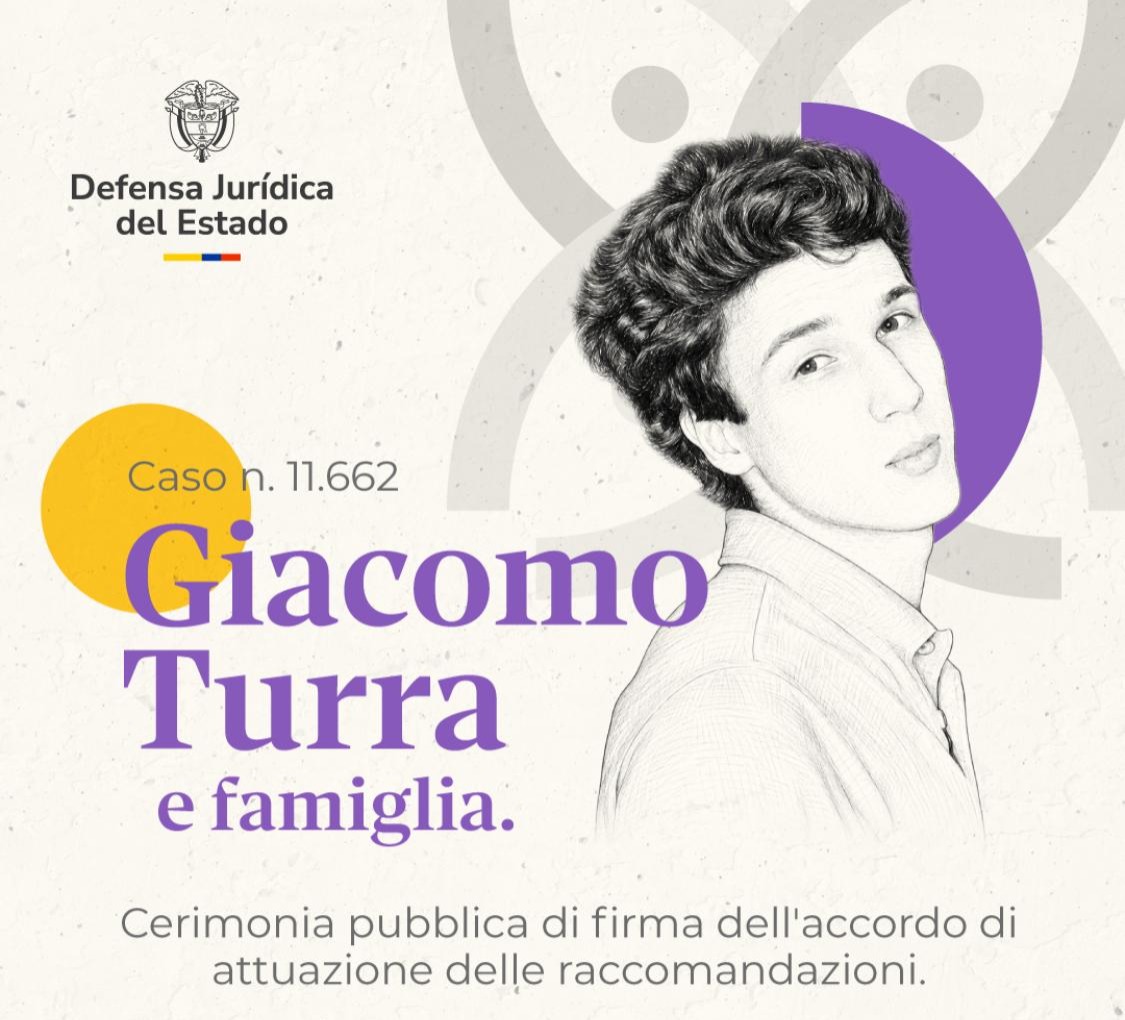
On 3 September 1995, Giacomo Turra, an Italian student from the University of Padova, entered a restaurant in Cartagena in an evident state of distress. The venue managers called the police, who stopped him and began beating him with incredible brutality. A few hours later, the young man died in hospital. His face was unrecognisable due to the blows he had sustained. The authorities spoke of drug use and self-harm, but provided no evidence. In 1998, a military tribunal acquitted the police officers. The Italian government of the time mobilised, while in Colombia Giacomo Turra became a symbol of the struggle against the unjustified violence of the police. Giacomo's family, together with the Comisión Colombiana de Juristas, brought the case before the Inter-American Commission on Human Rights. The petition was declared admissible in 2001 and since then attempts at mediation between the Commission and the Colombian State have multiplied, in order to obtain truth about the matter and a credible acknowledgement of responsibility.
In 2024, the Inter-American Commission decided to close the procedure and communicated its report to the State. In the report (still confidential) che Commission affirmed Colombia's responsibility for the violation of the right to life, personal integrity and liberty, judicial guarantees, and the health of Giacomo Turra. In addition to compensating the family for the damage suffered, the Commission called on Colombia to take measures to prevent similar occurrences and to provide protocols and training to police officers on how to deal with people affected by mental health crises without resorting to violence.
Two years later, the Colombian government finally accepted the Commission's conclusions, formally presented its apologies, and acknowledged its own responsibility for the unjust death of Giacomo Turra.
"Today is, in many respects, a day that we can define as historic. Not because it completely fills a wound, but because it represents a fundamental step in re-establishing the truth and publicly acknowledging what happened. The University of Padova, which has always recognized itself in the values of Paduan libertas, can only reaffirm its commitment to defend the dignity of the person, the freedom of research and the value of international law. We cling to the Turra family with intense participation, in memory of Giacomo and in the awareness that the truth, even when it arrives after many years, remains an indispensable value".
With these words the rector of the University of Padova, Daniela Mapelli, commented on the decision of the Colombian State to acknowledge, thirty years later, its responsibilities in the death of Giacomo Turra, the young Paduan student killed on September 3, 1995 in Cartagena des Indias by the Colombian national police.
On 20 May 2026, at a public event, the government and the Commission will sign a deal to implement the recommended measures. The Colombian government has issued a poster for the event. The ceremony will be broadcast on YouTube on Wednesday, 20 May, at 4 PM CET (Rome Time).
Thanks to a procedure established by international human rights law and committed to life and peace, justice has eventually prevailed over blatant impunity, the most significant obstacle to redress for victims of human rights violations.
The deal between the Inter-American Commission and Colombia’s State is particularly welcomed, as it comes at a historic moment when many governments are perpetrating serious violations of international human rights law, obstructing the functioning of supranational guarantee systems, and undermining the work of non-governmental organisations that fight for truth and justice.
This historic deal reminds us that the law of human rights is wounded, but not dead, for it possesses an inherent force of resistance.