


The First Conference for the Just Transition Away from Fossil Fuels took place in Santa Marta, April 24-29, 2026
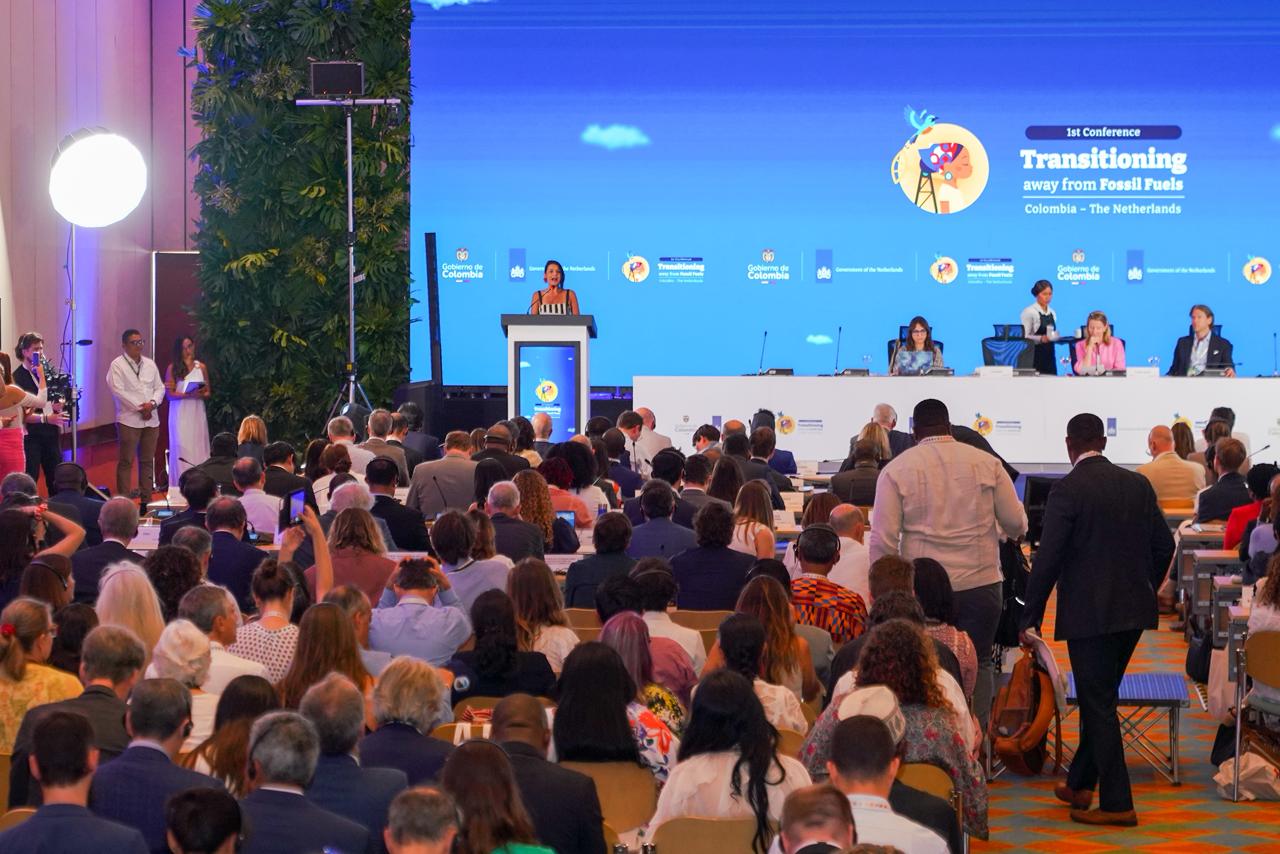
From April 24 to April 29, 2026, Colombia and the Netherlands co-hosted the First Conference on Transitioning Away from Fossil Fuels in Santa Marta, Colombia. First announced at the COP30 in 2025, this international gathering aimed to advance concrete actions to reduce dependence on oil, gas, and coal, in line with scientific evidence and global climate objectives.
Following the agreements reached at COP28, which recognized the need to move toward a just, orderly, and equitable transition away from fossil fuels, a gap persists between commitments and implementation. Designed as a space for dialogue among countries, subnational governments and other stakeholders, the Conference sought to deepen democratic climate governance with the objective of phasing out fossil fuels. It is not intended to replace the United Nations Framework Convention on Climate Change or the COP30 Presidency’s roadmap, but rather to build shared understanding and support practical action to accelerate a just, orderly, and equitable fossil fuels transition.
The Conference was organized into two segments. The first, from April 24 to 27, brought together academia, civil society organizations, private sector, workers, subnational governments and a people’s assembly for dialogues structured around the three thematic pillars of the conference: overcoming economic dependence, transforming supply and demand and advancing international cooperation and climate diplomacy. Each stakeholder-led dialogue aimed to create space for reflection and to identify enabling pathways for a just transition, building on proposals developed through a prior process of written contributions and global virtual dialogues. These outcomes were then brought to the high-level segment on April 28 and 29, convening ministers, high-level subnational government representatives and spokespersons from different stakeholder groups.
Colombia and the Netherlands delivered five key outcomes from the Conference:
- A second conference on transitioning away from fossil fuels was announced, to be co-hosted by Tuvalu and Ireland in 2027;
- A coordination group was established to ensure continuity toward the second and subsequent conferences, and to connect with COP30 Activation Group 4: Transitioning Away from Fossil Fuels in a Just, Orderly and Equitable Manner;
- The conference report will be presented to the COP30 Presidency, to the UNFCCC intersessional meetings in Bonn in 2026, at London Climate Action Week, and to the UN Secretary-General during New York Climate Week. The co-hosts will also work with incoming COP presidencies to align outcomes with the Global Climate Action Agenda and the Second Global Stocktake;
- Three workstreams will be established to identify concrete opportunities and channels for cooperation to overcome fossil fuel dependencies in preparation for the second conference: work on transition roadmaps, work on macroeconomic dependencies and financial architecture and work on producer-consumer alignment for the fossil fuel transition;
- Colombia's Acting Minister of Environment and Sustainable Development, Irene Vélez Torres, announced the establishment of the Scientific Panel for the Global Energy Transition (SPGET), the first panel of its kind in the world. Bringing together leading scientists in climate, economics, and technology, the panel will advise nations on concrete actions toward a transition beyond fossil fuels. It represents a bridge between academia and governments in the progressive elimination of fossil fuels, led by independent climate councils or similar bodies, and grounded in the collaboration between international expertise, the best available science, and regional knowledge.
To read the summary of the conference you can visit the link https://static1.squarespace.com/static/68dc91a7e566d74a91e8e22d/t/69f2979327f294060a2cb53d/1777506195819/TAFF+Conference_Co-host+Takeaways_DEF.pdf