


Art and Rights as a Journey
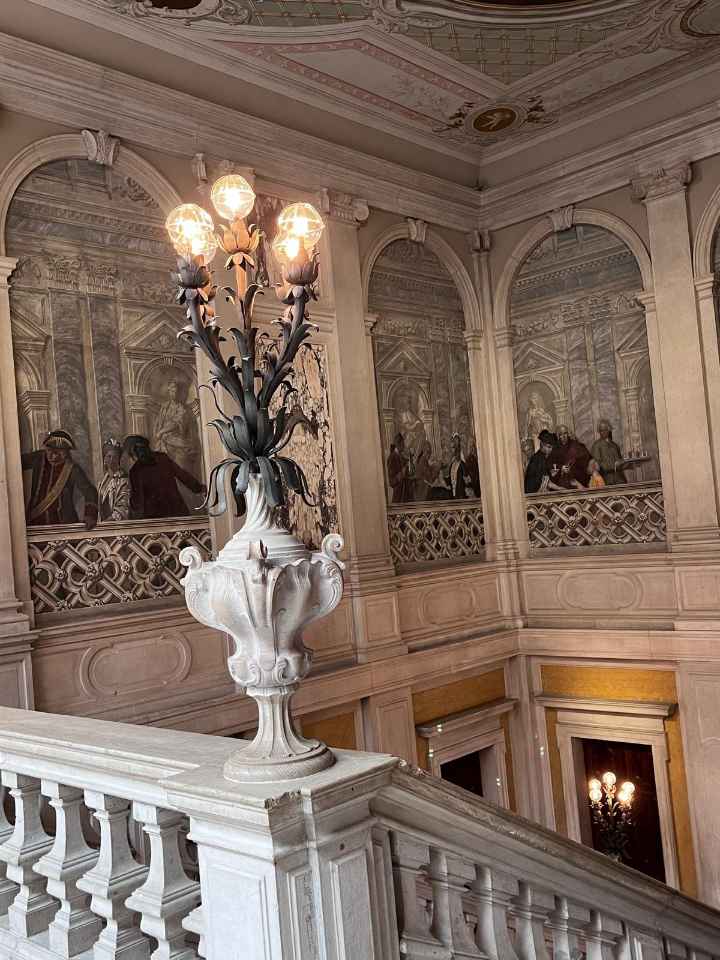
During the 61st International Art Exhibition in 2026, the Pinault Collection in Venice organised four contemporary art exhibitions across its two museum venues, Palazzo Grassi and Punta della Dogana.
These two buildings are part of the Pinault Collection, which has been presenting contemporary art exhibitions in Venice since 2005 and, since 2021, at the Collection’s Paris venue, the Bourse de Commerce. Both locations were restored by the Japanese architect Tadao Ando (TAAA – Tadao Ando Architect & Associates).
At Palazzo Grassi, the exhibitions on display are The Promise of Change by Michael Armitage and Co-Travellers by Amar Kanwar. At Punta della Dogana, visitors can experience Algebra by Paulo Nazareth and Third Person by Lorna Simpson.
This article focuses on the exhibitions by Michael Armitage and Paulo Nazareth, whose works address migration through their countries of origin, socio-political tensions, violence, ideologies, and the global migration crisis.
Palazzo Grassi was commissioned by the wealthy Grassi family and built from 1748 onwards. Designed as a residence overlooking the Grand Canal, its interiors were inspired by ancient Roman houses.
Until January 2027, the first and second floors of the palace host Michael Armitage’s exhibition The Promise of Change, a title that clearly evokes aspirations for social and political transformation in Africa while simultaneously confronting the deeply problematic realities that persist.
The British-Kenyan artist was born in Nairobi in 1984 and presents a body of forty-five paintings, including both historical works and new productions, alongside more than one hundred studies that reveal his rich and sensitive pictorial language. His works stage complex figures and compositions with remarkable chromatic intensity, bringing together diverse aesthetic traditions.
Armitage does not hesitate to address difficult and violent subjects, maintaining that art cannot ignore reality. The consequences of war, corruption, instability in equatorial regions, the migration crisis, the burden of external scrutiny, and the abuse of power all form the backdrop to some of his most moving works.
Dividing his life between Kenya and Indonesia, Armitage draws inspiration from a wide range of sources: historical events and contemporary affairs, political demonstrations, literature, cinema, local rituals, colonial and modern architecture, fauna and flora, as well as the global history of art. At the centre of his iconography lies East Africa, and Kenya in particular, which he explores with a perspective that is simultaneously critical, satirical, and visionary.
While some scenes are precisely situated in time and place—for example, when the artist accompanied a team of journalists documenting opposition movements and their violent repression during Kenya’s 2017 elections, or when he depicts events linked to the 2020–2021 lockdowns—other works remain more elusive and universal. This ambiguity leads Armitage towards fluid and shifting territories.
His paintings are executed in oil on bark cloth, a material traditionally produced in Uganda and Indonesia, thereby distancing his practice from the conventions of the Western canvas. The natural irregularities of this material—holes, folds, and a rough texture—directly influence the artist’s visual compositions. Created through a lush and sensual palette, Armitage’s paintings emerge from a process of layering and superimposition, whereby successive applications of paint generate a distinctive and evocative imaginative world. Drawing, to which a large room within the exhibition is dedicated, further demonstrates the attention the artist devotes to detail, composition, and preparatory studies.
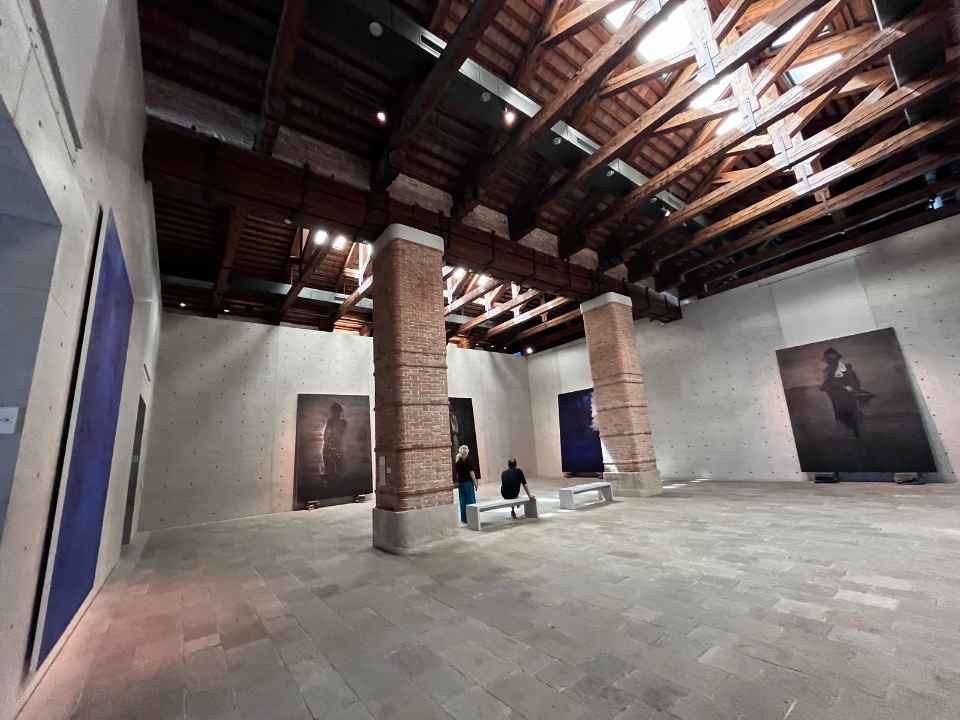
Punta della Dogana, or “Dogana da Mar”, has borne this name since the time of the Venetian Republic. Owing to its strategic location between the St Mark’s Basin, the entrance to the Grand Canal, and the Giudecca Canal, it served as the customs headquarters for goods and merchandise involved in maritime trade.
Following a major restoration completed in 2008 by Tadao Ando in collaboration with a group of Italian professionals, Punta della Dogana became the second Venetian exhibition venue of the Pinault Collection.
On the first floor of the building, visitors can explore the solo exhibition Algebra by the Brazilian artist Paulo Nazareth. The exhibition brings together more than twenty years of artistic practice. Its title derives from the Arabic al-jabr, meaning “the reunion of broken bones”, evoking the essence of algebra as the art of solving unknowns and reconstructing what has been fractured. For Paulo Nazareth, this becomes a methodology for confronting unresolved historical ruptures through epic journeys across the Americas, the Caribbean, and the African continent: an apparently simple practice through which to communicate a complex and significant message about belonging to a place.
Indeed, his practice of walking reveals the colonial and racial violence that has shaped contemporary borders, proposing forms of knowledge rooted in relationships and ancestral wisdom rather than colonial cartography.
A thick line of salt runs through each room, marking a threshold between what is visible and what remains submerged. For attentive visitors, this line gradually reveals the geometry of a ghost ship—a tumbeiro, the Portuguese term for the slave ships that crossed the Atlantic Ocean. Salt functions both as a metaphor and as a material agent: it heals, corrodes, and accumulates. It also represents a border line, which may be perceived as a liminal space capable of being crossed.
Among the central works on display is Noticias de America, which condenses Nazareth’s ten-month journey on foot from Brazil to New York. Photographs, texts, and worn Havaianas sandals trace moments in which identity and borders collide, offering direct testimony to migration both as a lived experience and as a socially constructed fiction.
Although Armitage and Nazareth are very different artists, using distinct media and aesthetics, they are united by a profound connection to their countries of origin, to history, and to both religious and everyday rituals.
Particularly significant is also Altri Sguardi (“Other Perspectives”), the cultural exchange programme that Palazzo Grassi – Punta della Dogana dedicates each year to refugees, asylum seekers, and participants with a migration background. Established in 2019, Altri Sguardi is conceived as a cultural exchange experience that values the plurality of perspectives and promotes active participation in cultural life.
Participants observe, interpret, and mediate works of art, offering visitors original and plural narratives of the exhibitions hosted by the Venetian venues of the Pinault Collection. The museum is transformed into a space of reflection and storytelling capable of welcoming diverse experiences and viewpoints, giving voice to perspectives that are often marginalised. The artworks become a platform for dialogue on urgent contemporary issues, including social and cultural inclusion.
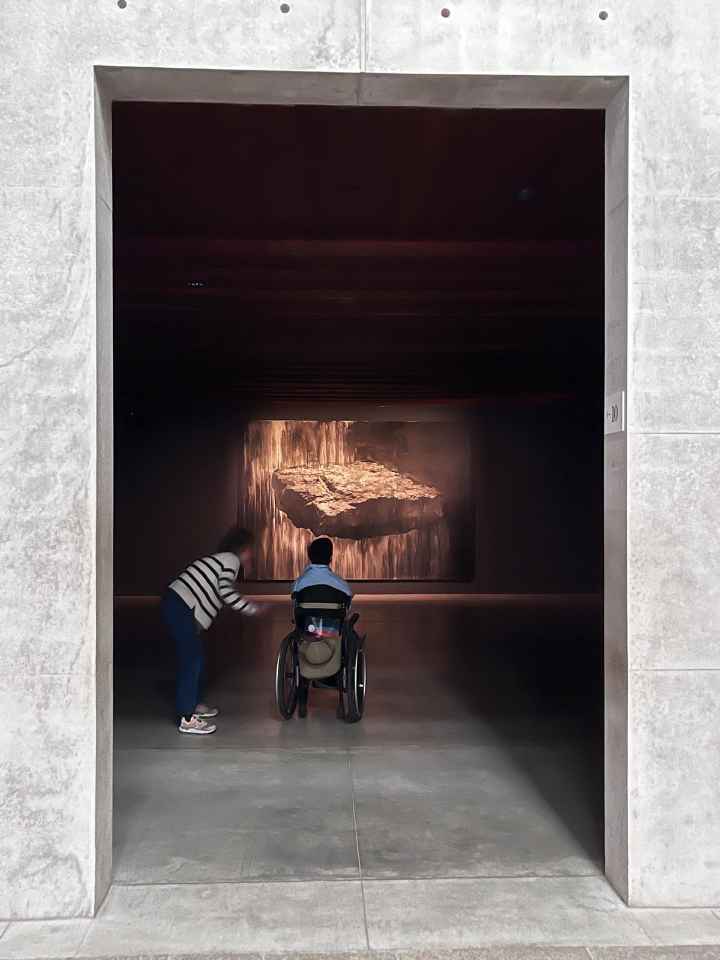
Attention to accessibility constitutes a further element of interest within both exhibition venues. When considered through the lens of the principles of Universal Design, theorised by Ronald Mace, the exhibitions display several features that encourage broad and inclusive participation.
The exhibition spaces are spacious and well organised, allowing easy mobility, including for people with physical disabilities. Furthermore, the positioning and height of the artworks enable visitors to appreciate the exhibitions from a variety of viewing perspectives.
Available resources include an accessible visitor route and informational materials in Italian Sign Language (LIS), which can be consulted through the official Palazzo Grassi website. Gallery staff also contribute to creating a welcoming environment that is attentive to the diverse needs of visitors.
While numerous positive aspects can be identified, a further implementation of Universal Design principles could include, where compatible with the conservation requirements of the artworks, the introduction of tactile models or supports. Such tools would broaden the possibilities for engagement and provide a more accessible experience for visitors with visual impairments.
Finally, it is important to note that the restroom facilities also meet accessibility requirements, thereby contributing to a more comfortable and inclusive visit.
Overall, Palazzo Grassi and Punta della Dogana represent an interesting example of how cultural institutions can promote pathways towards inclusion and accessibility, encouraging the participation of the widest possible range of visitors.
How to cite this article
Manuela Viezzoli (2026), "Art and Rights as a Journey", in Inclusion and Eco-Social Justice, ISSN 3035-5265, https://unipd-centrodirittiumani.it/en/topics/art-and-rights-as-a-journey (consulted on 06/10/2026).
