


Italian participation in the Global Sumud Flotilla’s 2026 Spring Mission
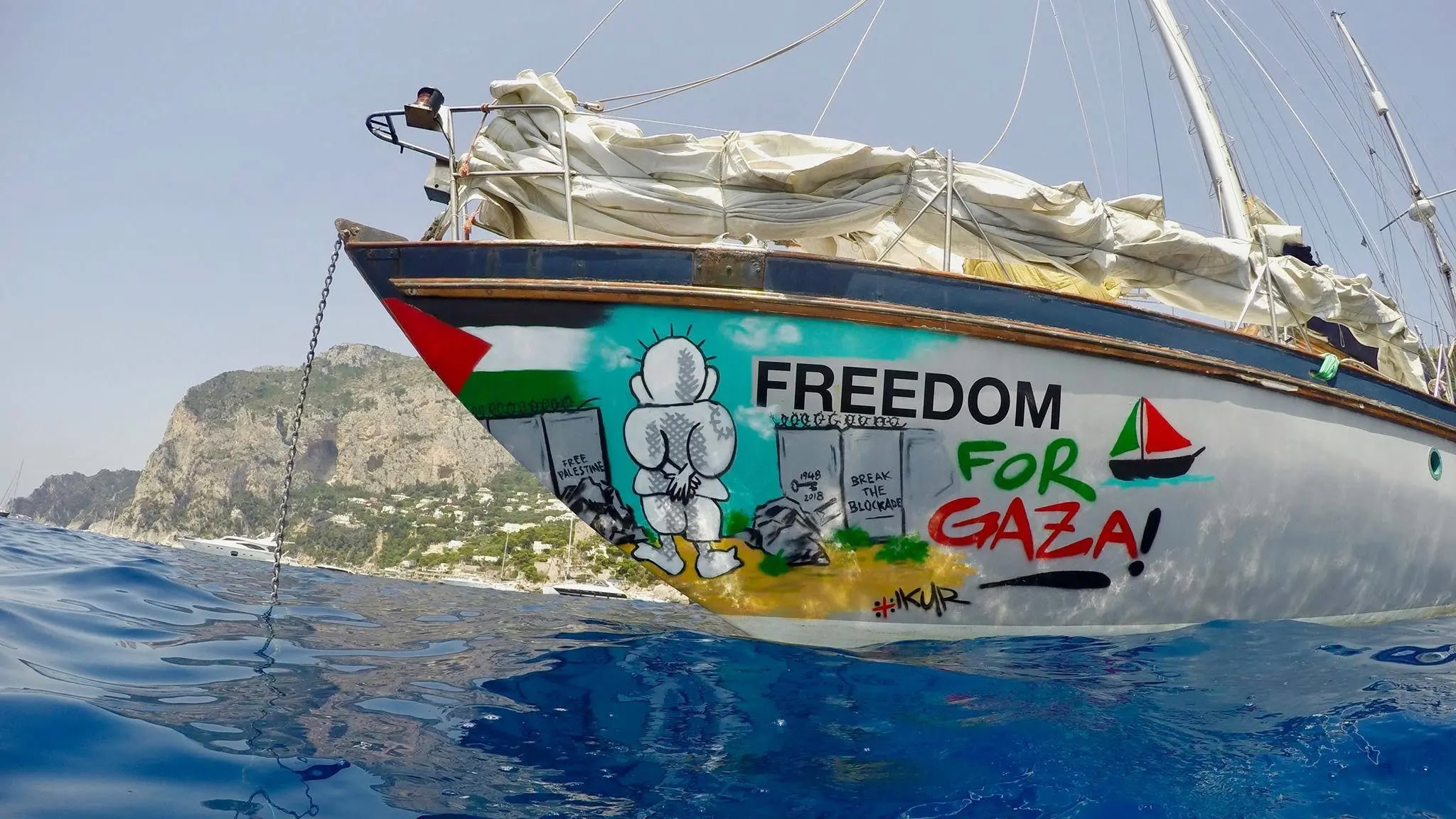
Table of Contents
- The New Global Sumud Flotilla Mission and the International Context
- The Italian Presence: Contribution and Contradictions
- The Boarding in International Waters
- The Meloni Government's Response
- Judicial Proceedings
- Later Developments: The Second Boarding and the Land Convoy
- The Mobilization of Italian Civil Society
- Comparison with the First Mission
- Concluding Remarks
The New Global Sumud Flotilla Mission and the International Context
On April 26, 2026, the "Spring Mission" of the Global Sumud Flotilla set sail from the coast of Sicily — an international initiative created to denounce the Israeli blockade of Gaza and the humanitarian situation in the Strip. Departing from Syracuse and set to meet in Greece with other vessels coming from Barcelona and various Mediterranean ports, the mission involved a total of 71 boats — although some estimates put the figure above 100 — and participants from more than 70 countries, a larger number than the previous autumn's mission.
Unlike that earlier mission, conceived mainly to bring humanitarian aid to the besieged population, the spring mission set itself a broader goal: not only to break the blockade, but to bring to Gaza doctors, technicians, educators, and other figures needed for the reconstruction of the Strip. The organizers presented the initiative as a direct response to a request from the Palestinian population itself, also framed as a reaction to the "Gaza Riviera" plan promoted by Donald Trump and Jared Kushner's Board of Peace — dubbed by activists the "Board of Shame."
The Italian spokesperson for the Flotilla, Maria Elena Delia, described the ceasefire then in effect, before the mission's departure, as a "fake ceasefire" concealing a new colonial project. In this reading, the Flotilla positions itself as a stand-in for international civil society in the face of the inaction of governments — including the Italian government — unable, or unwilling, to effectively condemn what is happening in Gaza.
The Italian presence: contribution and contradictions
Italy played a significant role in the mission, not only as a logistical starting point: boats that had set out from Ancona, Civitavecchia, Naples, and Bari converged on Syracuse before the final departure. Fifty-seven Italian citizens took part in the mission, including members of parliament, doctors, activists, and volunteers, involved both on the humanitarian front and in political solidarity.
This Italian centrality made a contradiction highlighted by the Flotilla's own spokespeople more visible: Italy is described as still involved, through Leonardo S.p.A. — a state-owned company active in the production of armed drones, radar, missile systems, cybersecurity, and surveillance infrastructure — in the supply chain of weapons destined for Israel. Activists also noted that, while the Council of Ministers expressed concern over the destabilizing effects of the conflict in the Middle East, Italy allegedly continued to supply weapons and host U.S. military bases, with no change in its strategic choices.
This duality — declared condemnation alongside the continuation of concrete industrial and military ties — feeds into a broader public debate on the consistency of Italian foreign policy, the transparency of controls on arms exports, and the democratic accountability of defense-related industrial policy choices.
The boarding in international waters
On the night between April 29 and 30, roughly two days after departure, several Flotilla boats were approached by military speedboats identifying themselves as Israeli, which allegedly pointed semi-automatic weapons and lasers at the crews, ordering them to "go to the bow and get on all fours," according to the mission's statement. The interception took place more than 600 nautical miles from the coast, off Crete — therefore in international waters — and was described by Turkey's Foreign Minister as "an act of piracy."
According to the Times of Israel, the Israeli navy intercepted 21 of the 58 boats then sailing near Crete; the Global Sumud Flotilla's own website, updated at 4:23 a.m., instead reported 22 boats stopped and 36 still sailing. Among the boarded vessels was an Italian boat, the Bianca. "Flotilla under attack: Bianca (Italy) is under attack and most of the boats are blocked," read a statement from the movement. In total, 175 activists were reportedly detained, including 25 Italians.
Activists reported that, during the roughly 40 hours that followed aboard the military vessels, they were systematically deprived of food and water and forced to sleep on deliberately flooded floors. When soldiers attempted to remove Saif Abukeshek and Thiago Ávila, the rest of the crew reportedly offered "peaceful resistance," which was met with a violent response. Israel's Foreign Ministry, for its part, attributed the Flotilla's "provocation" to Hamas and "professional provocateurs," accusing the mission of trying to sabotage the second phase of the Trump administration's peace plan, and released images of materials seized on board as alleged proof that the initiative was not humanitarian in nature.
The Meloni government's response
Following the boarding, a meeting was held between Prime Minister Giorgia Meloni, Deputy Prime Minister and Foreign Minister Antonio Tajani, Defense Minister Guido Crosetto, and Undersecretary to the Presidency Alfredo Mantovano. A statement from Palazzo Chigi followed, in which the Italian government condemned the seizure of the boats — which took place in international waters off the Greek coast — calling on Israel to immediately release the detained Italian citizens, to respect international law, and to guarantee their physical safety.
The same day, a joint statement from the Italian and German foreign ministries reaffirmed the priority of citizens' safety "in line with international humanitarian law," reiterating a shared commitment to aid for Gaza "in accordance with international law and standards" — a more cautious formulation, lacking any explicit condemnation of the Israeli action.
It remains notable that no official statement addressed the fact that Ávila and Abukeshek, at the moment they were taken, were aboard a boat flying the Italian flag: under international maritime law, a ship constitutes an extension of its flag state's territory, meaning their removal could potentially amount to a violation of Italian territorial sovereignty, as well as of international law more broadly — an issue on which the government has not commented.
Judicial proceedings
The Rome Public Prosecutor's Office opened a file on charges of kidnapping in relation to the boarding of the 22 boats off Crete. The investigation originated from three formal complaints, two of which specifically concern the position of Ávila and Abukeshek, both held in an Israeli prison at the time and removed from Italian-flagged boats.
Among the activists released and returned to Italy is Tony La Piccirella, who landed at Rome Fiumicino on May 3, while his two companions appeared before an Israeli court on terrorism charges. La Piccirella publicly challenged the term "act of piracy" — also used by the Italian government — calling it instead "the natural consequence" of the military, political, and economic support given to Israel, and described the conditions of detention aboard the military ship: crew packed together, water flooding in and out of the hulls, rifles pointed at them.
Later developments: the second boarding and the land convoy
The story did not end with the boarding in late April. The surviving boats withdrew to Turkey to regroup and set out again on May 14 from Marmaris, this time numbering 54. On May 18, off Cyprus and about 250 nautical miles from Gaza, the Israeli navy carried out a second boarding, on an even larger scale than the first: more than 400 activists were detained and transferred to Israel, before being released.
In parallel with the maritime mission, on May 15 — the anniversary of the 1948 Nakba — the Global Sumud Land Convoy set out from Tripoli, an overland expedition made up of roughly 200–300 activists from more than 25 countries, including medical staff, engineers, and volunteers, aiming to reach Rafah by crossing Libya. Despite holding visas issued by the Tripoli government, the convoy ran into the blockade imposed by militias from Cyrenaica, the eastern Libyan region controlled by forces linked to General Khalifa Haftar. A group of ten activists, including the two Italians Domenico Centrone and Leonarda Alberizia, was arrested in late May near Sirte while attempting to negotiate passage, and held in Benghazi for about a month, until their release was announced by Foreign Minister Tajani on June 23; the rest of the convoy was turned back by authorities in western Libya.
Overall, neither the boats nor the land convoy managed to reach Gaza: the stated goal of physically breaking the blockade was not achieved. The organizers themselves, in the final assessment published on the Flotilla's website, implicitly acknowledge this limitation but redefine its meaning in political and symbolic rather than operational terms, reaffirming their intention to continue mobilizing for the Palestinian cause.
The mobilization of Italian civil society
News of the first interception triggered a rapid mobilization in various Italian cities. The Coordinamento Marche per la Palestina was among the first to call an urgent mobilization; in the late afternoon of April 30, sit-ins and marches were held in Bari, Rome, Genoa, Cosenza, Alessandria, Naples, and Milan. Solidarity actions continued in the following days, particularly from May 1 onward, focusing also on demands for the release of Ávila and Abukeshek, who remained detained in Israel while, according to the Flotilla, around sixty mission members began a hunger strike in protest.
In the following weeks, the mobilization grew progressively larger, tracking the mission's developments step by step. USB organized a strike by port workers and, on May 7, a school strike together with CUB, COBAS, SGB, and SI COBAS; on May 16 a demonstration was held in Milan for the 1948 Nakba, the same date on which the land convoy set out from Tripoli. The turning point came on May 18, when USB and CGIL called a national general strike in solidarity with the Flotilla — coinciding, not by chance, with the day of the second boarding off Cyprus. The numbers were considerable: at least 300,000 people marched in Rome according to the local CGIL, more than 100,000 in Milan, with road blockades in Turin and Bologna, dockworkers present in Genoa, marches by transport and healthcare workers in Naples, and student occupations of train stations in Florence and Pisa. A second national demonstration, again promoted by USB on May 23, explicitly linked the Flotilla's cause to other domestic social demands concerning wages, the cost of living, and military spending.
The mobilization did not end with the close of the maritime mission: the case of the activists detained in Libya, including the Italians Centrone and Alberizia, also fueled public pressure throughout June, which several sources indicate as a significant factor in securing their release. This sequence — from the spontaneous sit-ins of late April, to the general strike in mid-May, to the pressure for the release of those detained in Libya — marks a step up in scale compared with previous protests, showing how the Flotilla story became intertwined, in Italian public debate, with broader social and economic policy issues as well as with foreign policy toward Israel.
Comparison with the first mission
Compared with the first mission, this was an initiative of far greater scale and with a much broader purpose. While the first mission had the more limited goal of breaking the Israeli naval blockade of the Gaza Strip in order to deliver food and medical supplies, this second mission was aimed at rebuilding the Strip's infrastructure — an action driven by requests from Gazans themselves.
How aware the organizers were, in both the first and second missions, of the real chances of reaching the population of Gaza is impossible to know. It also remains an open question whether, more than a practical goal, the primary aim was symbolic in nature. After all, the activists have never hidden their criticism of an international geopolitical system that they see as placing the economic interests of the powerful above people's wellbeing.
Particularly symbolic — and perhaps emblematic of the real message the Flotilla's activists wanted to convey — was the arrival on the shores of Gaza of the Kasr-i-Sadabad, a drifting, crewless boat that had been abandoned by Israeli forces in international waters. The boat, dragged ashore by a group of people who happened to be on the beach, was held up by some as a symbol of the blockade being broken. While it was celebrated as a victory by supporters of the mission, this enthusiasm was, on the other hand, mocked by critics for celebrating the arrival of what they dismissed as a mere wreck.
If the first mission generated unprecedented media and political resonance — partly because of its unprecedented nature and the presence on board of well-known figures such as Greta Thunberg — the Spring Mission 2026, while unfolding in a context that was by then less unexpected, nonetheless had a significant impact, albeit of a different kind. The first mission had an enormous political and social effect in Italy. The mobilizations reached a mass scale across the whole country, with enormous participation across many sectors, including the private sector. This does not diminish the significance of the participation in the mobilizations following the interception of the second mission; still, on a symbolic and media level too, the fact that it was "the first time" contributed to an unprecedented global media exposure for this type of initiative.
Concluding remarks
The case of the Global Sumud Flotilla's Spring Mission 2026 reveals, from an Italian perspective, a series of unresolved tensions: between the rhetoric of condemnation and the continuity of industrial and military ties with Israel; between the formal affirmation of respect for international law and the absence of any consistent action regarding the possible kidnapping of citizens aboard an Italian-flagged ship; between grassroots civil-society initiative and institutional inertia. The opening of a file by the Rome Public Prosecutor's Office represents, in this context, the only institutional tool that has so far translated into legal terms the accusations of international-law violations raised by the activists, leaving open the question of what concrete follow-up the judicial action may have, and how much the affair will affect, in the medium term, the consistency of Italian foreign policy on human rights.
Paths
How to cite this article
Federica Napoleoni (2026), "Italian participation in the Global Sumud Flotilla’s 2026 Spring Mission", in Italian Yearbook of Human Rights, ISSN 3035-5435, https://unipd-centrodirittiumani.it/en/topics/italian-participation-in-the-global-sumud-flotillas-2026-spring-mission (consulted on 04/10/2026).
