


The Transposition into Italy of Directive (EU) 2024/1203 of the European Parliament and of the Council: The New Penal Framework of Legislative Decree No. 81/2026 Against Eco-Crimes within the Context of Human Rights and Health Protection

Table of Contents
- Introduction: The Inseparable Nexus Between Environmental Crimes and Human Rights in the European Context.
- The Transposition of Directive (EU) 2024/1203: From the Legacy Regulatory Framework to the Turning Point of Legislative Decree No. 81/2026.
- Substantive Reforms of the Penal Code: Definitional Elements, New Offenses, and Sanctioning Remodulation.
- Penal and Administrative Liability of Corporations: Amendments to Legislative Decree No. 231/2001 and Remedial Measures.
- Constitutional and Procedural Profiles: Derogation from Ordinary Statutory Limits and New Investigative Coordination Tools.
- Conclusions and Future Perspectives: Towards the National Strategy for Combating Environmental Crimes (2027).
Introduction: The Inseparable Nexus Between Environmental Crimes and Human Rights in the European Context
The evolution of international legal doctrine and the alignment of interstate practice attest to the overcoming of the traditional dichotomy between the protection of the ecosystem and the safeguarding of civil rights. The right to a clean, healthy, and sustainable environment is no longer a programmatic principle or a mere policy objective. United Nations General Assembly Resolution 76/300 of 2022 qualified it as a universal human right. Its violation prejudices the exercise of primary rights to life, health, and psycho-physical integrity, with direct consequences for future generations.
At the supranational level, the interpretative orientation of the European Court of Human Rights (ECtHR) has progressively delineated rigorous obligations of protection incumbent upon member states, penalizing state inertia or systemic inadequacy in the face of industrial macro-pollution phenomena and the climate crisis. Nonetheless, civil liability remedies and administrative safeguards have proven inadequate to exert a real deterrent effect against large industrial conglomerates and transnational interests tied to the illicit exploitation of natural resources.
Within this framework, the recourse to criminal sanctions, as the extrema ratio of the legal system, constitutes a positive obligation of protection originating from EU law. The repression of behavior detrimental to ecological balance exceeds the mere conservation of the landscape; rather, it stands to safeguard the survival of communities against global environmental threats. The development of ecological criminality, currently ranked among the most lucrative cross-border activities and deeply interconnected with organized crime dynamics, necessitates the transition toward an organic, rigorous, and coordinated criminal sanctioning apparatus.
The Transposition of Directive (EU) 2024/1203: From the Legacy Regulatory Framework to the Turning Point of Legislative Decree No. 81/2026
The domestic legal order adapted to these supranational imperatives through the enactment of Legislative Decree no. 81 of April 21, 2026 (published in the Official Gazette no. 113 on May 18, 2026, and entered into force on June 2, 2026). The provision constitutes the formal act of transposition of Directive (EU) 2024/1203 of the European Parliament and of the Council of April 11, 2024, aimed at redefining the parameters of the criminal law protection of the environment. The new Union discipline replaces the previous Directives 2008/99/EC and 2009/123/EC, whose application difficulties and the lack of uniformity among member states' domestic sanctioning systems had led to asymmetries in protection, phenomena of environmental dumping, and wide margins of impunity.
The exercise of the delegated legislative function finds its foundation in Article 9 of the European Delegation Law 2024 (Law no. 91 of June 13, 2025), which established the guiding principles and criteria to which the Italian Government had to comply. From a procedural standpoint, drafting the text required a complex institutional consultation led by the Minister for European Affairs, the NRRP and Cohesion Policies, and the Minister of Justice, in concert with the Ministries of the Interior, of the Environment and Energy Security, and of Economy and Finance.
This articulated co-deliberation process reflects the transversal nature of the reform, the effects of which concurrently impact public order, the macroeconomic structure, and the ecological security of the State. Furthermore, moving along the path of the so-called "qualified minimum harmonization" imposed by the Directive, the Italian legislator exploited the margins of discretion granted to outline a rigorous protective framework, preventing any future regression of domestic protection standards.
Substantive Reforms of the Penal Code: Definitional Elements, New Offenses, and Sanctioning Remodulation
A primary source of ineffectiveness in the previous discipline of environmental crimes, introduced by Law no. 68/2015, lay in the structural vagueness and empirical character of certain statutory notions, the indeterminacy of which undermined the principle of specificity (tassatività) of offenses and the burden of proof in judicial proceedings. Legislative Decree no. 81/2026 pursues the resolution of these dogmatic criticalities through the introduction, under Article 2, of autonomous and binding legal definitions for the concepts of "habitat within a protected site" and "ecosystem", thereby amending the fabric of the Penal Code.
This definitional reorganization is accompanied by the categorization of novel criminal offenses, aimed at bringing into the criminal sphere conduct heavily detrimental to global climate balances. Indeed, the following are now punished as crimes:
- The placing on the market and trade of new-generation polluting products;
- The trade, import, export, and use of ozone-depleting substances, with the sole exclusion of inputs within the agricultural sector that are already subject to specific authorization;
- The unauthorized production, placing on the market, and commercialization of greenhouse gases, in violation of the parameters set by international commitments.
The element of dogmatic novelty lies in the introduction of so-called "qualified offenses", which adopt the EU's choice to penalize conduct comparable to ecocide. Any act that, while not immediately integrating a classic environmental disaster, is capable of causing destruction or widespread, severe, and irreversible—or at least long-lasting—damage to an entire ecosystem or a protected species is punished with severe custodial sentences inserted into Title VI-bis of Book II of the Penal Code. The legislator has also configured a system of special aggravating circumstances, the application of which is contingent upon objective indexes such as the extent of the environmental harm, the reversibility of the harmful effects, and the scale of the economic profit achieved by the perpetrator, thereby raising the minimum and maximum statutory limits of punishment to satisfy the obligations of effectiveness and proportionality.
Penal and Administrative Liability of Corporations: Amendments to Legislative Decree No. 231/2001 and Remedial Measures
The effectiveness of combating macro-pollution phenomena presupposes the liability of productive enterprises, within whose organizational and industrial framework most conduct harmful to ecosystems is concentrated. In adherence to Articles 6 and 7 of Directive (EU) 2024/1203, Legislative Decree no. 81/2026 has extended the catalog of predicate offenses (reati-presupposto) under Legislative Decree no. 231 of June 8, 2001, integrating environmental offenses capable of grounding the administrative liability of legal persons.
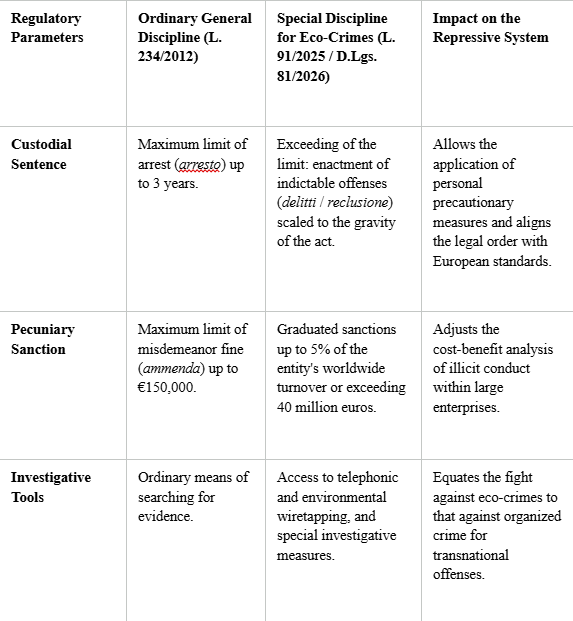
Regarding the sanctioning framework, the reform modifies the system based on fixed quotas, the economic impact of which was often derisory for large industrial conglomerates. In transposition of European constraints, pecuniary sanctions for legal persons are proportioned to the economic capacity of the entity, with a statutory maximum that can reach up to 5% of the total worldwide turnover of the company generated in the business year preceding that of the commission of the offense, or alternatively, fixed amounts exceeding 40 million euros for offenses of greatest severity.
This framework is complemented by the interconnection between punitive goals and demands for remedying the offense, implemented through the mandatory confiscation and asset freezing (sequestro preventivo), including by equivalent, of the price or profit of the crime, as well as corporate assets employed to carry out the prohibited conduct. Judicial restoration orders (ordine giudiziale di ripristino dello stato dei luoghi) also find application, configuring the sanction as an instrument for restoring ecological balance and providing remedial protection.
The principle of autonomy of the entity's liability, codified by Article 8 of Legislative Decree no. 231/2001, remains unaffected. Consequently, the financial and disqualifying liability of the legal person persists even if the physical perpetrator of the offense has not been identified or is not indictable, or if the individual criminal offense is extinguished for a reason other than amnesty, thereby guaranteeing the continuity of sanctioning action regardless of the outcomes of the criminal proceedings against physical persons.
Constitutional and Procedural Profiles: Derogation from Ordinary Statutory Limits and New Investigative Coordination Tools
From the perspective of constitutional law, the architecture of the delegated decree exhibits evident peculiarities compared to ordinary procedures for transposing Union law. Ordinarily, the Government's legislative power regarding the implementation of directives is subject to the general restrictions and sanctioning limits established by Article 32.1, letter d) of Law no. 234/2012, which identifies a maximum statutory threshold equal to three years of arrest and a fine of 150,000 euros for newly introduced offenses.
By virtue of the significance of the constitutional interests implicated by Articles 9 (insofar as it protects the environment, biodiversity, and ecosystems, also in the interest of future generations), 32, and 41 of the Constitution, Article 9 of the European Delegation Law 2024 expressly authorized the delegated legislator to derogate from the aforementioned general limits. This provision enabled the introduction of indictable offenses (delitti) punished in a manner proportional to the gravity of the harm inflicted upon ecosystems. The raising of criminal sanctions also produces immediate procedural ramifications, legitimizing the recourse to personal precautionary measures and the deployment of highly intrusive investigative means, such as wiretapping, electronic interception, and environmental surveillance, which were previously excluded for misdemeanor-type offenses.
In order to rectify the dysfunctions associated with the fragmentation of investigations across the national territory, the reform intervenes in the organizational structure of the public prosecutor's office. The National Coordination System for Combating Environmental Crime is established at the General Prosecutor's Office of the Court of Cassation. This body is tasked with rationalizing information flows, homogenizing investigative criteria among the various district prosecutor's offices, and facilitating international judicial cooperation through Eurojust and Europol, thereby reducing conflicts of jurisdiction and the duplication of investigative efforts in actions against transnational criminal syndicates.
Conclusions and Future Perspectives: Towards the National Strategy for Combating Environmental Crimes (2027)
The adoption of Legislative Decree no. 81/2026 does not exhaust the process of aligning the domestic legal system, serving instead as a prerequisite for the systematic implementation of supranational precepts. The text establishes a procedural deadline: by May 21, 2027, the Government must approve and publish the National Strategy for Combating Environmental Crimes, in compliance with the obligations set forth in Articles 21 and 22 of Directive (EU) 2024/1203. This programmatic act is destined to govern the allocation of financial resources, the development of specialized training programs for magistrates and judicial police bodies, as well as the establishment of a centralized system for the collection and processing of statistical data on environmental offenses.
The actual level of protection afforded to the right to health and environmental wholesomeness will remain contingent upon the enforcement practices of investigative and judicial authorities, which must navigate certain operational complexities.
First, the effectiveness of remedial sanctions will depend on the concrete execution of site restoration orders, overcoming the financial or bureaucratic hurdles that historically slow down their efficacy, leaving the damage to the territory unaltered. Second, the technical complexity of the new eco-crimes, linked to advanced polluting matrices and greenhouse gas markets, requires the development of specialized chemical-biological and economic expertise within the judiciary and judicial police forces. Finally, the real deterrent capacity of the reform will be tested through the application of sanctioning criteria indexed to global corporate turnover, the only mechanism capable of rendering environmental protection an absolute limit for industrial policy decisions.
The concreteness of these legal mechanisms will ultimately determine whether the new criminal provisions translate into effective safeguards for individuals and the territory, or whether they remain theoretical formulations devoid of impact on the dynamics of corporate profit.
Links
Keywords
How to cite this article
Megi Likmeta (2026), "The Transposition into Italy of Directive (EU) 2024/1203 of the European Parliament and of the Council: The New Penal Framework of Legislative Decree No. 81/2026 Against Eco-Crimes within the Context of Human Rights and Health Protection", in Italian Yearbook of Human Rights, ISSN 3035-5435, https://unipd-centrodirittiumani.it/en/topics/the-transposition-into-italy-of-directive-eu-20241203-of-the-european-parliament-and-of-the-council-the-new-penal-framework-of-legislative-decree-no-812026-against-eco-crimes-within-the-context-of-human-rights-and-health-protection (consulted on 15/10/2026).
