


Human Rights Watch published the World Report 2026 on the human rights’ situation around the world
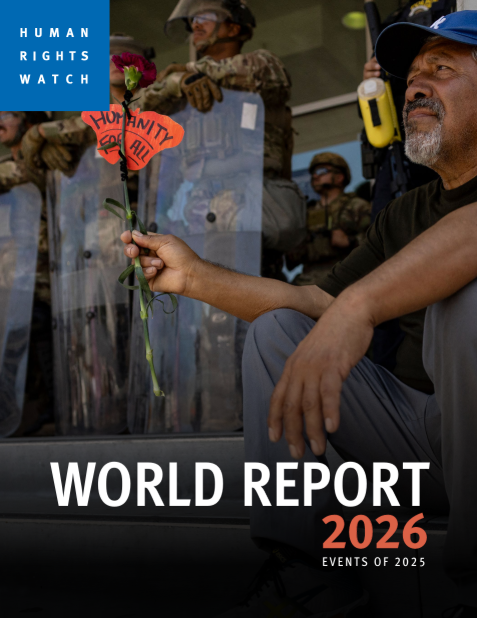
Human Rights Watch, an international non-governmental organization dedicated to protecting human rights, has recently published the World Report 2026, which offers a comprehensive overview of human rights conditions in over 100 countries worldwide in 2025.
The report emphasizes that the global human rights system in 2025 is in a critical situation, primarily threatened by pressures from the Trump administration and opposition to it from powers such as China and Russia. This attack is eroding the international order, jeopardizing the architecture that human rights defenders have relied upon for decades. Indeed, the global context is characterized by a "democratic decline," with a significant percentage of the world's population living under autocratic regimes.
The Trump administration, especially in 2025, has accelerated this process by conducting a broad attack on the fundamental pillars of American democracy and the international order. Its policies have embraced rhetoric aligned with white nationalist ideology, leading to inhumane treatment of immigrants and asylum seekers, excessive use of force by law enforcement, and serious violations of human rights and international law. The military intervention in Venezuela and the detention of President Maduro have further demonstrated disregard for international norms.
Sanctions and withdrawal from numerous international organizations by the United States have further eroded US credibility on the international stage. The impact of these actions on the international system has been profound and has undermined the foundations of multilateral institutions such as the UN and ICC, and the very international order that aimed to promote democracy and human rights globally.
The shift in the US position on human rights has led to an alignment with the illiberal agenda of China and Russia. These three countries, while remaining strategic rivals, are now led by leaders who share an open contempt for norms and institutions that could limit their power, and if they were to act as allies of convenience to erode global rules, they could threaten the entire international system.
In Sudan, the Rapid Support Forces (RSF) are again committing murders and rapes on a large scale, with relative impunity under the Trump administration. In the Occupied Palestinian Territories, Trump has continued the policy of almost unconditional support for Israel, despite accusations of genocide and crimes against humanity. In Ukraine, Trump's peace efforts have consistently minimized Russia's responsibility for serious violations and crimes. This situation represents a significant threat to the global human rights system and international stability.
With the United States undermining the global human rights system, the question arises as to who will stand up in its defense. The European Union, Canada, and Australia seem to be holding back for fear of antagonizing the United States and China. Other countries are weakened by illiberal trends in their domestic politics.
To fill this void, there is an urgent need for a new global alliance to support international human rights within a rules-based order and offer a hopeful counterpoint to the authoritarian narrative. Moreover, it's important to look beyond and include countries that have played important roles in specific human rights initiatives, such as Costa Rica, Ghana, Malaysia, Mexico, Senegal, Sierra Leone, and Vanuatu. This global coalition of rights-respecting democracies would also be a powerful voting bloc at the United Nations, committed to defending the independence and integrity of UN human rights mechanisms.
Effectively mobilizing governments to form such an alliance will not happen without strategic engagement from civil society within those countries that can help raise the priority of a rights-based foreign policy. These governments will need to be convinced that they have both an interest and a responsibility to protect the system. Projects of this type are emerging, such as the "Democracy Forever" summit hosted by Chile in 2025 and the Hague Group, formed in 2025 in "defense of international law".
In 2025, Gen Z protests against corruption, inadequate public services, and poor governance in Nepal, Indonesia, and Morocco brought to the forefront the need for governments to listen to their youth and tackle corruption and inequality. But as the difficulties of restoring rights in Bangladesh after years of authoritarian rule illustrate, gains won through public mobilization can easily be lost unless democratic participation and free expression remain unassailable.
In this hostile climate, civil society is more critical than ever, but also increasingly in danger. Restrictions on civil society and protests have become more common, even in Europe. However, despite difficult times, the idea of freedom and human rights endures. People power and mobilization remain an engine for change, as demonstrated by protests in the United States, South Korea, Nepal, and other countries. As emphasized by Philippe Bolopion, Executive Director: "Stopping the authoritarian wave and defending human rights is a generational challenge" that will require a determined, strategic, and coordinated response from voters, civil society, multilateral institutions, and rights-respecting governments worldwide.