


Reporters Without Borders: Italy regresses in the World Press Freedom Index 2026
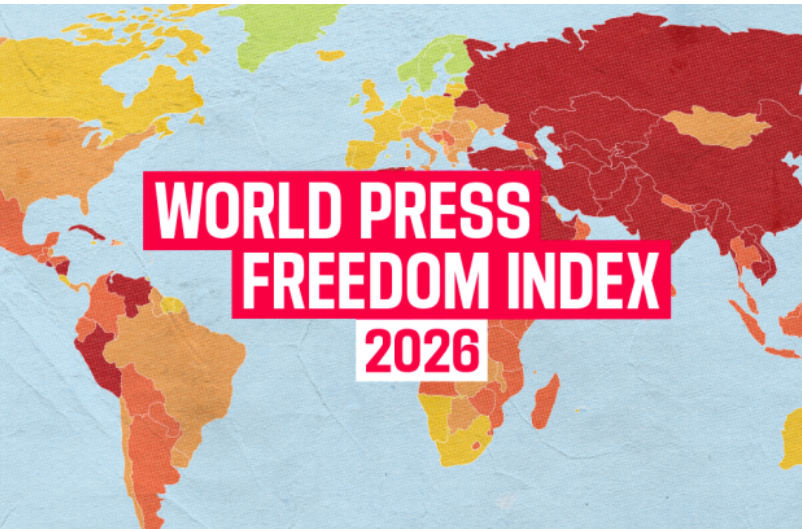
In the 2026 World Press Freedom Index published by Reporters Without Borders, Italy fell from 49th place in the previous year to 56th out of 180 countries, confirming a steady decline within the European landscape of press freedom. This development is part of a global context described by the organization as “the worst in the past 25 years”: for the first time, more than half of the countries surveyed are classified as having a “difficult” or “very serious” situation. While in 2002 approximately 20% of the world’s population lived in countries where the state of press freedom was considered “good”, according to the latest report this figure has now fallen to less than 1% of the global population.
According to Reporters Without Borders, journalists in Italy continue to face obstacles stemming from criminal pressure, intimidation by extremist groups, and the increasing use of judicial instruments with chilling effects on the media. Of particular concern is the growing recourse to so-called SLAPPs (Strategic Lawsuits Against Public Participation), legal actions brought against journalists and media outlets with intimidatory rather than compensatory purposes. These concerns are compounded by regulations regarded as restrictive of access to judicial information. In particular, Reporters Without Borders refers to the so-called “gag law” (L.D. 198/2024), which prohibits journalists from publishing, either in full or in part, pre-trial detention orders until the conclusion of preliminary investigations. Although the measure was formally introduced to safeguard the presumption of innocence, it has been criticized for limiting freedom of the press and reducing transparency in judicial reporting. Strong media ownership concentration and significant political influence within the national media system also persist.
As early as June 2024, Věra Jourová, then Vice-President of the European Commission for Values and Transparency, accused Giorgia Meloni’s government of exerting increasing intimidatory pressure on journalists, including through the growing use of legal actions considered capable of obstructing the work of independent media. On that occasion, concerns were also raised regarding attempts at political interference in the management of RAI, Italy’s public service broadcaster.
RAI has now remained without a fully operational president for almost two years, a situation that has fuelled controversy over institutional deadlock and political influence in the management of the company. The prolonged impasse within the Parliamentary Oversight Commission, responsible for approving the appointment of the Board of Directors, has been interpreted by observers and international organizations as a sign of the difficulties in guaranteeing full autonomy and stability to Italy’s main public broadcasting company. This situation unfolds within a broader context already marked by accusations of political patronage and pressure on editorial independence, as well as allegations of direct interference and attempts to transform public broadcasting into a tool of political propaganda serving the government.
However, Italy’s decline in the ranking does not merely reflect direct violations against journalists, but also the overall quality of the environment in which information is produced and disseminated. Despite the quantity and diversification of media channels and forms of information, Reporters Without Borders highlights the persistence of threats to media pluralism, particularly in the form of acquisition attempts and ownership concentration within the media sector. According to the organization, such dynamics risk reducing the diversity of voices in the public sphere and increasing economic and political influence over editorial offices. Reporters Without Borders further notes that the growing dependence of media outlets on advertising revenues and public funding, combined with declining print newspaper sales and increasing political and ideological polarization within Italian society, contributes to the precariousness of the journalistic sector, undermining its autonomy and dynamism while exposing journalists ever more frequently to verbal and physical attacks.
Within this context, journalists investigating organized crime and corruption continue to face systematic threats and physical violence, including attacks on homes and vehicles, as well as campaigns of media delegitimization. According to Reporters Without Borders, more than twenty journalists in Italy currently live under police protection due to intimidation and attacks connected to their professional activities.
Inserted within a broader global trend of deteriorating press freedom, the Italian case represents a significant indication of the tensions affecting the relationship between information, political power, and the protection of the rule of law in contemporary democracies.