


"The Challenge of Climate Energy Welfare" - In Rome on January 30 and 31, 2026, two days of meetings and work on the climate crisis and social impacts of decarbonization policies
-
 Event date:
January 30 and 31, 2026
Event date:
January 30 and 31, 2026
-
 Venue:
Rome
Venue:
Rome
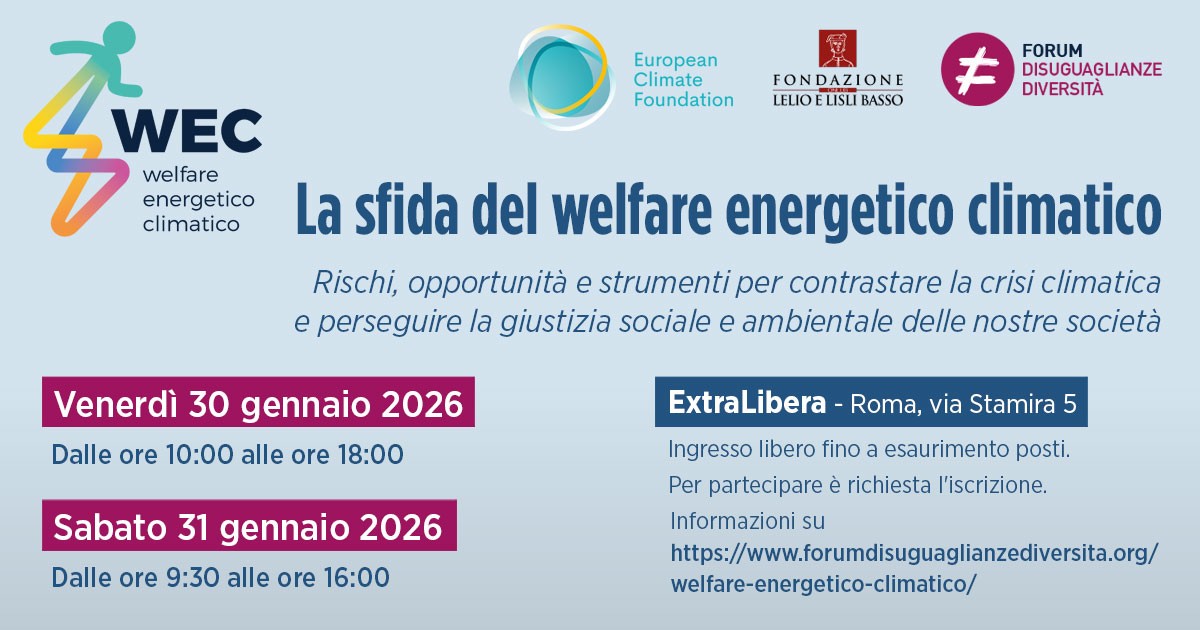
The Forum on Inequalities and Diversity and the Basso Foundation, in collaboration with numerous social and environmental organizations, are promoting a two-day event dedicated to building climate energy welfare. This innovative concept goes beyond simply implementing measures to counter the social impacts of the climate crisis; it represents a completely new approach to welfare and a revolutionary paradigm for understanding and addressing the multiple dimensions of inequality in contemporary society.
The event, entitled "The Challenge of Climate Energy Welfare", will be held on January 30 and 31 in Rome at the ExtraLibera space. This initiative is part of a broader path on climate energy welfare, launched three years ago by the promoting organizations, and sees the participation of a wide front of social, environmental and trade union organizations. These include prominent names such as Caritas, Legambiente, WWF, CGIL, and many others, testifying to the importance and cross-cutting nature of the topic being addressed.
The context in which the event takes place is characterized by growing political inattention to the climate crisis, an increase in favors granted to the powerful fossil fuel sector, and a general slowdown in decarbonization policies. In this scenario, it becomes even more urgent to keep attention high on the social impacts of the climate emergency, which particularly affect the most vulnerable segments of the population.
Climate energy welfare is based on the fundamental premise that placing the social impacts of the climate crisis and decarbonization policies at the center of attention is an essential condition for effectively countering the climate crisis itself, while at the same time avoiding creating new social fractures and fragilities. This approach recognizes that the climate crisis not only calls into question the traditional welfare system, but also offers a historic opportunity to reduce inequalities and strengthen social and environmental justice.
In the European context, while the effects of the climate crisis are manifesting with increasing intensity, the European Union is progressively weakening the framework of the Green Deal through processes of simplification and deregulation. These processes tend to favor economic competitiveness at the expense of a just ecological transition. Europe's marginality demonstrated at COP30 in Belém and the postponement of the entry into force of the new emissions taxation (ETS2) are worrying signs of this trend. There is a concrete risk that even at the national level, the commitments made could slip or even be abandoned.
The program of the event is structured to address these crucial issues through a series of meetings and seminars. The morning of January 30 will be dedicated to the energy efficiency of buildings, analyzing risks and opportunities both as a lever for decarbonization and as an opportunity to develop housing policies that counter poverty and energy vulnerability. This theme is particularly relevant considering that energy poverty has become a new source of inequality in contemporary society.
In the afternoon of the same day, two parallel seminars will be held. The first will focus on "Indicators of energy vulnerability and mobility", seeking to identify the contexts and territories where the climate crisis and decarbonization policies generate greater social and environmental vulnerabilities. The objective is to develop a multidimensional reading that takes into account social contexts, places and the people who inhabit them. The second seminar, entitled "Social Impacts of Decarbonization Policies", will start from the premise that the decarbonization of the production and consumption system is an inescapable choice, but one that must be accompanied by strong attention to social impacts.
The day of January 31 will instead be dedicated to paths of change in the territories. This moment of confrontation between realities active at the local level that have already worked, or intend to do so, to build experiences of climate energy welfare, will be fundamental to develop concrete methodologies, tools for the analysis of priority needs and operational proposals to be presented to local authorities.
The event "The Challenge of Climate Energy Welfare" therefore presents itself as a crucial moment of reflection and action to address the interconnected challenges of the climate crisis and social inequalities. Through a multidisciplinary and collaborative approach, the initiative aims to develop innovative strategies that can effectively combine the fight against the climate crisis with the promotion of social justice.
The participation of a wide spectrum of organizations and the variety of topics covered underline the importance of a holistic approach to these complex issues. The event not only offers an opportunity for theoretical study, but also aims to provide practical tools and operational indications for the implementation of climate energy welfare policies at the local and national levels.
In conclusion, this initiative represents an important step towards the creation of a new welfare paradigm that is able to effectively respond to the environmental and social challenges of our time. Its relevance is amplified by the current context of climate and social crisis, making this event a fundamental reference point for all those engaged in the fight against inequalities and for a sustainable future.