


A global coalition of researchers and social movements denounces extractivist energy corporations abuses: the case of ENI and Italy
Table of Contents
- Introduction
- ENI’s colonial roots
- The Mattei Plan for Africa
- Eni’s operations in Nigeria
- Eni’s operations is Mozambique
- Eni’s operations in Palestine
- Conclusion
Introduction
The toolkit “Disrupting energy corporations for the liberation of Palestine” was published in June 2025. It was written by a global coalition of researchers and civil society movements, Disrupt Power, Global Energy Embargo for Palestine and the BDS National Committee, to provide grassroot movements with narrative framing, detailed research and tactical inspiration.
The toolkit focuses on “exposing their colonial roots, environmental destruction, and ongoing struggles against their operations in countries across the world” of two petrol companies: Dana Petroleum S.p.A and Eni S.p.A. Due to the scope of the Yearbook we will focus on the latter.
ENI’s colonial roots
The toolkit underlines how ENI, currently ranking among the seven largest western oil firms globally, owns and operates gas reserves, pipelines, terminals, refineries and petrol stations over 61 countries. It also stressed that it was founded by the Italian State in 1953, descending directly from Agip, a state-owned company established during fascism in 1926 with the primary purpose of foreign extraction, which was rooted in Italian colonialism.
The Italian State holds “de facto control” of Eni S.p.A: possessing a combined stake-holding of 33.1 per cent, split among the Ministry of Economy and Finance (approximately 2.17 per cent) and the Cassa Depositi e Prestiti (approximately 30.92 per cent), it is the “single largest and most influential shareholder”.
According to Italy’s Court of Auditors, the Italian Ministry it holds enough votes to exert a dominant influence within the Company’s Annual General Meeting.
As a consequence, the toolkit maintains that Eni’s interests “are closely connected to Italian domestic, foreign and military policy”, underlying that Italy reportedly devoted “significant military resources to securing Eni’s foreign assets and access, under the pretexts of energy security, migration control, and regional stability”. Overall, Agip and Eni have been both an instrument and a “beneficiary of Italian foreign policy, leveraging the state to access resource markets and secure energy supplies”.
The document underlines that ENI has historically portrayed itself “as a non-conventional Western ally”, framing its partnerships as “equitable”. It followed Italy’s traditional self-portrayal as a good coloniser, thus concealing “Eni and Italy’s underlying extractivist aims”. It expressly used an “anti-colonial rhetoric”, exploiting the decolonization momentum (read more about it here and here). The toolkit argues that ENI gained power in regions previously colonised by other European countries, profiting from Italy’s reputation as a relatively “less imperialistic actor”, while parallely building ties with oil elites and political leaders in OPEC states who also wanted to resist the Seven Sisters’ hegemony. Consequently, Eni could act both as an “opportunistic ally to decolonising states” and “as a quasi-state actor”, providing Italy with an unequaled diplomatic and economic position.
The “Mattei plan for Africa”
The toolkit argues that the Mattei Plan, launched by the Italian Government in January 2024, and portrayed as “an investment plan for Africa” is not “far from neo-colonial dynamic”. It stressed the fact that, when the president Meloni addressed the press during her tour of African countries, she was accompanied by Eni’s Chief Executive.
The President mentioned it in her speech at the UN in September 2025 and she affirmed that: “unlike other players, we do not have ulterior motives in Africa; we are not interested in exploiting the African continent for its rich raw materials. Instead, we want Africa to prosper by processing its own resources, providing jobs and opportunities for its most talented people, and being able to rely on stable governments and on dynamic and secure societies [...]”.
ENI’s operations in Nigeria
The toolkit notes that Nigeria is a major player in the global oil market, extracting and exporting around 1.5 million barrels of oil daily from the Delta area, predominantly to Europe, North America, Asian and Israel, whose oil supply comes approximately by 9% from Nigeria.
In the sixties, following the “Grande disegno africano” project (1955), ENI became a “leading force in the oil markets of twenty-five newly independent countries across North and West Africa”, including in the Niger Delta. There ENI plays a major role, through its subsidiary, the Nigerian Agip Oil Company Ltd, which began onshore and offshore extraction in 1962. It participates in 17 onshore blocks and produces 11 million barrels of oil a year.
Eni affirms to be exiting the Niger Delta, selling their land-based operations. However, the toolkit maintains that it is just shifting the focus to offshore ones, while continuing to profit from Nigerian resources “while leaving unresolved ecological and social crises for the communities they have impacted”. It also stresses the latter's resistance to the exploitation of their land and “struggles for justice, dignity, and environmental repair continue despite overwhelming challenges”.
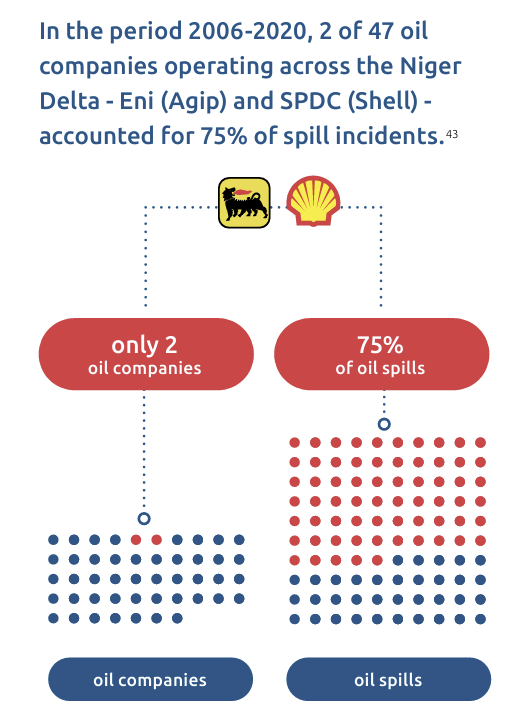
In this regard, the Bayelsa State Oil and Environmental Commission report “An environmental genocide - The human and environmental cost of Big Oil in Bayelsa, Nigeria” (2023) attributes to Shell and ENI “75% of all oil spillages in the Niger Delta between 2006 and 2020” resulting in “one of the worst cases of oil pollution”. In other words, despite operating less than a fourth of the total Nigerian oil output, they are responsible for three-quarters of the spillages.
Here we focus on Eni, but the report mentions several other companies (e.g. Shell). The Commission claims that oil companies implement systemic neglect, evidenced by consistent failure to clean spill sites and record-high spillages, caused by a lack of investment in asset maintenance and surveillance and not "accidents" as often claimed by the companies.
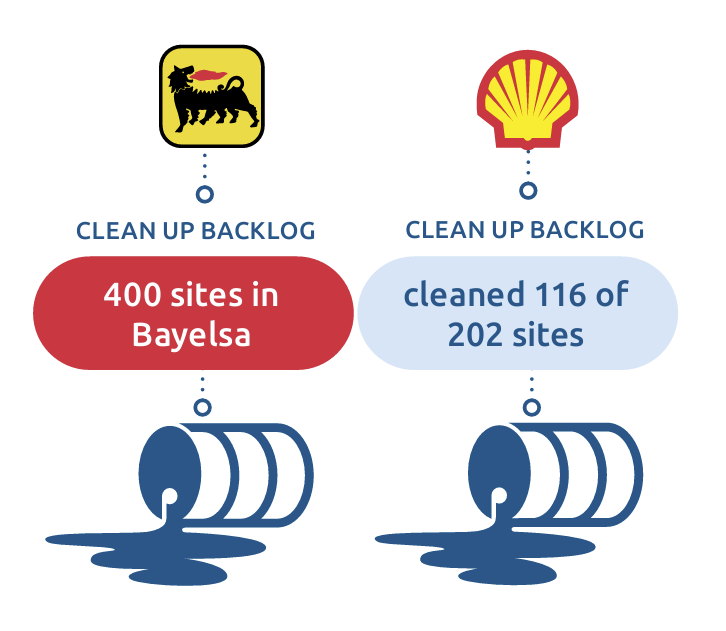
In particular, the report underlines that ENI, only for the 92 km of the Tebidaba-Brass pipeline, faced 262 spills reports between 2014 and 2017, leading Amnesty International to label it “Africa’s leakiest pipeline”. Furthermore, to respond to the leaks it took once up to 430 days, following a pattern of “strategic lethargy” and leaving the majority of the spills unaddressed. It has a clean-up backlog of more than 400 sites in Bayelsa alone. It also contested the company’s defensive argument of frequent “sabotage”.
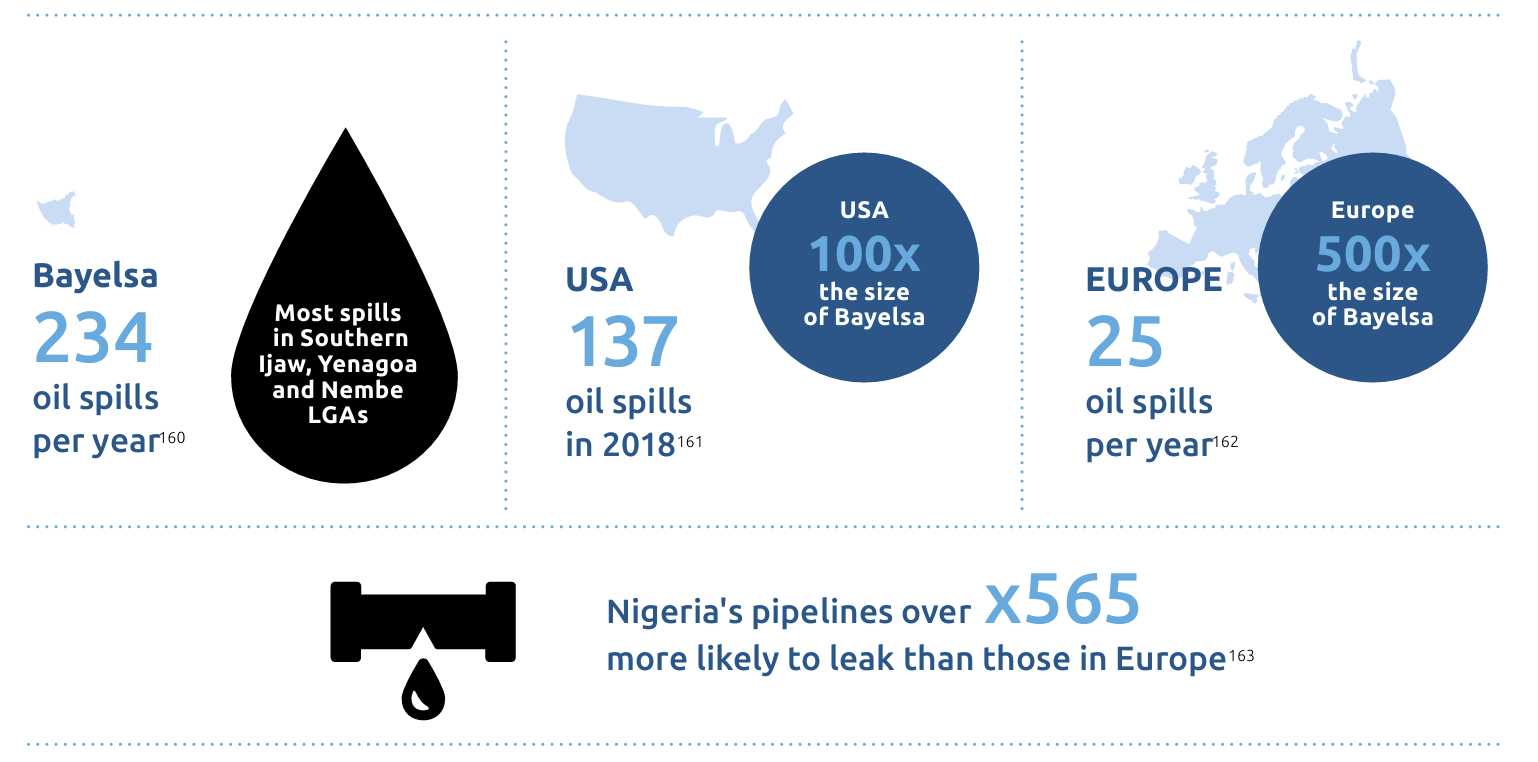
The Commission reports that Nigeria’s pipelines are 565 times more likely to leak per 1,000km than those in the European Union, especially in the State of Bayelsa where, on average, 1.5 barrels of oil have been spilled for every man, woman, and child. This resulted in what the members of the commission label “a silent health crisis” with groundwater Total Petroleum Hydrocarbons exceeding safe limits “by a factor of 1 million”, highly carcinogenic heavy metal 1000 times over WHO limits, an increase of neonatal deaths by 16000 in 2012 and an average life expectancy of just 50 years. Moreover, the largest mangrove forest on earth lost 40% of its cover.
The Commission contends oil companies have primary responsibility for the systemic oil pollution catastrophe, which has been underpinned by a fundamental institutional neglect. It stresses that also the Federal Government has repeatedly ignored the interests of those living in affected communities, while the International Oil and Gas Companies behave in ways they would never contemplate in their home jurisdictions, as if “Nigerian lives and the lives of people throughout Bayelsa” did not matter. Therefore it concludes that, intentional or not, the conduct of the oil producers amounted not just to “gross negligence” but to “environmental racism”.
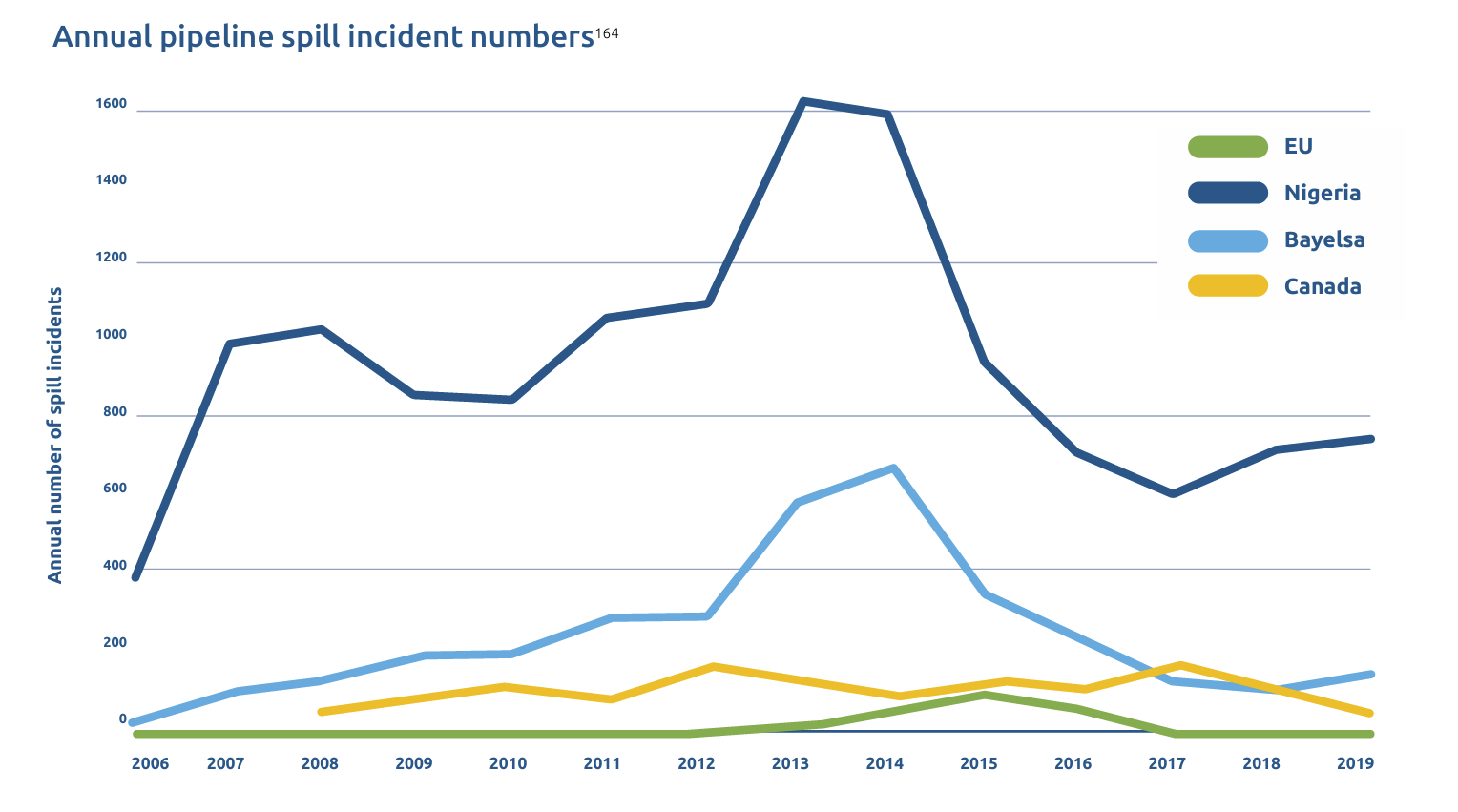
The Commission called upon home jurisdictions (Italy and the EU for ENI) to enforce minimum environmental and due diligence standards on their subsidiaries, in line with international laws against bribery and modern slavery and to respect the principles based on which the polluter pays and that of no fault liability, at the heart of environmental legislation. According to the latter, producers should fully internalise all environmental externalities, including clean-up and compensation regardless of whether there was third party interference or not (see Art.45 EU Directive 2024/1760). It stressed that accountability is essential for the survival of the people of the Oil rivers.
The authors of the toolkit, consider this case as emblematic of the “prioritisation of profit over environmental preservation and human life”, viewing it as part of the global inequality and injustice that is paired with extractivism.
ENI’s operations in Mozambique
The toolkit signals that Italy considers Mozambique “strategic” and an “opportunity” for its industries. It reports that Eni has been operating in Mozambique since 2006, where it discovered gas resources in the Rovuma Basin (Cabo Delgado) and it runs the only operational plant in the region: Coral South Floating LNG Project. It also leads the proposed Coral North FLNG, 10 km away, about which UN experts have voiced grave concerns, stating that it risks “exacerbating human rights harms, contributing to climate change, and diverting scarce public funds away from urgently needed investments in sustainable renewable energy” as well as having “harmful environmental and climate consequences”.
The toolkit criticises the fact that, despite only 33% of Mozambicans having regular access to electricity, none of the gas extracted by Eni’s Coral South FLNG is used domestically, but rather mainly sold to Asian markets. Furthermore, it emphasizes that where gas projects are most advanced, in the Cabo Delgado region, extractive projects “have not improved living conditions for the people affected, adding to the poverty, unemployment, and exclusion of communities”.
In the last years, after an insurgency for the development of extractive industries, thousands of people have been killed and up to one million displaced. There has also been heavy militarisation, particularly since 2021 surrounding the gas projects and creating “islands of security” around LNG projects, but did not improve security over the region. While TotalEnergies suspended its operations declaring “force majeure”, Eni continued its exportation from the Coral North FLNG project. The toolkit condemns how they have been profiting off extraction amongst extreme violence in this context and in Palestine today, as in the past during the Biafra War (1967-1970) in Nigeria.
It is essential to note some additional concerns that have been raised within the toolkit.
Firstly, the problem of tax avoidance by big corporations in this context: Mozambique risks losing between US$717 million and US$1.48 billion for tax avoidance on LNG’s financing and US$568 million on Coral South FLNG’s debt financing. Indeed, given the UAE-Mozambique tax treaty that exempts withholding tax payments on interest transactions, special purpose entities based in the United Arab Emirates handle most of the loans provided to Coral South FLNG and Mozambique LNG.
Secondly, ENI excluded from the proposed Coral North FLNG’s contract two clauses that could hamper both national and local interests: the possibility of paying the production tax in kind and a requirement to use local content. These raised concerns about the effective benefits Mozambique will gain from the exploitation of its own natural resources, in civil society and at the UN.
Thirdly, an independent analysis claims that the revenues from Mozambique LNG and Coral South FLNG” in 2021 would amount only to 40% of government projections. Furthermore, the majority would “reach Mozambique only after 2040 due to front-loaded contracts, favouring the companies.
Lastly the important issue of monitoring environmental damage was raised. Northern Mozambique Channel represents important “Indian Ocean biodiversity, especially coral reef”. However, the toolkit highlights the lack of sufficient research on the Rovuma Basin to understand the potential impact of gas exploration on marine biodiversity and ecosystems. In addition, due to the state’s little capacity to monitor compliance with environmental and social standards, leaving the “responsibility for upholding international and national standards” “in the hands of the gas companies and their financiers”.
ENI’s operations in Palestine
The toolkit devotes a large part to expose ENI’s involvement with Israel’s settler colonial project in Palestine. More details about the licences that ENI had illegally acquired in Palestine Exclusive Economic Zone off the Coast of Gaza in October 2023 and its illegal provision of crude oil for military use to Israel can be found here.
The toolkit denounces that it is impossible to “separate gas supply chains from the extensive complicity and military cooperation of neighbouring states in this ongoing genocide”.
In particular, it highlighted that the United States and Europe contributed to the normalisation of the settler colonial occupation of Palestine and profited from Israel’s gas export. The toolkit affirms that they did so by promoting various energy-centric normalisation deals in the region, which created an economic and political incentive for states to maintain Israel’s energy sector.
Furthermore it stresses that, in the case of ENI, given that shares represent an ownership stake across all of Eni’s multinational operations, being issued at the top company level, a shareholder cannot divest discretionarily from illegal operations in Palestinian waters.
The toolkit notes other two facts. Firstly, that in 2024, Eni signed a £754 million combination deal with Ithaca Energy, an Israeli-owned, British based oil and gas company, whose profits will flow to its parent company: Israeli Delek Group, one of the major fuel suppliers to the Israeli military, “blacklisted” by the UN due to its illegal operations in Palestine.
Secondly, that during Meloni and Netanyahu's meeting in March 2023, Netanyahu had explicitly mentioned Eni’s participation in Israeli “gas projects”.
Conclusion
In conclusion, the toolkit emphasizes how ENI’s partnership with universities serve “to greenwash its operations” and it stresses the need for transnational solidarity networks committed to hold these energy corporations accountable and make their criminal activities, driven by neocolonial extractivist aims, stop.
Links
Keywords
How to cite this article
Teresa Cucca (2026), "A global coalition of researchers and social movements denounces extractivist energy corporations abuses: the case of ENI and Italy", in Italian Yearbook of Human Rights, ISSN 3035-5435, https://unipd-centrodirittiumani.it/en/topics/a-global-coalition-of-researchers-and-social-movements-denounces-extractivist-energy-corporations-abuses-the-case-of-eni-and-italy (consulted on 14/10/2026).
