


"Gaza Genocide: a collective crime" - Italy's involvement highlighted by Francesca Albanese's new report and the Italian authorities’ reactions
Francesca Albanese, the Special Rapporteur on the situation of human rights in the Palestinian territories occupied since 1967, has been a pivotal figure in advocating for justice for Palestinian populations, who have lived for years under Israeli occupation.
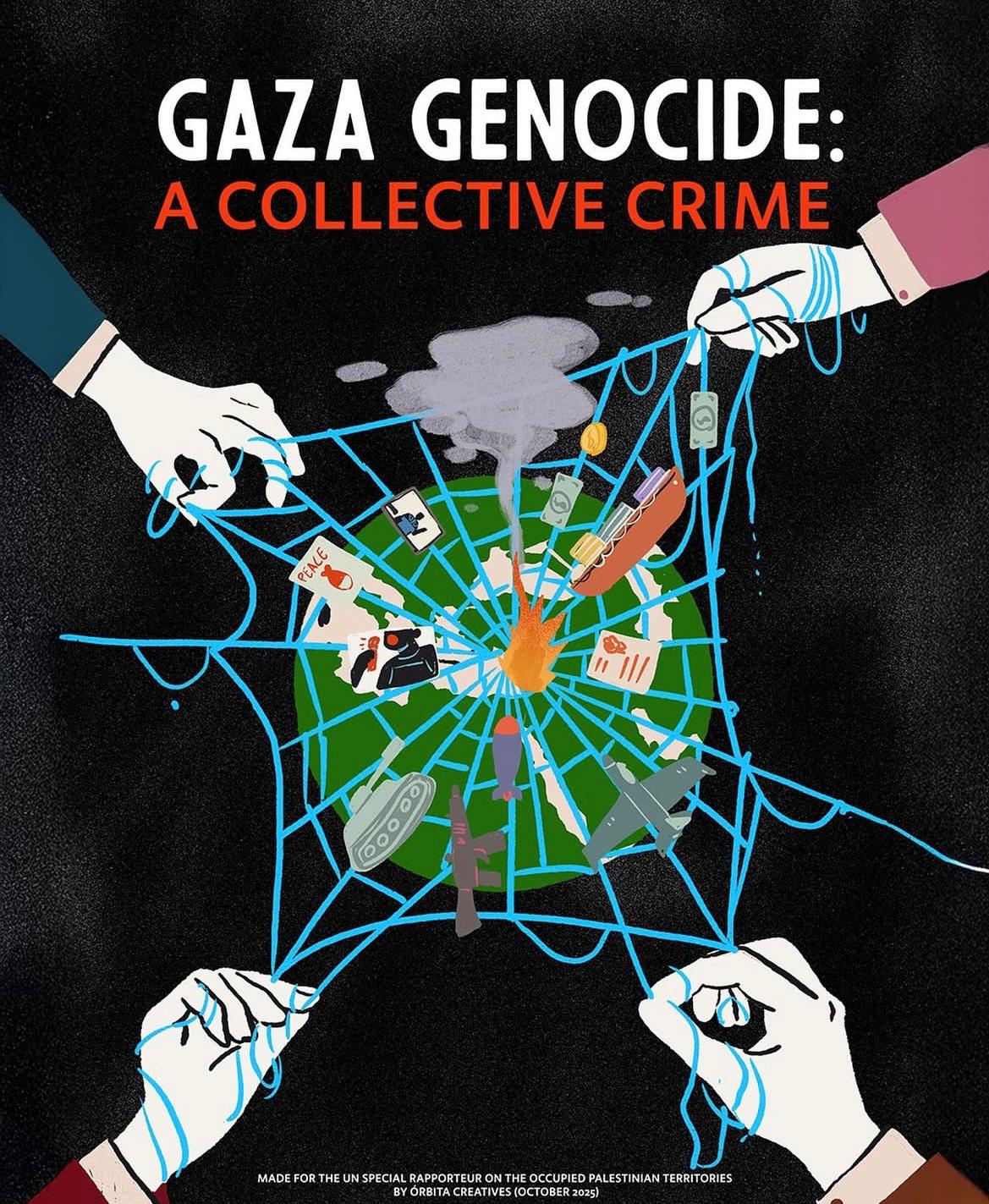
On 20 October 2025, the United Nations Office of the High Commissioner for Human Rights published a country report titled Gaza Genocide: A Collective Crime, delivered by Albanese to the General Assembly at its 80th Session, calling for the immediate prevention of human rights violations and the restoration of international law.
Her report highlights how Third states have been complicit in the mass atrocities in Gaza and have enabled the longstanding, systematic violation of international law by Israel through direct involvement, material aid, and diplomatic protection, among other forms of support.
She contends that the mass atrocities in Gaza are not solely the responsibility of Israel. Instead, she argues that, under international criminal law, particularly the doctrine of joint criminal enterprise, any state that performs a wrongful act or contributes to a constituent element of the crime bears responsibility. She openly criticises Western states’ involvement in violations of international law across several categories: military, diplomatic, and economic support.
The United States, Germany, and Italy are among the largest suppliers of military aid to Israel. For instance, the United States has provided financial support to Israel since its establishment and continues to do so. After October 7, 2023, both the Biden and Trump administrations have contributed financially to framing Israel’s actions as self-defence against alleged terrorist threats in Gaza. Furthermore, Germany has been the second-largest arms exporter to Israel during the mass atrocities and alleged genocide, justifying its support as a post-Holocaust obligation. Other Western countries, such as the United Kingdom, Australia, and Canada, have also been major contributors to military aid.
Additionally, many Western countries openly overlook Israel’s violations of fundamental human rights under the pretext of national security and counterterrorism, rather than pursuing accountability through legal mechanisms. During the same period, Israel enjoyed substantial diplomatic support from Western powers. For example, the United States used its veto power in the UN Security Council seven times and played a central role in controlling ceasefire negotiations. When the ICJ and ICC acknowledged the possibility of a genocide in Gaza, the United States sanctioned the courts, effectively granting immunity to Israeli authorities by restricting legal accountability. The United Kingdom threatened to withdraw funding from these courts, and Hungary withdrew from the Rome Statute in April 2025.
Furthermore, Albanese condemns Western powers for applying double standards in their economic relations with Israel. The European Union is Israel’s largest trading partner, and despite the ongoing genocidal actions, economic investment has increased. Albanese calls for the suspension of economic relations with Israel, similar to the measures imposed on Russia following its invasion of Ukraine.
Nevertheless, she also emphasises that several countries, such as South Africa, Turkey, Chile, Jordan, Bolivia, Honduras, Bahrain, and Chad, have terminated their relations with Israel and other countries, such as Belize, Bolivia, Colombia, and Nicaragua, have suspended their diplomatic relations with Israel.
Francesca Albanese has been sanctioned by the United States formally as “directly engaged with the International Criminal Court (ICC) in efforts to investigate, arrest, detain, or prosecute nationals of the United States or Israel, without the consent of those two countries” (see the US Department of State communiqué here). The Coordination Committee of the Special Procedures of the Human Rights Council has expressed its solidarity with Ms Albanese. In general, sanctioning a Special Rapporteur for fulfilling the responsibility of protecting human rights, as mandated by the Human Rights Council, constitutes a direct attack on the integrity of the UN human rights system, as well as on its accountability and transparency. Moreover, the sanctions imposed by the United States violate international law, including the 1946 Convention on the Privileges and Immunities of the United Nations, which grants appointed experts privileges and immunities to enable them to exercise their functions independently. Violating this Convention threatens the independence of the Special Procedures system, which is responsible for advocating for and investigating human rights violations.
Italy did not remain silent in the case concerning Albanese. The Italian authorities formally criticised Albanese’s conduct, characterising the report as lacking credibility and impartiality. Italy argued that the report clearly exceeds the scope of the Special Rapporteur’s mandate, which does not extend to investigating alleged violations committed by other States or organisations, nor to evaluating cooperation between third countries and the International Criminal Court. Moreover, Italy underscored the importance of adherence to the Code of Conduct for Special Rapporteurs, stressing the obligation to ensure that personal political views do not influence the execution of the mandate and to exercise restraint, moderation, and prudence so as to preserve the perception of the mandate’s independence and integrity.
Nevertheless, Ms Albanese’s contributions to investigating human rights violations in Gaza have not been met only with sanctions and criticisms. European Parliament lawmakers have also nominated her, through a formal submission to the Norwegian Nobel Committee, for the 2026 Nobel Peace Prize. According to them, this nomination represents recognition of the courage, commitment, and perseverance of an individual who has defended fundamental human rights values under extremely challenging circumstances.
Links
Keywords
How to cite this article
Danagul Alimova (2025), ""Gaza Genocide: a collective crime" - Italy's involvement highlighted by Francesca Albanese's new report and the Italian authorities’ reactions", in Italian Yearbook of Human Rights, ISSN 3035-5435, https://unipd-centrodirittiumani.it/en/topics/gaza-genocide-a-collective-crime-italys-involvement-highlighted-by-francesca-albaneses-new-report-and-the-italian-authorities-reactions (consulted on 20/10/2026).
