


Italian National Institute of Statistics (ISTAT): report on violence against women from childhood to adulthood in Italy

Table of Contents
- Introduction
- Violence experienced before age 16 among different citizenships
- Where does it all begin?
- Who are the perpetrators?
- Undisclosed violence
- Conclusion
Introduction
On 16 September 2026, the Italian National Institute of Statistics (ISTAT), jointly with the Department for Equal Opportunities of the Presidency of the Council of Ministers, published a report on violence against women aged 16 to 75. The report covered 17,500 Italian women and about 3,100 foreign women and is, in effect, the third Survey on Women’s Safety.
The Survey, which falls within the agreement between ISTAT and the Department for Equal Opportunities, signed in 2017 and extended until 2026, measured violence before age 16 using a methodology harmonised with the European gender-based violence survey conducted by Eurostat between 2021 and 2024, subsequently published in the report “Childhood violence and its lifelong impact” in 2026.
The new research took place between March 2025 and January 2026, while the previous editions of the survey were conducted in 2006 and 2014 respectively. Compared with the previous 2014 survey, the 2025 survey also investigated physical violence experienced at the hands of any perpetrator and some forms of psychological violence, such as humiliation by parents. Because the 2014 survey covered women aged 16 to 70, a comparison of sexual violence experienced before age 16 is possible only for that age group: among these women, the share fell from 10.6% in 2014 to 7.8% in 2025.
The research shows that 14.9% of women aged 16 to 75 experienced at least one act of physical or sexual violence before the age of 16. The study also confirms the findings of previous editions of the survey regarding the existence of processes of intergenerational transmission of violence, highlighting the close link between physical and sexual violence experienced in childhood and violence experienced in adulthood.
Violence experienced before age 16 among different citizenships
According to the survey, 15.3% of Italian women, 11.4% of foreign women and, overall, 14.9% of women aged 16 to 75 experienced at least one act of physical or sexual violence before the age of 16.
A similar share of Italian and foreign women were affected by physical violence (9.2% and 9.6%), mostly in the form of pushing, shoving or slapping (8.1% and 9.3%). The most severe forms of violence, such as being hit violently, kicked, beaten with objects, burned or injured with a weapon, affected 3.1% of Italian women and 3.3% of foreign women.
Unlike physical violence, sexual violence is more widespread among Italian women, who were victims in 8.2% of cases compared with 3.4% of foreign women. The gap stems from the data on unwanted touching of intimate parts, reported by 7.2% of Italian women and 2.8% of foreign women, while the other forms of sexual violence, such as being forced to touch another person’s intimate parts (2.1% and 1.8%) or being forced to have sexual intercourse before age 16 (equally 0.8%), affect a similar share of women.
Other forms of sexual violence, including being forced to pose naked or to send photos or videos of intimate parts, seem to affect a more limited share of respondents: the phenomenon concerns 0.3% of Italian women (0.5% of women aged 16 to 24), while it is almost non-existent among foreign women.
Considering the data on sexual violence reported by Italian women in the same age group, victims in the northern part of the country, particularly in the North-East, show the highest reporting rate (10.4%). This rate progressively decreases in the southern regions, falling to 5.7% in the Islands. The same decline is observed in the share of unwanted touching of intimate parts, which is 8.8% in the North-East and drops to 5.0% in the Islands.
The European survey on violence against women, conducted between 2021 and 2024, provides extensive data on sexual violence experienced before age 16. It shows an average prevalence of 7% among European women aged 18 to 74, while countries such as Sweden, Luxembourg, Finland, Denmark, the Netherlands and France tend to exceed 10%.
Among women with foreign citizenship, those aged 35 to 44 report the highest rate of sexual violence (4.9%), followed by the youngest (4.3%). Sexual violence before age 16 was experienced most often by refugees (6.9%), while by citizenship the figures are Romanian (4.6%), Ukrainian (4.1%), Filipino (3.1%), Albanian (3.0%), Chinese (2.7%) and Moroccan women (0.2%).
In light of the very low number of reports from Moroccan women and the above-average data from the countries mentioned, a phenomenon also known as the Nordic paradox, it is essential to analyse the data with caution, because the absence of disclosure does not necessarily mean the absence of violence, but rather the persistence of communication problems linked to social stigma.
The level of education is another substantial factor to consider, together with the sociocultural context and the obstacles women may face in answering questions on this subject. The level of education is in fact decisive for reporting. A post-secondary qualification gives women more tools to recognise and disclose the violence they experienced, among both Italian and foreign women. The above-average reporting rate, regardless of age, for women with a post-secondary qualification is 10.3% among Italian women and 5.3% among foreign women, while for women with no qualification or only primary education it falls to 4.4% and 1.2% respectively.
Where does it all begin?
The research report illustrates how women who as children experienced humiliation and belittling, or witnessed violence in the family, are more likely to be victimised again in the future, in line with the available literature on child maltreatment and revictimisation.
For many women, violence begins in the family. Parents occupy a prominent place among the perpetrators of violence experienced before age 16: they are named by 3.9% of Italian women and 4.3% of foreign women, most often the father or stepfather. The most severe forms of physical violence, such as being hit violently, kicked, beaten with objects, burned or injured with a weapon, are attributed mainly to parents.
In the report, humiliation and belittling by the father and mother are also considered indicators of psychological violence. 4.3% of Italian women and 4.6% of foreign women report having always or often been humiliated or belittled by at least one parent before age 16; the figures rise to 12.8% and 14.6% when episodes occurring sometimes are also included. Foreign women, unlike Italian women, more often report humiliation by their father.
Psychological violence frequently escalates into physical and/or sexual violence: 38.1% of Italian women and 45.9% of foreign women who report humiliation or belittling also state that they experienced physical and/or sexual violence by their parents, compared with 2.4% (2.3% among foreign women) of those who did not experience psychological violence.
Furthermore, witnessing violence in the family is both a risk factor and a form of violence in its own right, as recognised by the Istanbul Convention and Directive (EU) 2024/1385. 6.6% of Italian women and 5.1% of foreign women witnessed humiliation or physical violence between their parents. The father is the more frequent perpetrator, both of humiliation (5.6% against 2.6% for the mother) and of physical violence (2.0% against 0.4%). The association with directly experienced violence is marked: among women who did not witness violence between their parents, only 1.1% of Italian women and 0.9% of foreign women report physical or sexual violence by their parents. The share reaches 25.5% among Italian women when there was humiliation between the parents and 34.8% when there was physical violence.
This cycle of violence can extend into adulthood, increasing women’s vulnerability in the sense of exposing them to further abuse, and also involving the next generation: the findings of the ISTAT–DPO research show that children who witness or experience violence may develop anxiety, sleep disturbances, behavioural difficulties and problems at school, confirming that violence within the family can have consequences that go far beyond the immediate victim.
Who are the perpetrators?
The data from the analysis of perpetrators show that they are almost exclusively men and that, for 13.5% of Italian women and 11.2% of foreign women, the victims knew them. Male figures belonging to the victim’s family and social network play the predominant role as perpetrators in reports of sexual violence, while violence by strangers is reported by 2.1% of Italian women and 0.6% of foreign women respectively.
Perpetrators known to the victims are behind more repeated and more severe violence. Italian women victimised by their father or stepfather report that the incidents occurred sometimes (35.5%), often (23.2%) and always (2.7%). The opposite picture emerges among women victimised by strangers, 82.2% of whom, and among those naming an acquaintance, 67% of whom, describe the incidents as rare or isolated.
For Italian women, male acquaintances account for the largest share of perpetrators of the different forms of sexual violence, such as being touched on intimate parts (23.7%), being forced to touch another person’s intimate parts (29.2%) and being forced to have sexual intercourse (29.1%). For foreign women too, the analysis of perpetrators shows that this violence is committed mainly by people known to the victim, as is the case with violence experienced by women after age 16.
Among known perpetrators, parents play a significant role: they are named by 3.9% of Italian women and 4.3% of foreign women, particularly the father or stepfather (2.7% and 3.7%). Other relatives, friends, casual acquaintances and other figures, such as teachers, healthcare staff or religious figures, follow at lower rates.
Undisclosed violence
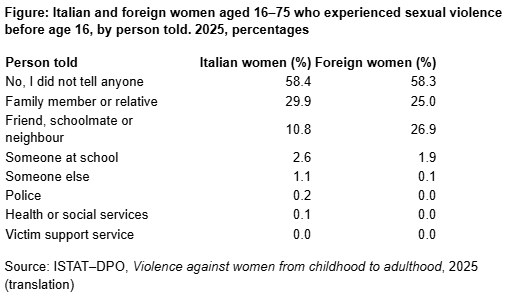
For sexual violence, the survey included questions about whether the woman told anyone and how serious she considered the violence. The study shows that silence about what happened is the most common response among both Italian and foreign women: 58.4% and 58.3% respectively of those who experienced sexual violence before age 16 state that they did not tell anyone. Among those who did talk to someone about the violence they experienced, Italian women more often turned to family members or relatives (29.9%) and less often to friends, schoolmates or neighbours (10.8%); foreign women, on the other hand, turned to family in 25.0% of cases and to friends, schoolmates or neighbours in 26.9%.
Turning to institutions – school personnel, police, health or social services, or victim support services – was extremely rare, as the table below shows.
These percentages raise important questions about the reasons behind undisclosed or unreported violence. The decision to remain silent is shaped by overlapping psychological, social and institutional barriers. Shame, guilt and self-blame can make children feel responsible for the abuse, while fear of not being believed, family conflict or retaliation may make disclosure seem dangerous. A systematic review by Lemaigre, Taylor and Gittoes (2017) identifies these and other barriers to disclosing childhood sexual abuse. The prospect of secondary victimisation can further discourage survivors: insensitive questioning or the public disclosure of intimate details can aggravate the original trauma. For example, in a decision of 27 February 2025, the Italian Data Protection Authority (Garante per la protezione dei dati personali) criticised media coverage that exposed a person who had reported sexual violence to the risk of identification and disseminated unnecessary and highly sensitive personal details. Recognition is a further barrier: survivors may lack the language or reference points to understand what happened as abuse. Research by Peterson and Muehlenhard (2011) also shows that people do not always label non-consensual experiences as sexual assault or rape, particularly when those experiences conflict with social expectations of what violence looks like.
Conclusion
The 2025 ISTAT–DPO survey confirms that violence against women from childhood to adulthood must be understood as an issue that runs across the entire life course, often rooted in childhood and family environments. Nearly 15% of women aged 16 to 75 experienced physical or sexual violence before age 16, with parents and other people known to them accounting for a substantial share of perpetrators. The association between early exposure to violence and victimisation in adulthood is particularly marked and reinforces the need for prevention and support measures that take the whole family context into account.
Equally concerning is the silence surrounding childhood sexual violence, which underlines the importance of accessible, trauma-informed support, education about consent and abuse, and institutional responses that protect survivors’ dignity and privacy.
Finally, differences between population groups and between survey editions must be interpreted with caution, recognising that the measured prevalence reflects not only experiences of violence but also the conditions that enable women to recognise and disclose them.
Keywords
How to cite this article
Sara Comba, Melika Mohammadnejad (2026), "Italian National Institute of Statistics (ISTAT): report on violence against women from childhood to adulthood in Italy", in Italian Yearbook of Human Rights, ISSN 3035-5435, https://unipd-centrodirittiumani.it/en/topics/italian-national-institute-of-statistics-istat-report-on-violence-against-women-from-childhood-to-adulthood-in-italy (consulted on 24/11/2026).
