


Slow Looking at the Civic Museums of Padua
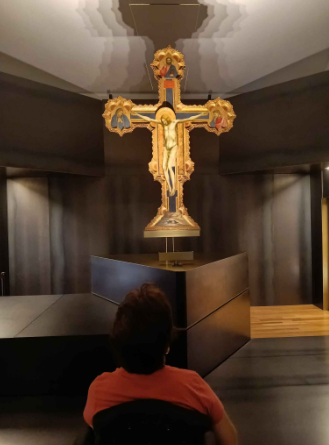
On Tuesday 4 August, some members of the technical and administrative staff of the Human Rights Centre of the University of Padua, including Manuela Viezzoli and assistant Giulia Granzotto, who also acted as an internal museum guide, visited the Civic Museums of Padua with two main aims: to test the usability of the artworks within the museum from the perspective of a person with a disability and to assess the accessibility of the museum spaces.
The visit was carried out as part of the CAM Accessibility and Inclusion Group, Centro di Ateneo per i Musei (University Centre for Museums), with the support of an internal guide to the museums of Venice and Padua.
The Municipality of Padua offered the entire local community the opportunity to enjoy a free visit to the Civic Museums’ galleries during the month of August. In addition to this service, the Museum had devised a Slow Looking experience, namely the opportunity to focus on a single work of art and observe it attentively, in order to gradually deepen one’s understanding of the work itself. Overwhelmed by constant information and stimuli, not only within museums, visitors can thus find a moment for themselves and for reflecting on the work they are observing. Studies have, in fact, shown that an average visitor looks at a work of art for approximately eight seconds before moving on to the next one. Slow Looking emerged as a way of counteracting this hurried form of engagement. The concept was theorised by Shari Tishman, a researcher at Harvard Project Zero, and is promoted by major museum institutions such as Tate, with the aim of fostering a deep connection rather than a mere accumulation of factual knowledge. No specialist expertise is required. It involves allowing the gaze to wander, noticing hidden details, colours, textures, and emotional or physical responses connected to the present moment. For this reason, it is an inclusive technique for everyone, allowing freedom in engaging with the artwork while training the mind to move from a superficial first impression towards the construction of a structured meaning. It can reduce the frenetic pace of everyday life, functioning almost as a form of meditation or mindfulness applied to the visual experience.
The Eremitani Museum organised two Slow Looking sessions (Tuesday 5 and 18 August, from 5.00 pm to 6.00 pm), but, for logistical reasons, the visit was carried out independently, with the support of the internal guide, Giulia.
For the Slow Looking activity, a particularly important and emblematic work in the history of Padua and of the Museum was selected: Giotto’s Cross, formerly located inside the Scrovegni Chapel, a magical place in Padua, which was frescoed by the Tuscan painter between 1303 and 1305.
The Cross is painted on both sides: in addition to the figure of Jesus, it depicts the blessing Christ (at the top), Mary and Saint John (on either side), and Golgotha (at the bottom). On the reverse, which is very badly damaged, there are five tondi, with the Mystic Lamb at the centre and the symbols of the Evangelists on the four arms. Jesus’ body is slender and elongated, gently caressed by the light; the swelling of the veins and tendons can be observed beneath the skin. His head is bowed forwards, his lips are slightly parted and his limbs are abandoned. The background of the cross imitates a real fabric decorated with a diamond-shaped pattern: the preciousness of the painted cloth is worthy of the sacredness of the relic-like body. As for the mourners, Saint John is a powerfully sculptural figure, with his left shoulder and arm extending beyond the limits of the frame; his grief is expressed through his eyes and the position of his mouth, while the Madonna appears to withdraw, enclosing herself within her mantle with a sorrowful expression. The observation of the work also brought to mind the four elements — air, water, earth and fire — which are indispensable to human life, just as art and faith are.
Another work, Guariento d’Arpo’s Angelic Hosts, had also been considered for the Slow Looking activity, but it was not possible to observe it because restoration work is currently under way in the room dedicated to this series.
With regard to the accessibility of the museum, the entrance door is not automatic and is therefore not easy to use independently. The accessibility of the museum and the height at which the artworks are displayed are, on the other hand, well suited to people who use wheelchairs, as is the use of the lift, which can be accessed easily. The archaeological section, however, contains display cases that are difficult to use because they are too high, while the captions accompanying the artworks are too small to be read comfortably. The gradient of the ramps is appropriate. A LIS video interpreting service is also available, which is not a given in many museum settings; attention to disability and inclusion is therefore present. The gallery staff proved to be courteous and helpful.
An additional measure could be to communicate at the ticket office, upon entering the museum, if some artworks are unavailable, as a matter of fairness towards visitors. To make the museum even more accessible, it would also be appropriate to introduce some Reasonable Accommodations, such as tactile panels for blind people and rest rooms for people on the autism spectrum. In this regard, within the rooms dedicated to the temporary exhibition, it would be useful to place notices indicating the presence of fluorescent lighting.
Overall, the accessibility of the museum can be considered adequate, with some possible additional measures aimed at improving its usability. The introduction of further Reasonable Accommodations could contribute to making art increasingly accessible and inclusive.
How to cite this article
Manuela Viezzoli (2026), "Slow Looking at the Civic Museums of Padua", in Inclusion and Eco-Social Justice, ISSN 3035-5265, https://unipd-centrodirittiumani.it/en/topics/slow-looking-at-the-civic-museums-of-padua (consulted on 09/11/2026).
