


International IDEA: published the report “The Global State of Democracy 2026: Democracy in an Age of Conflict”
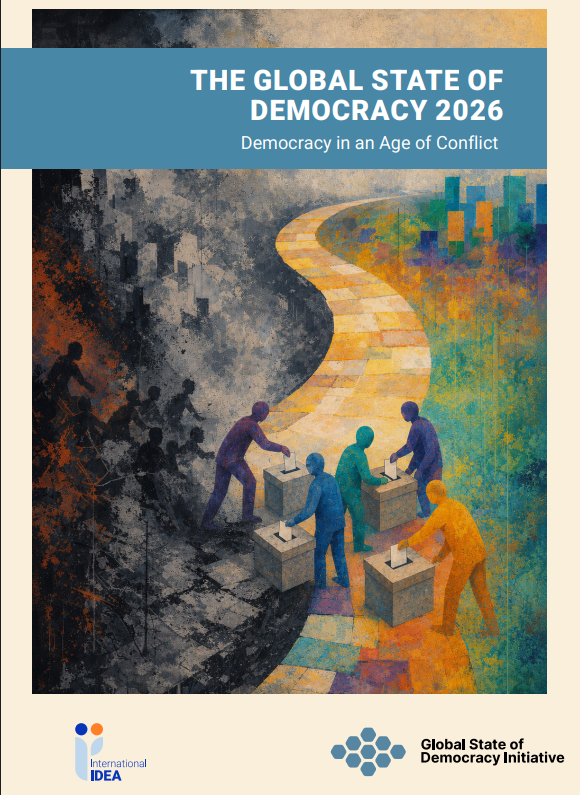
On September 15 International IDEA' published the report “Global State of Democracy 2026: Democracy in an Age of Conflict". The report presents a sobering analysis of democratic performance worldwide, revealing a troubling convergence between democratic decline and rising violent conflict.
Drawing on the Global State of Democracy Indices, the report identifies what the Institute for Economics and Peace has termed a "Great Fragmentation" of historical alliances, compounding a climate of radical uncertainty across the globe. While stagnation remains the dominant pattern, this is concerning precisely because most nations remain clustered in politically fragile mid- and low-performance ranges. When change does occur, it increasingly tends to be negative: in 2025, 57 percent of countries (98 nations) suffered declines in at least one democratic factor compared to five years prior, versus only 32 percent that improved. The steepest deteriorations occurred in Freedom of Expression (24 percent of countries), Freedom of the Press (23 percent), and Access to Justice (18 percent), often driven by coups, conflict, and power centralization. Rule of Law emerged as the weakest category overall, with 41 percent of countries ranked as low-performing, reflecting weakening judicial independence and a rapidly shifting international legal order destabilized in part by the current U.S. administration's actions against allies and adversaries alike. Civic space is also narrowing globally, with SLAPPs, foreign agent laws, and protest criminalization curbing civil society even in high-performing democracies.
The report's second major contribution links these democratic trends to an alarming rise in violence: 2025 recorded the most violent conflicts (65) and interstate conflicts (8) since the Uppsala Conflict Data Program began tracking data in 1946. As the number of consolidated democracies shrinks, the protective scope of the "democratic peace", the well-established finding that democracies rarely fight each other, correspondingly narrows.
In response, International IDEA offers three central policy recommendations:
- First, governments should treat democracy support abroad as a core pillar of national security strategy, since even modest democracy funding yields significant conflict-prevention returns at a fraction of military intervention costs;
- Second, governments, donors, and civil society should invest in strengthening social cohesion and social accountability, both domestically and transnationally, since accountable governance allows grievances to be addressed before escalating into violence;
- Third, stakeholders should identify and prioritize countries facing democratic decline that heightens conflict risk, maintaining ready-to-deploy resources and flexible funding mechanisms to enable rapid, evidence-based intervention.
Ultimately, the report argues that the tools long known to strengthen democracy, like civic participation, open civic space, peaceful power alternation, accountability, and genuine responsiveness to citizens, remain the most effective safeguards against both democratic erosion and violent conflict, making this a critical moment to reinvest in them rather than abandon them.