


Media Freedom Rapid Response (MFRR): new report on Italy raises concerns over media impartiality
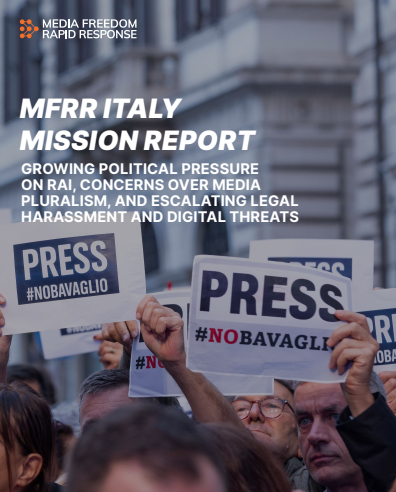
The Media Freedom Rapid Response (MFRR) consortium has released its mission report titled “Growing Political Pressure on Rai, Concerns Over Media Pluralism, and Escalating Legal Harassment and Digital Threats.” Based on a fact-finding mission conducted in Rome in March 2026, the analysis examines the state of press freedom in Italy. The report highlights that Italy continues on a negative trajectory, marked by a systematic erosion of media freedom across several critical areas, including public broadcasting governance, media market concentration, legal intimidation, physical safety, and digital surveillance.
The report places heavy emphasis on the persistent political interference within Italy’s public service broadcaster, Radiotelevisione Italiana (Rai), which fails to comply with the European Media Freedom Act (EMFA) standards that entered into full force in August 2025. Board nomination procedures remain heavily linked to political majorities rather than objective, independent criteria. Tensions over governance triggered a two-year political stalemate in the Rai Oversight Parliamentary Committee, leading to the eventual resignation of both its Chair and committee members in July 2026 as a protest against executive control.
Central to the debate on Rai’s governance is a proposed reform bill currently under discussion in the Italian Parliament. Although the bill aims to eliminate direct executive appointments to the Board of Directors, it proposes lowering the required voting quorum from a three-quarters qualified majority to an absolute majority after initial voting rounds. Critics and MFRR analysts caution that this change would effectively allow the ruling political coalition to solidify its control over key leadership positions without meeting EMFA Article 5 standards for independent, transparent, and objective selection criteria.
The report notes that Italy’s media landscape remains dominated by concentrated private interests with strong political ties, while public media registries kept by the communications regulator (AGCOM) still lack full public transparency as required by EMFA Article 6.
Legal harassment remains a pervasive threat to independent journalism in the country. Physical safety also remains threatened, with over 110 verbal attacks, 36 physical assaults, and violent targeted actions - such as a car explosion targeting Rai journalist Sigfrido Ranucci. In the digital sphere, the report raises alarm over state surveillance and the deployment of military-grade spyware like Graphite against investigative journalists and news editors, exposing systemic gaps in source protection and state accountability.
In conclusion, despite the alarming global trends and structural backsliding in Italy - which led the V-Dem Institute to label the nation an "autocratising country" - the report outlines actionable pathways forward. The MFRR calls on Italian authorities to urgently reform Rai's governance in line with EMFA, fully extend anti-SLAPP (Strategic Lawsuits Against Public Participation - refers to legal measures designed to protect journalists, activists, and citizens from abusive, bad-faith lawsuits aimed at silencing them) protections to domestic cases, ensure complete media ownership transparency, and establish robust judicial safeguards against digital surveillance to uphold democratic standards.