


The Report “Freedom in the World 2026. The Growing Shadow of Autocracy" by Freedom House is published, March 2026
In March 2026, Freedom House published the report “Freedom in the World 2026. The Growing Shadow of Autocracy”, in which it analysed and evaluated the state of freedom in 194 countries and 13 territories during the 2025 calendar year.
In brief, the report shows that freedom globally declined for the 20th consecutive year in 2025, affecting more than 40 percent of the world’s population. Particularly, Freedom House registered a deterioration in the political rights and civil society in 54 countries, among which we can find Guinea-Bissau, Tanzania, Burkina Faso, Madagascar, and El Salvador with the largest score declines. Only 35 countries registered improvements, with Syria, Sri Lanka, Bolivia and Gabon recording the largest gains.
Each country and territory is assigned between 0 and 4 points on a series of 25 indicators, for an aggregate score of up to 100. The graph below, drawn from the report (pag. 3), shows the number of countries whose score has improved and the number of countries whose scores declined over the years:
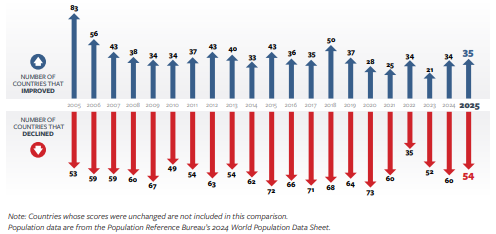
The report identifies that the freedoms more affected by the deterioration over the last two decades are media freedom, freedom of personal expression and due process. It also identifies coups, armed conflicts, attacks against democratic institutions by elected political leaders and growing repression by authoritarian regimes as the main drivers of such decline.
Of particular note is that among the countries rated as “Free”, the United States, Bulgaria and Italy recorded the largest declines in the protection and promotion of political rights and civil freedoms in 2025.
In the United States, the decline stemmed from a combination of long-term patterns and recent developments. The executive branch increasingly claimed unilateral powers, while threats against free speech, especially targeting non-citizens, created a broader chilling effect on expression. The administration also weakened anticorruption safeguards and ignored conflicts of interest.
The fallout in Bulgaria's score is linked to irregularities and corruption associated with and originated from the 2024 parliamentary elections.
The Italian national government weakened anticorruption safeguards despite emerging evidence of corruption among regional politicians. A further factor behind the score decline regards the shrinking space for migration-focused non governmental organizations to operate.
For completeness, the report specified that freedom is being threatened not only within individual countries, but also at the global level. An increasing number of authoritarian regimes are actively undermining civil society groups, international institutions and election monitoring bodies. Nevertheless, the analysis examines this intensifying global architecture of autocracy in depth.
In spite of the overall decline in global freedom, democratic nations continued to show considerable resilience when confronted with both internal and external challenges, while pro-democracy movements in some of the world's most oppressive environments kept fighting for a better future. In line with a commitment to not giving up on democracy, the report concludes with a series of policy recommendations, addressing three key areas
- strengthening democratic coordination and collective action;
- reimagining international democracy assistance to help reverse the global decline in freedom;
- prioritizing engagement with younger generations in the digital spaces where civic identity is now formed