


Albania’s ‘Flamingo Revolution’: From Environmental Protection to Demanding Rule of Law and Institutional Transparency
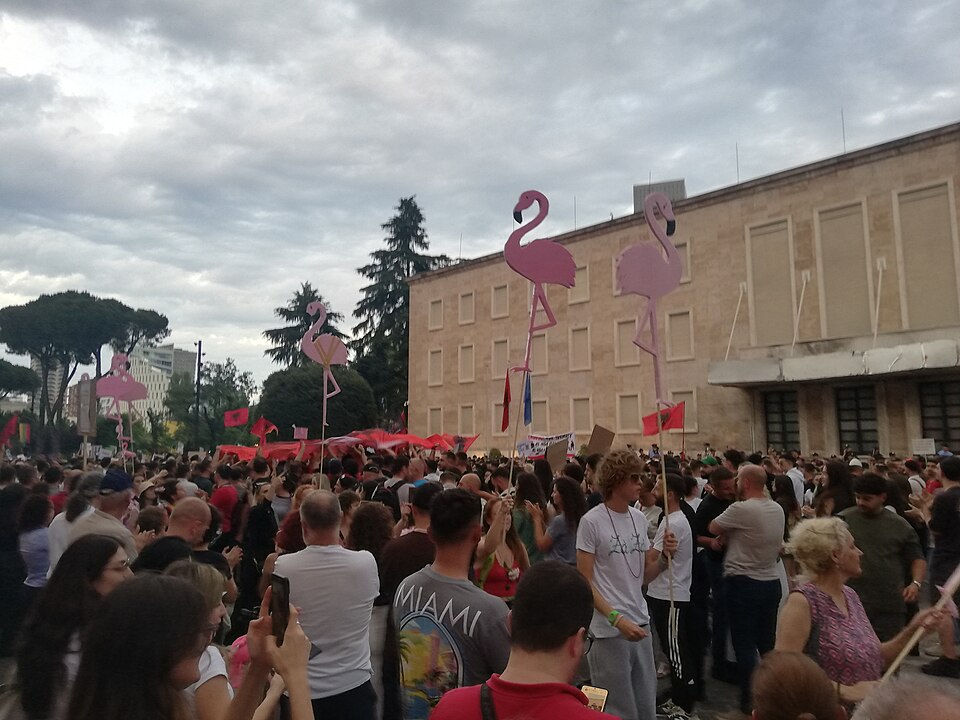
For the past nine days, since the first of June 2026, the streets of Tirana and several major Albanian cities have been occupied by growing numbers of citizens chanting a clear message: “Albania is not for sale.” What began as a localized ecological defense campaign has rapidly evolved into a widespread national and diaspora-led civic movement popularly dubbed as “the Flamingo Revolution.” Among flamingos, creative memes, One Piece flags, and calls to “get out of the cafes” and join the protests, this movement highlights the growing friction between aggressive, top-down economic globalization and fundamental democratic principles, including public consultation, environmental protection, media freedom, and institutional accountability.
The Spark
At the heart of the controversy lies a proposed multi-billion-dollar luxury resort in the Vjosa-Narta Protected Area. This area is the direct geographic extension and delta of the Vjosa River, officially declared Europe’s first "Wild River National Park" in 2023. As an unobstructed fluvial ecosystem, its sediment dynamics feed the Narta Lagoon, a critical global sanctuary for over 200 migratory bird species along the Adriatic Flyway, most iconically the pink flamingo and the globally endangered Dalmatian pelican.
The ecological integrity of this sanctuary was legally compromised following targeted legislative changes passed by the Albanian Parliament in February 2024 through Law No. 21/2024. This revised law on protected areas stripped away stringent conservation boundaries, effectively permitting large-scale, luxury tourism developments within formerly untouchable zones.
.jpg)
Tensions reached a tipping point last week when heavy industrial machinery moved into the protected coastal wetlands in the Zvërnec area to initiate construction without even presenting a project. Public outrage escalated dramatically following the viral circulation of a video showing private security guards physically assaulting a peaceful environmental protester at the site, while state police officers stood by without intervening. This event immediately shifted public perception, transforming an environmental issue into a wider outcry against corporate impunity and lack of transparency.
The Geopolitical and Financial Intricacies Behind the Coastal Projects
International headlines have frequently linked Jared Kushner’s Affinity Partners — the private equity firm of U.S. President Donald Trump's son-in-law — to this strategic investment, and this has contributed to the global traction of this movement. While Kushner’s direct multi-million dollar luxury development has been formally confirmed for the island of Sazan, the institutional and ownership structure behind the mainland project in the Zvërnec area remains highly convoluted.
An extensive investigation by BIRN / Reporter.al exposed a deep network of shell companies and local corporate vehicles covering the true players behind the development. The land allocations in the area also involve a controversial web of unresolved property disputes and have culminated in Albania’s Special Anti-Corruption Structure (SPAK) launching a formal criminal investigation into the legality of the land acquisitions, ownership transfers, and institutional oversight in the area.
Prime Minister Edi Rama, on the other hand, has firmly defended the coastal infrastructure project, dismissing ecological concerns as obstacles to modernization and development. During a high-profile CNN interview, he asserted that no final, definitive blueprint had been officially sealed for Zvërnec yet; he has since declared that “the developers will ‘stun’ onlookers with their plans in the coming months and that parts of the resort could be open to the public before the end of the decade”. Rama has framed public dissent as an anti-progress stance, even labeling the protests a product of a "hybrid war" orchestrated by external "enemies" aiming to disrupt national stability.
European Integration and the Human Rights Dimension
As evidenced by this international attention to the cause, the "Flamingo Revolution" is not just an internal domestic dispute. As Albania follows its European Union accession process, questions surrounding transparency and the rule of law increasingly carry consequences for the country's international standing.
According to Politico, the European Commission has warned that developments surrounding the controversial coastal projects could have implications for Albania's EU accession trajectory. These concerns are echoed in the European Commission's 2025 progress reports as well, particularly under Chapter 27 (Environment and Climate Change), which reiterates that the 2024 amendments to the Law on Protected Areas effectively weakened conservation safeguards and reduced the level of protection afforded to previously protected areas.
Furthermore, the 3rd EU-Albania Civil Society Joint Consultative Committee (JCC) officially highlighted its reservations about the recent changes to the law on Protected Areas and called upon the Albanian government to show “full respect for legal procedures, institutional safeguards and inclusive public consultation”.
Major national media outlets have also been faced with criticism as demonstrators argue that reporting has frequently focused on political reactions rather than the substantive environmental and governance issues raised by the movement, contributing to wider concerns about media independence and pluralism in Albania.
A Transnational Civic Spirit Awakening
Despite Prime Minister Rama’s allegations regarding the protests and the national media’s partial coverage, this kind of massive protest and huge mobilization of young people have not been seen in Albanian squares in years. Writing for Anabel Magazine, journalist and founder Dalina Buzi argued that the heavy presence of youth in the public squares represents a unique, non-partisan awakening capable of saving Albania's democratic fabric from oligarchical captures.
Crucially, the movement has bridged the geographical gap between domestic activists and the vast Albanian diaspora. Protests have spread around the world where the diaspora resides, such as New York, Paris, London, Brussels, to name a few. As reported by Osservatorio Balcani e Caucaso Transeuropa, recent demonstrations in Bologna or Milan represent “a different kind of Albanian square”. Rather than mirroring the historically polarized, party-political disputes of Tirana, these diaspora squares are strictly focused on human rights, environmental justice, and systemic transparency.
In Bologna, activists drew a direct parallel between the lack of transparency in coastal land allocations and the controversial 2023 Italy-Albania protocol, which established externalized Italian-run migrant containment centers in Gjadër and Shëngjin. In both cases, civil society groups argue that sovereign territory has been transactionalized through top-down diplomatic or corporate deals that bypass standard public consultation and local community consent.
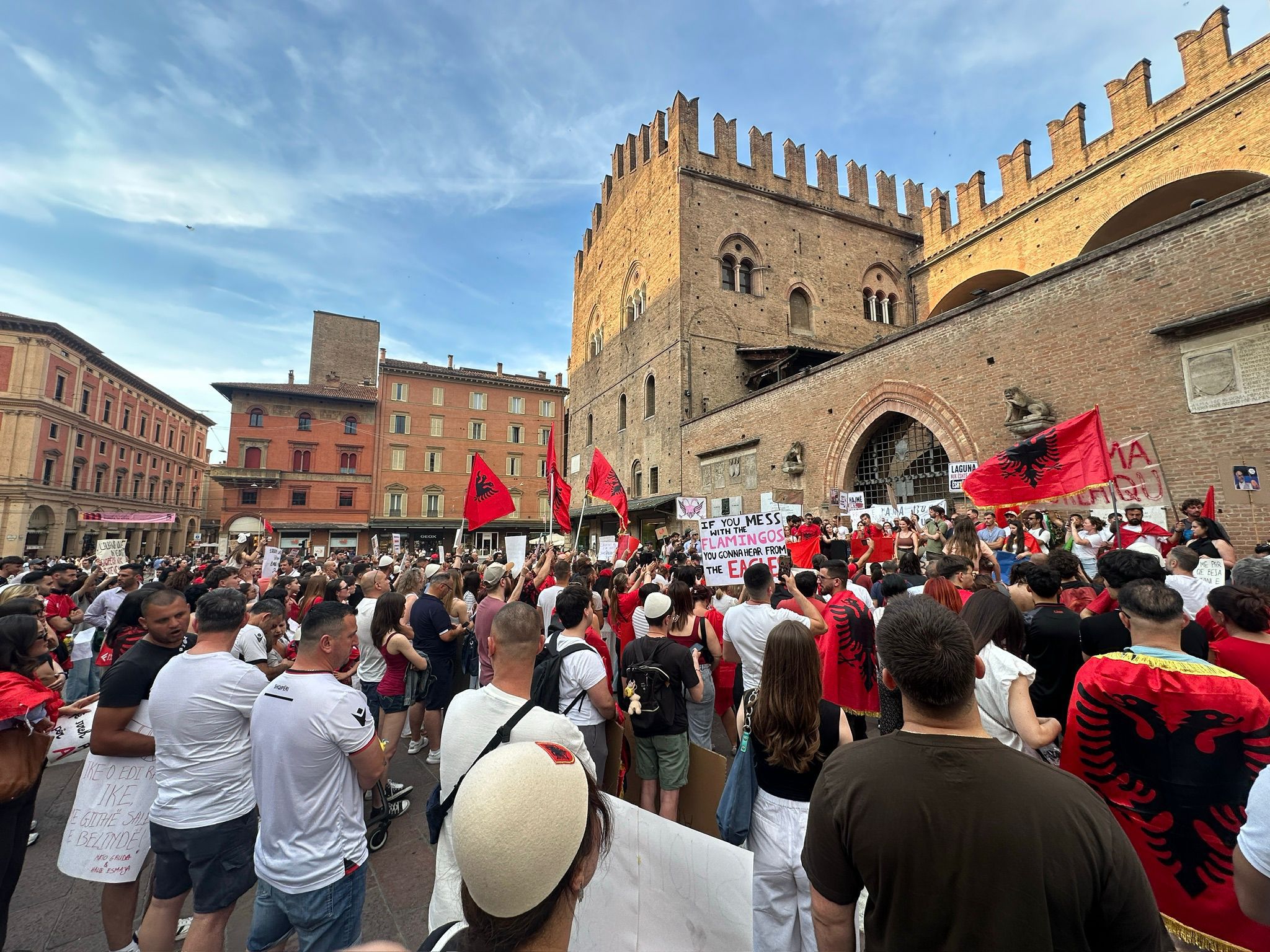
Political philosopher Lea Ypi, writing for The Guardian, also highlights that this generation of protestors carries a historic opportunity that transcends national borders:
“For once, Albania doesn’t need to catch up with Europe – it can lead. A generation willing to mobilise for an alternative model of development, one that rejects oligarchic capture and connects environmental protection to democratic legitimacy, should not be feared but celebrated. Rather than becoming 'like the rest of Europe', as the old slogan used to go, Albania could teach the old continent a lesson in self-respect.”
By demanding that international and national standards of law be upheld over oligarchical real estate deals dressed as ‘strategic investments’, the Flamingo Revolution challenges the current institutional status quo. It poses a fundamental question for the future of Albania and the wider region: can economic growth in the current system coexist with environmental preservation and the democratic rule of law?
Keywords
How to cite this article
Sabaeta Zeneli (2026), "Albania’s ‘Flamingo Revolution’: From Environmental Protection to Demanding Rule of Law and Institutional Transparency", in Human Rights Centre "Antonio Papisca", University of Padova, https://unipd-centrodirittiumani.it/en/topics/albanias-flamingo-revolution-from-environmental-protection-to-demanding-rule-of-law-and-institutional-transparency (consulted on 16/10/2026).
