


European Union Agency for Fundamental Rights (FRA): results of the survey on the rights of Roma and Travellers in Italy in 2024
Table of Contents
- Introduction to the FRA Roma/Traveller Survey 2024
- Manifestations of Antigypsyism
- Discrimination Reporting and Awareness of Rights
- Employment, Economic Inclusion, and Education
- Housing, Health, and Life Expectancy
- Final Remarks: EU-Level Targets and Italy’s Performance
Introduction to the FRA Roma/Traveller Survey 2024
The latest Roma and Travellers survey was launched in 2024 by the European Agency for Fundamental Rights (FRA), which examined the situation in the following 10 European Union (EU) countries: Bulgaria, Czechia, France, Greece, Hungary, Ireland, Italy, Portugal, Romania, and Spain (as well as three accession countries: Albania, North Macedonia, and Serbia). The findings were published in October 2025 and offer insight into how Roma/Travellers experience fundamental rights in the EU. The progress towards the objectives set under the EU Roma Strategic Framework was also assessed.
The report attempts to compare data from 2024 with that from 2021 and 2016 when possible (2016, 2021, and 2019 for France and Ireland), however, comparability and trend analysis for Italy are limited due to the absence of survey data for 2016. The data was collected from 10,126 self-identified Roma respondents (or groups under the Roma umbrella) from private households who have resided in the country surveyed for at least the past 12 months and were 16 years of age or older. Information was also collected from 22,484 individuals within the respondents’ households.
Manifestations of Antigypsyism
The report states that one of the main principles of the EU Roma Strategic Framework for equality, inclusion, and participation urges Member states to fight against persistent antigypsyism and discrimination. However, there have been no considerable changes regarding discrimination and harassment Roma/Travellers due to their ethnicity. Italy is among some of the main countries in which Roma/Traveller living in non-Roma/Traveller neighborhoods experience fewer instances of discrimination than those residing in mostly Roma/Traveller neighborhoods. Italy also experienced a substantial increase in the percentage of Roma/Travellers, who felt that, in the 12 months preceding the survey they were discriminated against in core areas of life because of them being Roma/Travellers. The numbers for this specific indicator rose from 15% in 2021 to 60% in 2024. The survey also examined the perception of discrimination that Roma/Travellers face, based on the grounds of skin colour, racial origin, background, religion, age, sex, disability, sexual orientation, gender identity, and “other”. While discrimination rates decreased in some countries, they reached their highest points in Italy, alongside Ireland and Portugal.
In the year 2024, about 44% of Roma/Travellers surveyed in Italy said they have experienced at least one kind of hate-motivated harassment in the 12 months preceding the survey. This was an increase compared with 2021 data, when it was around 40%. When compared to other surveyed countries, Italy showed one of the highest levels of hate-motivated harassment in 2024. In general, harassment due to ethnicity has not shown improvements overall at the EU level. Regarding the formal reporting of discrimination incidents experienced by Roma/Travellers in Italy, the reporting rate remains low, indicating a significant level of underreporting. In 2024, only 11% of Roma/Travellers in Italy reported the most recent experience in which they were discriminated against. A broad pattern across the EU, including Italy, suggests that most incidents of discrimination are not formally reported at all.
Employment, Poverty, and Education
For this chapter, the report additionally references the Charter of Fundamental Rights and the EU Racial Equality Directive and how both of these documents safeguard equal access to sustainable employment, as well as access for Roma/Travellers. The EU Roma Framework presses Members to significantly reduce the paid employment gap by 2030. In almost all of the countries surveyed, the rate of employment among Roma/Travellers is much lower compared to the general population. However, some countries, including Italy, demonstrated smaller gaps compared to the rest. Italy is also one of the countries in which Roma/Travellers residing in non-Roma/Traveller neighbourhoods receive higher pay than those from predominantly Roma/Traveller neighbourhoods. In terms of employment rates, there has been a general increase for men and women, although the gender gap has also increased. Italy is among the four countries that have accomplished the EU-level target for the employment of Roma women, at 45%.
An average of 70% of Roma/Travellers surveyed across EU Member states are at risk of poverty. For Italy in particular, the rate for Roma/Travellers at risk of poverty was about 89%, compared to 98% in 2021. Although a decrease can be observed, Italy remains among the top countries in the EU with a higher poverty risk among Roma/Travellers. Overall, poverty rates remain high across Europe. Household earnings remain below 60% of the national median income. Although there has been a general decrease in this rate across the EU, the gap between the rate for Roma/Travellers and the general population remains large at 54%. In terms of Roma/Travellers living in severe material deprivation in Italy, there was a decrease from 44% in 2021 to 30% in 2024, which is on the lower end compared to other EU countries. Specifically for children experiencing severe material deprivation in Italy in 2024, the rate is about 34%, down from 48% in 2021.
The survey asks respondents to supply information about all the children (15 years old and under) in their household’s participation in education. In 2024, children aged 6 to 15 who attend schools with mostly Roma/Traveller students in Italy account for about 6%, a decrease from 7% in 2021. Italy is among the countries with the lowest percentage for this specific indicator. Children between 3 years old and the starting age for compulsory primary education that attend early childhood education and care increased drastically in Italy from 30% in 2021 to 61% in 2024. The proportion of Roma/Travellers aged 20 to 24 in Italy who completed at least upper-secondary remained practically the same at 27% in 2024, up from to 26% in 2021. Regarding experiences of discrimination as a Roma/Traveller when in contact with educational institutions in the 12 months preceding the survey, whether as a student, parent or guardian, Roma/Travellers in Italy reported the second highest percentage, with 43% as compared to 1% in 2021.
Housing and Health
The report notes on the overall improvement across member states in terms of the Roma/Traveller housing situation. Most of the surveyed countries have universal or mostly universal core healthcare services for their population, with 74% of Roma/Traveller respondents in Member States having healthcare coverage in their countries. The proportion of Roma/Traveller respondents that had medical insurance coverage increased, from 58% in 2021 to 81% in 2024. Most surveyed EU countries have promising housing projections for achieving EU-level targets for most of the evaluated indicators except overcrowding. To calculate the overcrowding rate, each respondent reported the number or rooms in their residence at the time, as well as the household members in their lodging and their ages. On average 83% of Roma/Travellers from all surveyed countries live in housing lacking sufficient rooms to accommodate all residents, a condition that, in all surveyed countries including Italy, is far above that of the general population.
The gap in housing deprivation is targeted to be reduced by one third by the year 2030. In 2023, about 18% of the general EU population lived in housing deprivation and although Italy had one of the smallest gaps, it was 19%. Italy experienced an improvement from 54% in 2021 to 38% in 2024. Concerning the perception of housing discrimination due to being Roma/Traveller in the five years before the survey, Italy saw quite an increase from 2021 to 2024, from 6% to 70%.
For the health portion of the survey, the report references the previously mentioned rights frameworks and their protection of Roma/Travellers’ equal access to quality healthcare and social services. It is further noted that the EU Roma Framework requests the reduction of the existing life expectancy gap by 50% by 2030, ensuring that Roma/Traveller men and women live an additional 5 years on average. Due to specific data limitations, robust life expectancy estimates for the 2024 Roma survey could only be done using 2017 and 2019 data. The data showed that the gap in lifespans of Roma/Traveller individuals and the general population was largest in Italy, with Roma/Traveller women living 12.8 years less and men 12.5 years less. The report does underscore that this can be explained by the exceptionally high life expectancy of the general Italian population, which ranks among the highest globally. Respondents were also asked about their medical insurance coverage, and in the case of Italy there was an increase from 58% in 2021 to 81% in 2024. Finally, regarding the respondents who reported experiencing discrimination as a result of being Roma/Traveller when seeking access to health services in the 12 months prior to the survey, Italy again saw a sharp increase between 2021 and 2024, from 1% to 41%.
Final Remarks: EU-Level Targets and Italy’s Performance
Regarding the EU-level goals put in place by the EU Strategic Framework, the likelihood of their widespread achievement is not promising. Among all surveyed countries, Bulgaria and Italy are projected to achieve the largest number of objectives. In Italy’s case, these are in the areas of education, employment, and housing, as can be observed in more detail in the following table extracted from the Roma/Traveller 2024 Survey report:
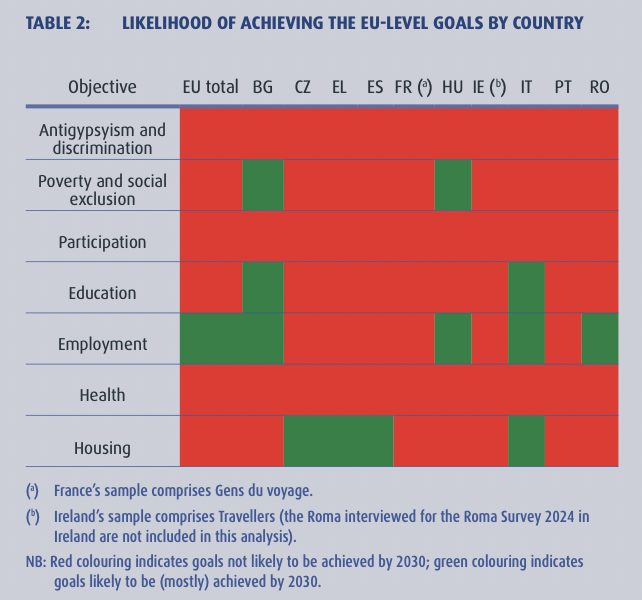
For Italy specifically, employment outcomes were among the highest, with smaller gaps relative to other EU countries. There has been a slight decrease in severe material deprivation for Roma/Traveller households in Italy, which is encouraging. A significant increase in early childhood attendance was observed between 2021 and 2024, indicating progress toward the EU objectives for early inclusion. Another positive outcome is Italy’s considerable improvements in the percentage of medical insurance coverage of the Roma/Travellers.
Nevertheless, progress remains limited in the Roma/Traveller experience with discrimination and harassment due to ethnic origin, making it difficult to achieve the goals on this particular issue by 2030. Discrimination is high within educational, housing, and healthcare contexts, placing Italy among the EU countries with the highest rankings for discrimination and hate-motivated harassment in 2024. This issue stands out as one of the main challenges the surveyed countries face going forward. Despite positive results in employment, poverty levels remain substantial, placing it among the highest in the EU. It can be concluded that while Roma/Travellers in Italy may have benefited from increasing access to employment, insurance, and even education, the barrier of discrimination remains difficult to overcome.
Links
How to cite this article
Natalia Michelle Aguierre Sanchez (2025), "European Union Agency for Fundamental Rights (FRA): results of the survey on the rights of Roma and Travellers in Italy in 2024", in Italian Yearbook of Human Rights, ISSN 3035-5435, https://unipd-centrodirittiumani.it/en/topics/european-union-agency-for-fundamental-rights-fra-results-of-the-survey-on-the-rights-of-roma-and-travellers-in-italy-in-2024 (consulted on 20/10/2026).
