


How Kosovo’s non-membership in the Council of Europe affects the lives of its youth, despite the fulfilment of membership criteria
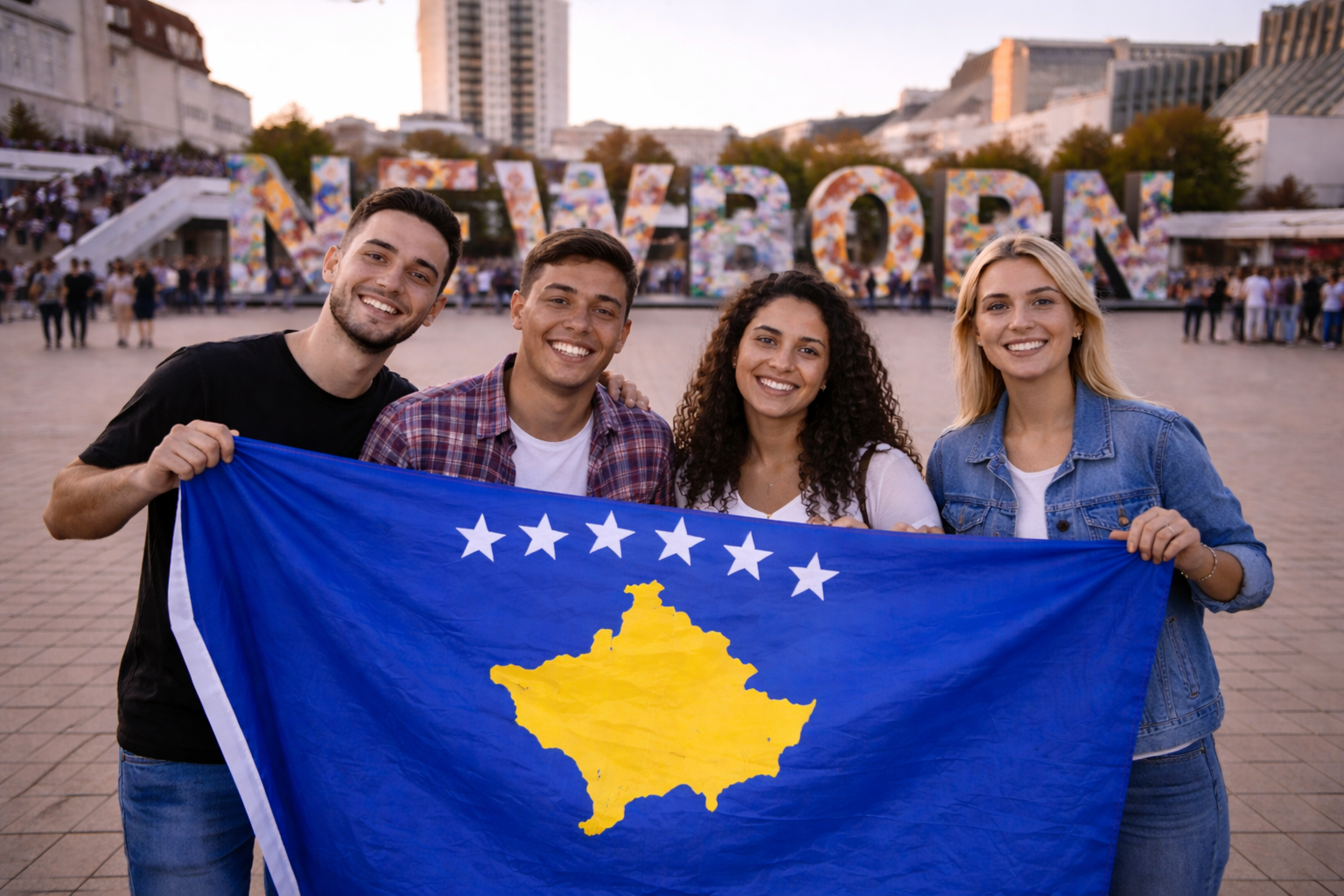
Table of Contents
- Introduction
- Kosovo's Membership in the Council of Europe
- Key Consequences of Non-Membership for Kosovo Youth
- Conclusion
Introduction
The Council of Europe remains one of the strongest international organizations, founded in 1949 to protect human rights, promote democracy, and strengthen the rule of law. Since its establishment, the organization has been expanding, adding more European countries each year under its own umbrella, with 46 member states and more than 700 million citizens (Council of Europe, 2023). The integration and acceptance in the Council of Europe have never been automatic or immediate. Instead, it has developed as a gradual, conditional, and value-based process, designed to ensure that new members genuinely respect human rights, democracy, and the rule of law. Therefore, countries that applied to be part of the Council of Europe had to fulfil certain criteria to be admitted to the organization. Usually, the process begins when one country expresses political will to join the Council of Europe, as stated in Article 4, any European state willing and able to fulfill the requirements of Article 3 may be invited to become a member by the Committee of Ministers, and becomes a member on depositing its instrument of accession (Council of Europe, 1949). Some of the main criteria that one country must comply with are respecting the rule of law, the jurisdiction of human rights and fundamental freedoms, and the state must show the ability and will to fulfill these criteria. Therefore, the countries that have joined the Council of Europe had to go through the process of the criteria compliance verification process to be part of the organization.
The Council of Europe also plays an important role in empowerment, respectation of rights and freedom of young people, where it has developed its own “Youth Policy,” which is a “strategy implemented by public authorities with a view to providing young people with opportunities and experiences that support their successful integration into society and enable them to be active and responsible members of their societies, as well as agents of change.” (Council of Europe, 2025). Therefore, young people who come from member states of Counil of Europe are protected by the European Convention on Human Rights, and have access to the European Court of Human Rights through domestic remedies, where their rights gain international legal protection. The Council of Europe continuously monitors human rights through indipented budies such as CPT, GRECO, ECRI. Furthermore, youth from member states gain access to different youth training courses, human rights education programs, youth exchanges, and can build meaningful networks with young people across Europe. Considering the range of benefits available to young people in Council of Europe member states, the question that this article raises is what happens with the youth of Kosovo, who are citizens of the youngest country in Europe, with the youngest population, and yet not a member state in the Council of Europe despite the fulfilment of the main criteria.
Kosovo's Membership in the Council of Europe
In 17th of February 2008, Kosovo celebrated its declaration of independence from Serbia, becoming the youngest country in Europe. Kosovo's independence is recognized by 34 members of the European Council, while 12 have not recognized it yet, including countries such as Cyprus, Greece, Romania, Slovakia, Spain, Armenia, Azerbaijan, Georgia, Moldova, Serbia, and Ukraine for various political reasons. Kosovo applied to be part of the Council of Europe on 12 May 2022 (Council of Europe, 2024). Following the submission of the application, the Council of Europe started assessing Kosovo's application and progress for membership. Expert legal evaluations concluded that Kosovo’s constitutional and legal framework is largely aligned with Council of Europe standards. The constitution of Kosovo incorporates several key human rights instruments, including the European Convention on Human Rights and other international protections concerning minority rights and the prevention of violence and discrimination.
On 20 May 2022, foreign ministers met in Turin, but they failed to pass an application of Kosovo to the PACE to evaluate it. This was passed a year later, in April 2023, when PACE requested the lawyers to write an in-depth report on Kosovo's candidature. The report was published in November 2023, where it noted that Kosovo's progress in fighting corruption, in human rights protections, and many other chapters. It also highlighted that the failure to implement binding court decisions concerning a land property dispute involving the Orthodox Deçan Monastery remained a matter of serious concern (Council of Europe Parliamentary Assembly, Bureau, 2023). This issue was resolved in 2024 by the Kosovo institutions, who followed the suggestion of the report of the Council of Europe, being the last criterion requested. A new report was published in 2024, further supporting Kosovo's membership and acknowledging its progress (Council of Europe Parliamentary Assembly, 2024). Furthermore, the Parliamentary Assembly acknowledged that Kosovo had made a lot of progress in strengthening democracy, the rule of law, and human rights protections. The Council has also stressed that Kosovo’s potential membership would be very important, as it would allow individuals under Kosovo’s jurisdiction to gain access to the European Court of Human Rights.
In April 2024, as the last condition was met, PACE parliamentarians agreed by a huge majority of 131 to 29 votes to support Kosovo's membership in the Council of Europe, and push the decision to the next meeting of foreign ministers in May 2024. The representative reporter Dora Bakoyannis stated that “No candidate member has ever been asked to undertake so many reforms before even being brought up for discussion on its accession to the Organization. This is probably why 83% of the Assembly voted in favor of the Report.” However, despite the positive report and the majority of votes in favor of Kosovo's membership by PACE parliamentarians, the ministers did not put in a vote for Kosovo's application in May 2024 and 2025, while several countries that are part of the CoE clearly underperform in the rule of law, freedom of speech, and human rights compared to Kosovo. In the “Global Safety Report” published by Gallup in 2025, Kosovo ranks as the top country in Europe in the law and order index, while the Freedom Rights Report, a report that rates people’s access to political rights and civil liberties in 208 countries and territories, ranks Kosovo higher than some of the countries that are part of the European Council, same for Human Right Index.
Key Consequences of Non-Membership for Kosovo Youth
The delayed process of Kosovo's membership in the Council of Europe has a lot of consequences for Kosovo's youth. One of the main consequences is that young people from Kosovo have limited access to the European Court of Human Rights, which means they cannot currently submit complaints to the ECHR in case of violation of their rights. As a result, in worst-case scenarios, if youth faced violations of freedom of expression, minority rights, or education, in this case, they would have no supranational recourse. Violations that would be addressed in other European countries, which are part of the Council of Europe, in Kosovo, in this case, would remain domestically unresolved, weakening protection and accountability. Therefore, Kosovo's membership is very important for the protection of youth rights and for giving them a voice in cases when that voice would be undermined.
Council of Europe programs such as European Youth Centres, European Youth Foundation, and non-formal education projects are directly linked to membership; therefore, youth from non-member countries have limited access or conditional participation. Kosovo youth can sometimes attend as observers but not as official delegates, which means in most cases they do not have the right to vote. While in cases of Youth Camps and Training Courses, they are open to youth from CoE member states, but Kosovo youth can participate mostly via NGO partnerships, but not through official delegations. Furthermore, youth from Kosovo are also restricted from participating in the application of different youth grants and initiatives that are offered by the CoE in collaboration of European Union. All these results limit the inclusion in European peer-learning and exchange networks.
Conclusion
In conclusion, Kosovo's lack of membership in the Council of Europe, despite the fulfilment of all the required criteria, significantly limits the formal participation of its youth in European governance structures. Without representation in the Youth Department, Advisory Council on Youth, and related decision-making bodies, Kosovo’s young people are excluded from shaping policies that influence youth across Europe. While limited participation through NGOs or observer status exists, this does not provide equal influence or access to funding and institutional networks. As a result, Kosovo’s youth remain partially disconnected from European youth policy development, which may affect long-term civic engagement and European integration. Therefore, this article suggests to the foreign ministers of the CoE to decide postively for Kosovo's accession to Counil of Europe and not push from one year to another without having in consideration that this delay has an impact on the lives of youth of the country with the highest number of youth in Europe.
References
Council of Europe. (1949). Statute of the Council of Europe (European Treaty Series No. 1). https://rm.coe.int/1680306052
Council of Europe. (2023). The Council of Europe at a glance. https://www.coe.int/en/web/portal/the-council-of-europe-at-a-glance
Council of Europe. (n.d.). Youth policy. https://www.coe.int/en/web/youth/youth-policy
Council of Europe Parliamentary Assembly, Bureau. (2023). Application for membership set out in the letter of 12 May 2022 addressed to the Secretary General of the Council of Europe (AS/Bur (2023) 64). https://rm.coe.int/application-for-membership-set-out-in-the-letter-of-12-may-2022-addres/1680ad7750
Council of Europe Parliamentary Assembly. (2024). Application by Kosovo for membership of the Council of Europe (Doc. 15958). https://rm.coe.int/application-by-kosovo-for-membership-of-the-council-of-europe-/1680af1575
Parliamentary Assembly of the Council of Europe. (2024). Vote 39707: Opinion on the application of Kosovo for membership of the Council of Europe. https://pace.coe.int/en/votes/39707
Keywords
How to cite this article
Ylli Alija (2026), "How Kosovo’s non-membership in the Council of Europe affects the lives of its youth, despite the fulfilment of membership criteria", in Inclusion and Eco-Social Justice, ISSN 3035-5265, https://unipd-centrodirittiumani.it/en/topics/how-kosovos-non-membership-in-the-council-of-europe-affects-the-lives-of-its-youth-despite-the-fulfilment-of-membership-criteria (consulted on 20/10/2026).
