


Human Rights Watch World Report 2026: Italy’s human rights record
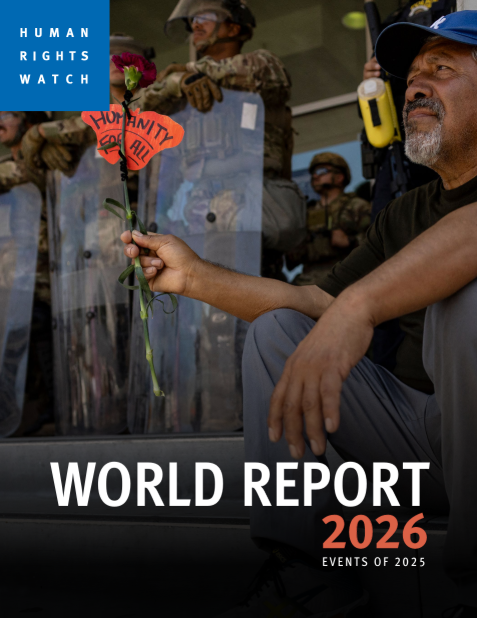
Table of Contents
- Italy’s human rights record in 2025
- Migration
- Discrimination and intolerance
- Socio-economic inequalities
- Women’s rights
- Sexual orientation and gender identity
- Rule of law
- Conclusion
Italy’s human rights record in 2025
Human Rights Watch has recently published its World Report 2026, the annual, global review of human rights which examines the human rights situation in over 100 countries. Among the European countries covered in the report is Italy.
Human Rights Watch’s report about Italy tackles multiple areas of concern: migrants and asylum seekers, discrimination and intolerance, poverty and inequality, women’s rights, sexual orientation and gender identity and the rule of law.
It underlines that in 2025 Italy has adopted new security measures, including racial profiling, which mainly have an impact on marginalised groups such as migrants and people living in vulnerable conditions. Moreover, the Italian state is pursuing a model of control and harsh repression against migration flows which includes the detention of people in migration processing centres in Albania and the obstruction of humanitarian rescues at sea.
Migration
Based on numbers provided by the Italian government, around 49,000 people had reached the Italian coasts by mid-September 2025, marking a slight increase compared to the same period in 2024. One way to face migration flows adopted by Italy is the building of migration facilities in Albania. These spaces are aimed at processing asylum applications, but authorities’ attempts to process asylum claims in Albania have been blocked by Italian courts. Consequently, the Italian government turned them into detention centres.
Human Rights Watch highlights that these centres violate many rights that are guaranteed by the Italian Constitution, as well as EU law and multiple human rights treaties, including the right to asylum seeking, the right to an effective remedy, the right to health and the right to information. These claims find further support in the legal position of the Court of Justice of the European Union, which ruled that EU asylum law standards have not been met by Italy in a case involving two Bangladeshi citizens.
Since 2017 Italy and Libya have had a Memorandum of Agreement, a formal political deal on migration cooperation which automatically renews every 3 years, unless one of the two States explicitly expresses its intention to conclude the agreement. Italy provides the Libyan Coast Guard with economic support and material and technical equipment, enabling Libyan coastal authorities to intercept migrant boats and prevent them from crossing the Mediterranean Sea and reaching Italy. Despite serious human rights abuses, the Memorandum has been renewed in November 2025. Abuses linked with these operations include ill-treatments of migrants. In this respect, in June 2025 the ECtHR declared inadmissible a complaint concerning a deadly interception by Libya’s Coast Guard in 2018. Moreover, an investigation has been opened by an Italian prosecutor following an incident, occurred in August 2025 when a rescue ship operated by SOS MEDITERRANEE was attacked by a Libyan patrol boat, which opened fire against it.
In March the Cassation Court established that 177 migrants were entitled to compensation for deprivation of liberty, precisely for being forced to stay aboard the Italian Coast Guard ship “Diciotti” for ten days before being allowed to disembark.
More judicial actions were taken during summer 2025: in July the Constitutional Court affirmed that, according to the Italian Constitution, the government is allowed to fine and detain NGOs rescue ships; however, it made clear that saving lives justifies disregarding state orders.
In the same month four Guardia di Finanza and two Coast Guard officers were ordered to go to trial on charges of manslaughter for the events concerning the February 2023 shipwreck in Calabria, where 94 people died. Between February 2023 and September 2025 the Italian government detained rescued ships 34 times, preventing vital rescue operations for 700 days.
One more action against more inclusive integration and migration policies is the boycott campaign, led by Prime Minister Giorgia Meloni and other right-wing politicians, against the referendum that aimed at reducing the mandatory legal residency from 10 to 5 years before being eligible for Italian citizenship. In June the referendum failed to meet the quorum, representing a setback in the broader debate over integration.
Discrimination and intolerance
Beyond restrictive migration policies, the report also addresses persistent forms of discrimination and intolerance.
In May 2025 the European Commission Against Racism and Intolerance (ECRI) recommended to conduct an independent study of racial profiling by Italian police, following episodes of racial profiling concerning Roma and African people. The government’s reaction to this recommendation was hostile: the ECRI was publicly criticised by Prime Minister Meloni, who defined the ECRI’s point of view as shameful and groundless.
The report underlines that, according to government statistics, between January and July 2025 foreigners, who represent 9% of the population in Italy, accounted for 42% of people stopped by police in “red zones” in urban areas and 76% of people subsequently subjected to enforcement measures.
Socio-economic inequalities
Alongside concerns about discrimination, the report draws attention to the issues of poverty and other socio-economic inequalities.
In June the Italian Parliament adopted a new law which introduces severe criminal sanctions on squatters - and those who help them in any way - and reduces procedural guarantees against forced evictions.
In this regard, the United Nations special rapporteurs had previously expressed concerns about the impact that the adoption of this law could have on homelessness, but the Italian government ignored them.
Women’s rights
Another relevant issue is that of sexual and gender-based violence. Human Rights Watch reports the data shared by the Interior Ministry about the number of femicides occurred between January and July. What emerged from data collection is that the number of women killed during those months in 2025 is almost equal to the number of victims of femicide for the same period in 2024 (60 femicides in 2025 and 61 in 2024). The dossier published by the Interior Ministry also shows an increase in the number of foreign women killed by their partners or former partners.
Significantly more warnings to alleged stalkers and abusers were issued by Italian police and in November the Parliament approved a bill which introduces the crime of femicide. The law then came into force the following month. Another bill which defines sex lacking consent as rape stalled in the Senate.
The HRW’s report also stresses the problems related to the right to abortion. Although access to abortion should be always guaranteed, in reality women often encounter obstacles that limit its availability. One reason is the high number of medical professionals being conscientious objectors. To overcome this problem, in July Sicily passed a regional law that obliges healthcare centres to hire medical personnel willing to perform abortions. This law was challenged before the Constitutional Court by the government.
Sexual orientation and gender identity
Beyond women’s rights, the report underlines ongoing concerns about sexual orientation and gender identity.
In May, the Constitutional Court declared that Italian authorities must allow lesbian couples to register their children, born via medically assisted procreation abroad, as having two mothers. Separately, the Constitutional Court also determined that gay parents should be allowed to legally adopt children born via surrogacy abroad before the entry into effect of a 2024 law that criminalises surrogacy outside Italy.
In August, changes to limit the access to gender-affirming care for people under the age of 18 were proposed by the government to the Parliament.
Rule of law
The last theme addressed by the report is the rule of law.
In April 2025 the Italian government enacted a security decree including provisions that had been previously criticised by the United Nations and the Council of Europe’s Commissioner for Human Rights for its serious and unmotivated limits on freedom of expression and association. As the report released by Human Right Watch explains, these limitations became a permanent law in June and they introduce tougher penalties for participation in unauthorised demonstrations and make it a crime to take part in protests in detention and reception centres and prisons; moreover, the decree increases sanctions for offenses against public officials.
An incident involving the Libyan official Osama Elmasry Njeem (known as “Almasri”) occurred in January 2025: Almasri was under an arrest warrant from the International Court of Justice (ICC) for alleged crimes against humanity and war crimes and Italian authorities took him into custody, but released him two days later and flew him to Libya on a state aircraft. The ICC was not informed about these events.
An investigation was opened and, in August, a case against Prime Minister Meloni over her alleged role in the release of the Libyan official was dismissed by the Italian judges that were conducting the investigation. In October the government majority reaffirmed the immunity from prosecution of 3 officials under investigation.
In its “2025 Rule of Law Report”, the European Commission urged Italy to address conflicts of interests and corruption in politics, as well as to establish an independent national human rights institution (NHRI) and to improve protections for journalists.
Conclusion
The findings of the 2026 HRW report portray a complex human rights picture in Italy: 2025 was marked by tensions and challenges, mainly concerning migration governance and civil liberties. Overall, the report highlights the need for stronger safeguards for human rights.
Keywords
How to cite this article
Francesca Simonato (2026), "Human Rights Watch World Report 2026: Italy’s human rights record", in Italian Yearbook of Human Rights, ISSN 3035-5435, https://unipd-centrodirittiumani.it/en/topics/human-rights-watch-world-report-2026-italys-human-rights-record (consulted on 20/10/2026).
