


Let's defend the right to imagine the future - Part one
Among the constructs to which researchers and practitioners interested in decision-making processes, including those relating to education and careers, often refer, imagination is given pride of place, particularly the kind that allows us to question what is possible, even going beyond the boundaries of our experience and knowledge of reality, our past and our present.
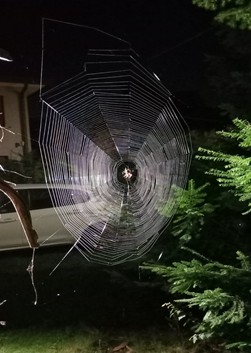
I recently had the opportunity to discuss this, in a decidedly non-academic way, as befits a convivial gathering among colleagues and friends, with my colleague Prof. Sergio Roncato, starting from the photograph (shown alongside these sentences) taken late at night by him. We wondered how such precision could be found in a spider's web built to ensure the survival of its creator.
Tonight I managed not to bump into it with my head. I can see it perfectly, I can even photograph it with flash after trying various angles.
I try to put myself in its perspective:
'I have to stretch out some threads to form a sunburst; there must be 20 rays and they must lie on the same plane.
I just follow him as he builds the sunburst.
The beginning? Perhaps he fixed the thread to a support (leaf) and then looked for one further away. How? By swinging it?
Waiting for a breath of air? (Let's skip that).
I put myself in his perspective again: 'Now there is a thread stretched between two supports, I go to the central point and pull a thread from it towards a third support. I have to solve the following problems: choose the angle, find a support that is coplanar with the first thread already stretched and that allows me to form the right angle, then reach this support. I have to act in the third dimension, but I can't fly, so do I wait for a breath of air? Assuming I succeed in my goal, I have to stretch a fourth ray. What do I do: go back to the centre and recalculate the coordinates to reach? I am in a two-dimensional world (the plane of the web), and I need 3D. All this has to be repeated 18 times, as many as the supports to which the rays of the web are attached. This concludes the first part, which we will refer to as the “scaffolding”. Now we should begin weaving the threads between the spokes. The geometry is impressive; I challenge anyone with a pencil and paper to draw a spiral (is it even a spiral?) like this. This reconstruction of HOW it appears is embarrassing, not the entire web, but only the ray.
I would not pass the entrance exam to the Arachnid Academy. We wonder WHERE this “work” comes from. Is it a step-by-step advancement, the result of improvised solutions? Better not to think about it, you need intelligence for “problem solving”. Is there a preparatory “design”, would it be pure abstraction... in the brain of a spider? Or is there something that “lives” in the brain of any living species “sub species aeternitatis”?
These are Professor Roncato’s words1, and from these exchanges, the following questions emerged: those of us who are committed to fostering high-quality futures for all people and for the natural contexts in which they live—do we encourage or inhibit the capacity and desire to imagine, collectively, desirable futures for everyone? Or do we tend, more “realistically”, to warn them about the “dangers of fantasy”, about the risk of losing ground in educational, professional and even recreational competitions? Moreover, do all individuals have the same opportunities to access, reflect upon and, if they wish, pursue their own imaginative capacities?
I find myself grappling with similar questions very often, especially when, in dealing with inclusion and guidance, I am faced with the need to suggest how to choose between educational or professional alternatives that evoke similar degrees of attraction or aversion—or, worse still, when I do not know what meaningful advice to offer because no realistically viable options exist for someone. In those moments, like Sergio’s spider, I feel I can do nothing but attempt to imagine something that does not yet exist, and ask—especially of those who cannot afford not to choose or to postpone decisions—to help me imagine what we might “invent together”, explore or attempt.
This situation seems to arise with increasing frequency in working groups and discussion settings with adolescents and young people, likely because they have mostly been taught to repeat, to “report faithfully” something that has already happened, that they have read or listened to in class, or that they have observed—yet far too rarely have they been taught to imagine what might have happened only if…, what could or could not happen soon, in the short term, but also in the medium and long term (what will become of school subjects in 15, 20 or 30 years? And what of the work of IT specialists, programmers, teachers or journalists? And will issues such as migration, inequality, unaffordable housing, undeclared work, etc., persist?).
These are, ultimately, legitimate questions, given that we are already living in a VUCA world (Volatility, Uncertainty, Complexity, Ambiguity) and are immersed in a profound crisis of imagination—one that should compel us all to seek to spark, protect and, indeed, where possible, teach it (Arjun Appadurai, 1996; Cornelius Castoriadis, 1978; Wright Mills, 1959). Even Martin Reeves and Jack Fuller—economists inclined to support and promote competition—arrived at titling a contribution published in the Harvard Business Review in 2020 “We Need Imagination Now More Than Ever”, although their primary concern was probably not the well-being of individuals, their communities or their ecological environments, but rather the survival of the neoliberal economy.
We should try to stimulate imagination for several reasons, which, in my view, can be widely shared:
- The first concerns the fact that, despite many things not going as we would wish, most of us still tend to “resist change”, to refrain from taking action to ensure that the future does not simply remain an extension of the present.
- The second is that we have trained our imagination far too little, to the point that we struggle even to describe “the details” that would allow us to recognise that tomorrow has begun, and we experience discomfort when asked to specify where and with whom we would like to be and do something in the future… in three months, in a year;
- The third is that without imagination—without recourse to what Seligman and colleagues (2018) call prospection, a form of pragmatic imagination that turns the noun “imagination” into a rich constellation of verbs—it becomes difficult to spark the changes we aspire to.
Moreover, among these verbs—verbs that indicate, above all, what to say and what to do—the ones that resonate most strongly with me are two in particular: to resist and to provoke, which I also regard as “hybrid engines” capable of helping us reduce existing inequalities concerning the “right to imagine”.
That such verbs are needed is confirmed by a range of studies showing that this right is not equally guaranteed to all, that it is unevenly distributed within the population, and that, once again, those who are least able to exercise it fully are the most vulnerable groups, primarily for socio-cultural reasons.
Let us consider these verbs more closely. Here, I shall limit myself to the verb resist, while the second piece will be devoted entirely to the verb provoke.
The verb to resist, as its etymology suggests, denotes the act of standing firm, of becoming a barrier against something that is moving towards us in a threatening manner, of preventing it from “penetrating” us, harming us, or even destroying us. We have all heard expressions such as “the dam did not withstand the flood”, “the bridge did not withstand the erosion of its pillars”, and so forth; and in biology, too, certain organisms resist infections or the action of toxic substances. In engineering and construction science, materials, systems and structures may be resistant to heat, humidity or even devastating natural events.
It goes without saying that it is better to be resistant than fragile; yet both words—resistance and fragility—lead me to think of qualities that may or may not be present, that may have been shaped by certain conditions or agents, or may have developed by chance. The design of the future, and the imagination we might employ to anticipate and shape it, likewise require resistance—yet a resistance that is distinctly active and proactive, articulated through a series of actions, even of real struggle, in pursuit of recognition, change and improvement. After all, it is often said that our Constitution is itself founded on the active resistance of many honourable predecessors.
The “psychological and economic-financial derivative” of resistance is resilience, which, however, originally referred to drawing back, from the Latin resilire, meaning to spring or leap back. I should clarify, though, that especially since the early 21st century, the term has entered common use to indicate, more generally, the capacity to react, to avoid being crushed by adverse events (one need only think of the NRRP, which appears to make Recovery depend on Resilience).
The discomfort I feel towards this expression—and towards its companion term, flexibility—has increased significantly in recent years, as I have observed the extensive use made of both by the entrepreneurial and economic world shaped by a distinctly neoliberal logic. We hear, increasingly often, talk of workers’ resilience and flexibility. And thus, workers—employable or bendable?—are required, in the name of resilience, to demonstrate operational flexibility, adaptability, “bendability”, even in the face of new and unforeseen changes and demands. “Resilience” and “flexibility” are thereby offloaded onto individuals and included among the “competences” that everyone, particularly future citizens, is expected to possess. They must minimise their expectations and demonstrate “understanding” towards their employers—even those who fail to invest in safety, in less stressful working processes, or in better social protections, the absence of which is associated with workplace accidents and fatalities that are increasingly frequent and utterly intolerable.
These concerns are increasingly reflected in numerous multidisciplinary research contributions. Philosopher Byung-Chul Han (2020) speaks of a “performance and fatigue society,” while sociologist Illouz (2018) sharply criticises all those who tend to “psychologise”2 social problems, turning them into individual psychological flaws and anomalies, ignoring those who, on the other hand, since the founding of the Club of Rome, have argued for the necessity of putting a brake on growth. Like Fusaro (2022), I am tempted to say, “I hate resilience,” pointing out that those who demand it forget that fragility is an inescapable characteristic of Homo sapiens. Resilience, like “flexibility,” I would add, transforms citizens into ideal subjects, because, as Fusaro notes, they are encouraged to settle for what exists, for what is offered to them, being led to believe that there are no alternatives, that nothing else exists—not even the possibility of imagining and attempting to realise something different.
Certainly, if we wish to be active in shaping our existence and the livability of our environments, we must adopt behaviours aimed at not giving up at the first obstacle or difficulty, promoting the achievement of even challenging goals, and particularly opposing a present considered the only possible one. This constitutes active resistance against everything that may pose a threat. Resistance, unlike resilience, precisely because it is not passive, stands against the presence of what is wrong—such as unjust demands or actions that disrespect human and social dignity, or the presence of “aggressive intruders” interested in our subjugation. In this way, resistance is fundamental for imagination, and particularly for the kind that seeks improvements regarding the quality of life of all living beings, present and future, and their environmental contexts.
Meanwhile, I anticipate that in the second part of this work, in addition to emphasising the right to imagine, I will also consider how imagination can be provoked and taught. In the meantime, I invite all those interested in their own imagination to complete and send me the attached questionnaire (salvatore.soresi@unipd.it), to which I will provide, free of charge, a report offering comments and reflections regarding:
- the extent to which each person might consider themselves in an imagination crisis;
- how and to what extent they are actively engaging in favour of imagination; and
- What they expect from educational systems and political institutions in this regard.
1 The dialogue between Prof. Roncato and myself regarding spiders continues: every now and then he sends me some ‘bibliography’. As I write these lines, he has forwarded me two articles: a) the first is by Marco Belpoliti (2015), who states that the silk thread that spiders weave is a physical-chemical masterpiece and that males mate only once in their lives before being devoured by females. He also reminds us that even Primo Levi was amazed by the fact that for many people, their first impulse when faced with a spider is revulsion. There may be many reasons for this: its shape, its legs, its carnivorous nature. Yet spiders are one of the most fascinating animals on Earth.
b) The second is a scientific article published in PNSA (2022) by Roßlera, De Agroò et. al. who argue that sleep and its stages are present throughout the animal kingdom and even in arthropods. This makes Sergio Roncato and me wonder whether spiders are even dreamers!
2 ‘Serious’ psychology, which is concerned with people's well-being and how to promote their problem-solving skills, has been studying the processes and conditions that favor its development since the 1950s. Consider the contributions made by Blok (1924-2010), Norman Garmezy (1918-2009), and Elder (1999), who asks education to no longer think of children as passive subjects, but as actors capable of imagining and shaping their own lives.
References
Appadurai, A. (1996) Modernity at Large: Cultural Dimensions of Globalization (1996). Tr.it., Modernità in polvere, Milano: Raffaello Cortina.
Belpoliti, M. (2015). I ragni, meravigliosi artisti della tela condannati a morire d’amore. La Stampa, 25 agosto.
Castoriadis, C. (1978) History as Creation, Solidarity, London: Pamphlet 54.
Elder, G.H. (1999). Children of The Great Depression. Londra: Routledge.
Fusaro, D. (2022) Odio la resilienza. Contro la mistica della sopportazione, Milano: Rizzoli.
Ghosh, A. (2016). The Great Derangement: Climate Change and the Unthinkable. Tr.it ital: La grande cecità: Il cambiamento climatico e l'impensabile (2017), Milano: Neri Pozza Editore.
Han, B-C. (2022). Palliativgesellschaft Schmerz heute. Berlin: Ullstein Verlag.
Illouz, E. (2018). Happycratie: Comment l’industrie du bonheur a pris le contrôle de nos vies. Paris: Premier Parallèle.
Reeves, M., J. (2020). Abbiamo bisogno di immaginazione ora più che mai. Harvard Business Review.
Roßlera, De Agroò et. al (2022), Regularly occurring bouts of retinal movements suggest an REM sleep–like state in jumping spiders, PNAS, Vol. 11, 33. https://doi.org/10.1073/pnas.2204754119.
Seligman, M. E.R., Railton, P., Baumeister, R.F., Sripada, C. (2016). Homo Prospectus, Oxford University Press.
Wright Mills, C.W. (1959). The Sociological Imagination, Trad. it., L'immaginazione sociologica, Milano: Il Saggiatore, 2017.
Documents
How to cite this article
Salvatore Soresi (2025), "Let's defend the right to imagine the future - Part one", in Inclusion and Eco-Social Justice, ISSN 3035-5265, https://unipd-centrodirittiumani.it/en/topics/lets-defend-the-right-to-imagine-the-future-part-one (consulted on 20/10/2026).
