

Ten years on from Havana: reflections on the Colombian Peace Agreement
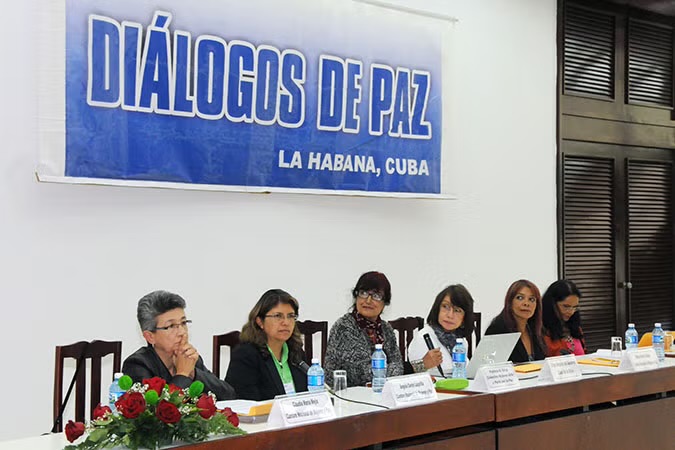
Table of Contents
- A 50-year conflict
- The road to Havana
- What makes the agreement unique
- The differentiated approach
- The gender approach today
- Implementation of the ethnic chapter
- A disputed anniversary
- Conclusions
On 24 November 2016, in Bogotá, the government of Juan Manuel Santos and the FARC-EP guerrilla group signed the Final Agreement for the Termination of the Conflict and the Construction of a Stable and Lasting Peace, bringing an end, at least on paper, to more than 50 years of armed conflict. Ten years on, that agreement remains an international benchmark and is regarded as one of the most comprehensive and inclusive ever signed. In this article, we shall attempt to understand why, focusing in particular on its gender approach and the ethnic chapter, and to assess what remains of it today, ten years after it was signed.
A conflict lasting more than 50 years
Colombia’s contemporary history is marked by recurring cycles of political violence. As early as the mid-20th century, the clash between Liberals and Conservatives – which went down in history as ‘La Violencia’ – had caused hundreds of thousands of deaths. Building on that legacy, the 1960s saw the emergence of revolutionary guerrilla groups, including the FARC-EP (Fuerzas Armadas Revolucionarias de Colombia – Ejército del Pueblo), which were rooted in rural areas and the peasants’ land claims. In the decades that followed, the conflict became increasingly complex: paramilitary groups emerged and drug trafficking became the fuel for the war, whilst the civilian population in rural areas paid the heaviest price. This gave rise to what scholars describe as a ‘protracted’ conflict, fuelled by deep-seated inequalities, political exclusion and a high concentration of land ownership.
The Road to Havana
Before reaching the 2016 agreement – the most comprehensive to date – Colombia had already seen numerous attempts at peace with various armed groups, some successful and others unsuccessful. The path that led to Havana began in 2010, when the Santos government opened a secret channel of dialogue with the FARC. After around two years of exploratory talks, the negotiations were officially announced in 2012 and moved to Havana, with Cuba and Norway acting as guarantor states. Four years of negotiations followed, centred on a six-point agenda: comprehensive rural reform (1), political participation of the FARC-EP (2), an end to the conflict and DDR for former combatants (3), a solution to the problem of illicit drugs (4), victims’ rights (5) and implementation and verification mechanisms (6).
What makes the agreement unique
Several elements distinguish the Colombian agreement from other peace processes.
Victims at the centre. Victims were placed at the centre of both the negotiations and the agreement. In July 2014, the government and the FARC agreed on a mechanism for direct participation, which allowed victims to make their voices heard at the negotiating table in Havana. The groundwork had been laid by Ley 1448 of 2011, known as the Law on Victims and Land Restitution. By comprehensively recognising victims’ rights to truth, justice, reparation and non-repetition, the law laid the foundations upon which the agreement would subsequently address the age-old dilemma between peace and justice, resolving it in favour of a model of restorative transitional justice.
A justice that repairs. Point 5 of the agreement established the Comprehensive System for Truth, Justice, Reparation and Non-Repetition, comprising one judicial body and two extrajudicial bodies.
- The Special Jurisdiction for Peace (JEP) is the judicial heart of the system. It investigates the most serious crimes – grouped into 11 ‘macro-cases’ – committed during the conflict by former FARC guerrillas, members of the security forces and other state agents. Those who acknowledge their responsibility and contribute fully to the truth receive so-called ‘special sanctions’: between 5 and 8 years of restricted liberty, during which they carry out reparative work and activities defined with the participation of the victims, such as searching for the disappeared, demining or building infrastructure for communities. The hearings on the acknowledgement of truth and responsibility are public and can be followed on the JEP’s YouTube channel.
- The Commission for the Clarification of Truth, Coexistence and Non-Repetition (CEV) is the body within the system that addresses the ‘truth and memory’ pillar of transitional justice: the right of victims and society to know what happened and why. Its mandate is extrajudicial. In 2022, it presented the country with the final report Hay futuro si hay verdad, comprising eleven volumes. The report combines victims’ testimonies with a historical reconstruction of the conflict and recommendations to ensure non-repetition.
- The Search Unit for Persons Deemed as Missing (UBPD) has a humanitarian and extrajudicial mandate: it directs and coordinates the search for people who have gone missing in the context of, and as a result of, the armed conflict, in order to provide answers to the families searching for them.
Collective reincorporation. Previous processes followed the classic model of disarmament, demobilisation and reintegration (DDR), with an individual pathway for each former combatant. Point 3 of the agreement, however, introduces ‘reincorporation’: a collective process in which the more than 13,000 former guerrillas who have laid down their arms have set up cooperatives and joint productive projects and are building communities in the territories. The safety of former combatants remains a key concern to this day: according to the Indepaz Observatory, over 520 signatories to the agreement have been killed in the last ten years.
The differentiated approach
The differentiated approach (enfoque diferencial), which recognises that the war has affected people differently depending on their gender and ethnic background, and which is reflected in the Agreement through two mechanisms: the enfoque de género and the capítulo étnico.
- The gender approach
At the start of the negotiations, the negotiating table in Havana was composed almost exclusively of men. Things changed thanks to the mobilisation of the Colombian women’s movement. In October 2013, around 500 women from across the country gathered in Bogotá for three days at the first Cumbre Nacional de Mujeres y Paz. A few weeks later, the government appointed the first two women as plenipotentiaries to its delegation. The Summit drew on the Women, Peace and Security Agenda, established by UN Security Council Resolution 1325, which calls for the full participation of women in peace processes. This external impetus was complemented by an internal process within the FARC. The female guerrilla fighters – who made up around 30 percent of the FARC-EP’s ranks – began to re-examine their own experience as women in arms through a gender lens, in response to the media backlash they faced in Havana. For many of those present in Havana, Cuba marked their first encounter with feminism and gender issues. From this engagement emerged what came to be known as ‘insurgent feminism’ – an endogenous form of feminism developed by the female combatants based on their experience in the armed struggle, through which they recognised themselves as political agents.
This convergence of demands led to the establishment of the Gender Sub-Committee: created in June 2014 and inaugurated on 11 September of the same year, it was composed of ten members from both delegations. Its work was based on the principle that the war had not affected everyone in the same way, and that it was necessary to recognise its specific and disproportionate impact on women and LGBTQ+ people. The Sub-Committee operated on two fronts. On the one hand, it revisited the points already agreed upon prior to its establishment – namely, Comprehensive Rural Reform (point 1), Political Participation (point 2) and the Solution to the Problem of Illicit Drugs (point 4) – and retroactively incorporated a gender perspective into them. On the other hand, it supported the drafting of the points still under discussion, namely Victims (point 5) and the End of the Conflict (point 3), in which the gender perspective was included from the outset. In the final text, the gender-related measures comprise around 130 provisions, spread across all six points of the agreement
In addition to these measures, there is the creation of the Instancia Especial de Mujeres, comprising women’s organisations and tasked with monitoring the implementation of the gender approach, and the recognition of sexual violence as a crime not eligible for amnesty. These crimes are currently being investigated by Macrocaso 11 of the JEP. Launched in September 2023, it deals with gender-based violence, sexual and reproductive violence, and crimes motivated by prejudice against sexual orientation or gender identity. It investigates both acts committed by former guerrillas and members of the security forces against the civilian population, and those that took place within the armed forces themselves.
The same principle of differentiated impact underlies the work of the Truth Commission. The seventh volume of its Final Report, Mi cuerpo es la verdad. Experiencias de mujeres y personas LGBTIQ+ en el conflicto armado, brings together the testimonies of women and LGBTIQ+ people. The volume recognises patriarchy as a structural factor that drives and sustains gender-based violence during the armed conflict.
It is interesting to note how one of the agreement’s most innovative elements – the gender approach – was turned into a tool for opposition propaganda during the referendum on 2 October 2016, in which the ‘No’ vote won with 50.24 per cent of the vote against 49.75 per cent for ‘Yes’. The campaigners opposing the agreement denounced what they claimed was a ‘gender ideology’. In the final text of 24 November 2016, the gender approach remained among the guiding principles, but many references were amended or removed.
The gender approach today
According to the latest report from the Kroc Institute – the institute entrusted with technical monitoring under point 6 of the agreement (paragraph 6.3.2) – the implementation of the gender approach is proceeding slowly: only 13 percent of the gender-related provisions have been fully implemented, compared with 36 per cent of the agreement as a whole. The Kroc Institute attributes this delay primarily to the lack of institutional ownership of the gender approach on the part of the administrations.
- The Ethnic Chapter of the Peace Agreement
Colombia is a multi-ethnic country, a fact also recognised in the 1991 Constitution, which is committed to protecting and defending the country’s ethnic and cultural diversity. The ethnic population is divided into indigenous peoples, Afro-descendant or Afro-Colombian peoples, and the Rom (Romani) community.
Precisely in light of this vast diversity and the enormous impact of the internal armed conflict on ethnic populations, these groups played a key role in the Havana talks, bringing to fruition a long process of advocacy to secure such recognition.
Indeed, in 2013, during the initial phase of negotiations between the Colombian Government and the FARC-EP, several organisations representing people of African descent complained that their concerns and needs were not being adequately represented at the negotiating table. This was a particular cause for concern as the negotiations touched on issues that directly affected ethnic communities, such as land management, whilst they were not present at the table. Thanks to a massive advocacy effort, both domestically and internationally, the indigenous and Afro-descendant organisations, united within the Comisión Étnica para la Paz y la Defensa de los Derechos Territoriales, succeeded in securing their presence in Havana. The result was the drafting of the so-called ‘ethnic chapter’ of the 2016 Final Peace Agreement. The ethnic chapter represents a unique achievement on a global scale; it is, in fact, the first set of specific principles and guarantees for ethnic groups within a peace agreement anywhere in the world.
The ethnic chapter, just three and a half pages long, is a comprehensive document setting out clear principles and measures to protect ethnic rights, and addresses all six points of the Agreement. The Government and the FARC recognise the importance of applying an ethnic and cultural perspective to the interpretation and implementation of the Agreement, with an intersectional focus on ethnicity, gender, women, the family and generations.
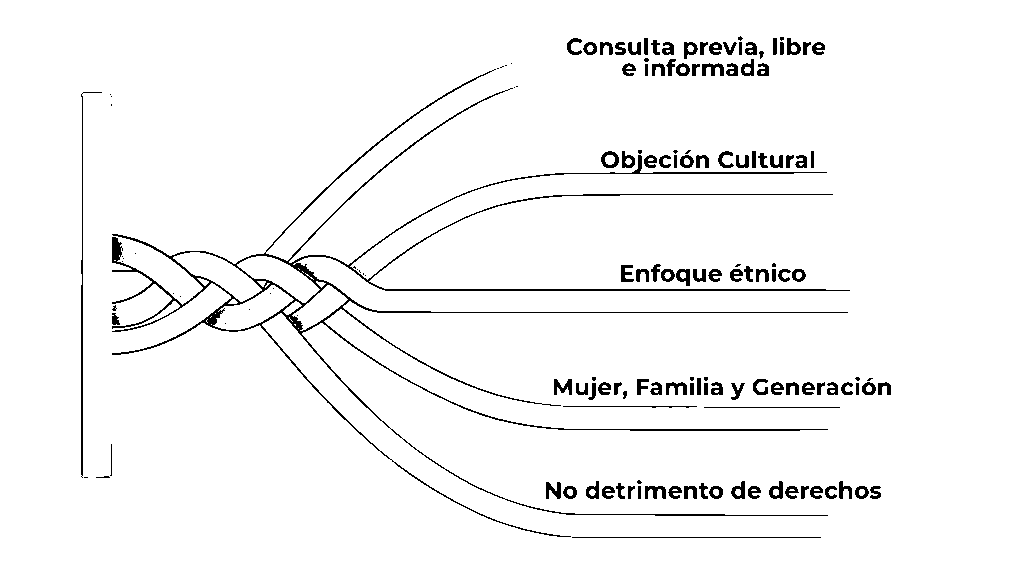
Prior, free and informed consent, as well as the right to cultural objection, are guaranteed for decisions relating to the implementation of the Agreement that affect ethnic populations. Autonomy, self-government, participation and the right to lands, territories and resources are recognised. The ethnic chapter gives priority to ethnic territories in agrarian reform, the substitution of illicit crops (recognising the cultural and ancestral importance of certain substances for indigenous peoples), humanitarian demining and land restitution. Judicial and extrajudicial measures must be applied with an ethnic focus, and the JEP must work in conjunction with and coordinate with the Special Indigenous Jurisdiction. With regard to the reintegration of demobilised men and women belonging to an ethnic group, the development of a harmonisation programme is required to ensure the restoration of territorial harmony. As with the gender approach, the Instancia Especial de Alto Nivel de los Pueblos Étnicos IEANPE, was established for the ethnic chapter; it is responsible for monitoring, implementing and verifying the ethnic approach of the Agreement.
Implementation of the ethnic chapter
Around 20 percent of registered victims belong to an ethnic group. The suffering and violence experienced by ethnic populations are documented in the chapter of the CEV’s Final Report entitled Resistir no es aguantar. Thanks to the relentless demand for truth and justice from victims of ethnic origin, in 2022 the JEP opened Macrocase 09 on non-administrative crimes perpetrated against ethnic populations and territories. A milestone in the JEP’s work was the recognition of ancestral territory as a victim of the armed conflict. This is the first time that a transitional justice tribunal has recognised nature and territory as victims.
As reported by CONPA (Consejo de Paz Afrocolombiano), 10 years after the signing of the Peace Agreement, it is estimated that only 14 percent of the ethnic chapter has been implemented. The International Working Group on Indigenous Affairs describes the outcome of the implementation of the ethnic chapter as bittersweet. On the one hand, the Peace Agreement has reduced the violence perpetrated by the FARC and the security forces and guaranteed the visibility and participation of ethnic communities as full political actors in the institutional dialogue. On the other hand, the conflict has never truly ended, and the power vacuum left by the FARC has given rise to new armed groups, including dissident factions of the FARC itself, leading to an escalation of violence.
A disputed anniversary
The tenth anniversary comes at a politically fraught time. On 7 August 2026, Abelardo de la Espriella, a member of the radical right, took office; he had based part of his campaign on opposition to the agreement and, in particular, to its judicial pillar. As a candidate, he had promised to abolish the JEP: doing so by decree is not possible, as the JEP is protected by the constitution. The government has therefore resorted to financial pressure by drastically reducing the tribunal’s budget for 2027, with cuts to staff, premises and the protection of victims and witnesses. The JEP thus finds itself in difficulty right in the middle of its term of office, just as the major cases are entering the sentencing phase.
The pressure is not limited to the justice system. The government has openly framed this as a ‘cultural battle’, and the battleground is the very memory of the conflict. On 15 October, the Museo Nacional removed dozens of exhibits dedicated to sexual diversity, feminism, the Unión Patriótica and the Peace Agreement.
International scrutiny is also narrowing. On 30 October, the UN Security Council unanimously renewed the mandate of the Verification Mission until 31 October 2027, but under different conditions. At the explicit request of the De la Espriella government, the Council excluded monitoring of the Comprehensive Rural Reform from the mandate, and from now on the Mission will focus on reintegration and security guarantees. As early as 2025, the Security Council had already removed from the mandate the verification of JEP sanctions and the monitoring of the ethnic chapter. The government hailed the vote as an affirmation of sovereignty. The risk, however, is that the very most innovative parts of the agreement will be left without an external observer: land, ethnic groups and transitional justice.
Conclusions
Whilst the peace agreement marks its tenth anniversary in a fragile and contentious political climate, there are nevertheless signs pointing in the opposite direction. On 4 November 2026, the Constitutional Court, in Order (auto) No. 1538, reaffirmed that the agreement constitutes a matter of state public policy, the implementation of which is a duty of good faith for all authorities, thereby ordering the government to include a chapter dedicated to peace in the National Development Plan. Civil society, victims’ organisations and opposition parties also tell us that, ten years on, there are still many who want peace and are defending it. It is significant that, for example, around 11,000 former guerrilla fighters are continuing their reincorporation process.
The Colombian agreement therefore remains a model studied worldwide for having placed victims, women, LGBTQ+ people and indigenous and Afro-descendant communities at its centre; yet its history serves as a reminder that the most difficult part of a peace agreement is not the signing, but its implementation. A text, however innovative and comprehensive, remains a dead letter unless there are governments willing to fund it, institutions capable of putting it into practice on the ground, and a society ready to defend it. Colombia thus demonstrates that peace is a political choice that must be renewed every day: the choice to invest in peace rather than in war.
Bibliography
Anctil Avoine, Priscyll; Weber, Sanne (eds.) (2027). Ten Years after Havana: Feminist and Decolonial Analyses of the Implementation of Colombia’s Peace Agreement. Cham: Palgrave Macmillan.
Álvarez, Josefina Echavarría; Gómez Vásquez, Mateo; Forero Linares, Brenda; Balen Giancola, Mariana; Gutiérrez Pulido, Enrique; Joshi, Madhav; et al. (2026). Noveno año de implementación: tendencias y claves para la transición política. University of Notre Dame. Report. https://curate.nd.edu/articles/report/Noveno_a_o_de_implementaci_n_tendencias_y_claves_para_la_transici_n_pol_tica/31753045?file=64708323
González Posso, Camilo (2026). “Del dicho al hecho… Del acuerdo a la implementación”. Bogotá: Indepaz, luglio. https://indepaz.org.co/wp-content/uploads/2026/07/Parte-2-Del-dicho-al-hecho-f.pdf
Gutiérrez Danton, José A.; Kurtenbach, Sabine (eds.) (2026). “The Colombian Peace Agreement 10 Years Later: Between Total Peace and a New Cycle of Conflict”. Numero speciale, Latin American Perspectives 53 (5). https://journals.sagepub.com/toc/lapa/53/5
Sánchez-Garzoli, Gimena (2026). “The Ethnic Chapter of Colombia’s 2016 Peace Accord 10 Years Later”. WOLA, 10 novembre. https://www.wola.org/analysis/the-ethnic-chapter-of-colombias-2016-peace-accord-10-years-later/
Wright, Claire (2026). “Decentring and decolonising studies on memory within the field of transitional justice: Lessons from Colombia’s truth commission and its engagement with ethnic peoples.” Memory Studies 19(5). https://journals.sagepub.com/doi/10.1177/17506980261464107
How to cite this article
Sofia Pieretti, Daniela Susarenco (2026), "Ten years on from Havana: reflections on the Colombian Peace Agreement", in Human Rights Centre "Antonio Papisca", University of Padova, https://unipd-centrodirittiumani.it/en/topics/ten-years-on-from-havana-reflections-on-the-colombian-peace-agreement (consulted on 25/11/2026).
