


“The courage not to stop, without compromise”: the Commitment of Amnesty International Italy in 2024 and Future Challenges
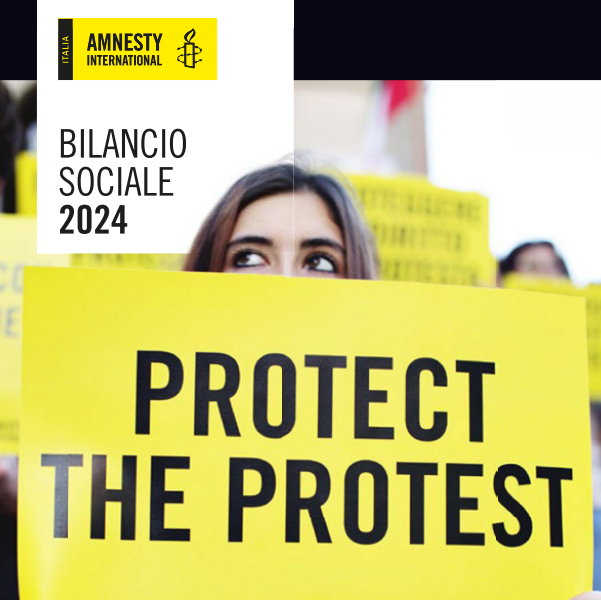
Table of Contents
- The Presence of Amnesty International Italy Across the Country
- The Work of Amnesty International Italy in 2024
- Free Julian Assange
- Freedom for Maysoon Majidi
- Challenges and Prospects for 202
Introduction
2024 was a year marked by numerous challenges and mobilizations for Amnesty International Italy, which documented its commitment to the defense and promotion of human rights in Italy in its annual publication “Social Report 2024”. Among the main areas of action were the promotion of the right to protest, work on international crises, particularly the dissemination and promotion of the report entitled “You Feel Like You Are Subhuman: Israel’s Genocide Against the Palestinian Population in Gaza”, the rights of migrants, and the celebration of the release from prison of Australian journalist Julian Assange.
The organization operated through research activities, human rights education, institutional lobbying, and civic mobilization, actively involving thousands of people across the national territory. In a difficult political context, Amnesty Italy continued to serve as an independent and authoritative point of reference, strengthening its action through specialized task forces and continuous activation of civil society.
The presence of Amnesty International Italy across the country
The Italian Section of Amnesty International was founded in 1975 and has since expanded to involve activists from across Italy and from different generations.
Amnesty International Italy defines an activist as “any person who carries out continuous activities within an organizational structure, is regularly associated and registered in the volunteer register and, in addition to responding to Amnesty International’s proposals for action, maintains a circular relationship with the organization by sharing both its values and its associative life in terms of collective participation in actions aimed at protecting human rights and in the construction of those actions, as well as enjoying full participation in decision-making processes.”
Activists in Italy mobilize locally through public awareness initiatives, human rights education, public demonstrations, and signature collection campaigns.
In 2024, the movement counted 30,174 registered members, of whom 1,340 were activists (among registered members, 15% were aged between 14 and 25, 23% between 26 and 35, 21% between 36 and 50, and 23% between 51 and 65). These activists were active in local groups and/or engaged in specialized forms of activism operating at the national level.
As of 2024, there were 163 active groups across the Italian peninsula, mainly located in the northern regions. At the same time, 79 individuals were involved in diversified or specialized forms of activism through thematic or geopolitical coordination groups, and an additional 79 were involved in the so-called Task Forces, divided into “Hate Speech,” “Observers,” and “Research-Action.” These forms of activism involve not only public awareness activities but also complementary actions to traditional activism, such as monitoring online hate speech and observing public demonstrations.
Furthermore, as Amnesty International is a deeply democratic movement, those involved in the association are called upon to participate in the annual General Assembly, held each year in a different Italian city. The 39th General Assembly of the Italian Section of Amnesty International took place in Ravenna (Emilia-Romagna) from 31 May to 2 June 2024, with the participation of 270 delegates and members.
The Work of Amnesty International Italy in 2024
The work of Amnesty International Italy in 2024 focused on a range of campaigns, lobbying actions, human rights education and training activities, media communication, and artistic and cultural initiatives for human rights.
Each year, the Italian Section organizes its efforts through an Annual Operational Program derived from decisions made at the global and regional levels among Amnesty International Sections in Europe and Central Asia. The Italian Section then develops its own strategy for the coming year, identifying priority areas, flexible areas, and areas of ongoing work.
In 2024, Amnesty Italy’s human rights work followed global and regional priorities, including support for freedom of expression and association in the protection of the right to peaceful assembly; the strengthening of equality and non-discrimination through the promotion of gender, racial, and intersectional justice; climate justice; the right to health, housing, and social security; and the protection of the rights of migrants, refugees, and people in crisis contexts.
Human rights work was also developed through specific campaigns encompassing a wide range of forms of activation, from civil society mobilization to dialogue with Italian state authorities. Below is an overview of the campaigns on which Amnesty Italy focused in 2024.
- “Protect the Protest” is a global Amnesty International campaign aimed at denouncing human rights violations occurring in the exercise of freedom of expression and peaceful assembly by monitoring the restriction of civic spaces. Within this campaign, Amnesty Italy paid particular attention to demonstrations held in Italy in solidarity with the Palestinian population. The national demonstration held in Rome on 5 October 2024 was monitored by the Observers Task Force, as were others held throughout Italy, and was also the subject of research published by Amnesty International’s central offices. This research identified numerous unjustified interferences by Italian authorities against demonstrators, such as preventive bans, unlawful checks and detentions, and the absence of safe entry and exit routes from the square, among other hostile measures affecting the right to protest. The organization called for an independent and impartial investigation into the human rights violations that occurred on 5 October 2024.
Furthermore, in the context of protecting the right to protest, Amnesty Italy joined the national network No Ddl Sicurezza – A Pieno Regime, which mobilizes to defend freedom of expression and peaceful assembly against the criminalization of protesters and the restriction of civic space in Italy. - Through the campaign “Equality, Justice and Intersectionality,” Amnesty Italy advocated for the rights of LGBTQIA+ people by participating in 33 Pride events through 47 groups across Italy.
The organization also acted through the Hate Speech Task Force to counter online hate speech. Additionally, it continued its lobbying efforts within the campaign “Io Lo Chiedo: Il sesso senza consenso è stupro”, aimed at amending Article 609-bis of the Italian Criminal Code in compliance with commitments undertaken by the Italian government under the Council of Europe Convention on Preventing and Combating Violence Against Women and Domestic Violence (Istanbul Convention). - Within the “Migration” campaign, the organization worked to promote and protect the rights of migrants, refugees, and asylum seekers, as well as people affected by the consequences of wars and crises. Particular focus was placed on the agreement between Italy and Albania establishing two migrant centers on Albanian territory for the detention of individuals intercepted at sea by Italian authorities, as well as on Italy’s Repatriation Detention Centers, through interviews with detained individuals and dialogue with institutions. In 2024, Amnesty Italy also celebrated the acquittal of the crew of the Iuventa ship, operated by the German NGO Jugend Rettet. Proceedings against them had been ongoing since 2017, when the Trapani prosecutor’s office seized the ship and investigated part of the crew on charges of “aiding and abetting illegal immigration,” in an attempt to undermine NGO activities in the Mediterranean. From the outset, Amnesty Italy opposed the investigations and the initiation of legal proceedings, monitoring every phase of the case.
- Through the campaign “Climate Change and Human Rights”, the NGO continued its struggle for climate justice, with Amnesty Italy activists exerting pressure on local institutions, municipalities, and regions to promote the defense of the right to a clean, healthy, and sustainable environment.
- Amnesty also worked to defend people affected by armed conflicts and severe crisis situations worldwide through the campaign “International Crises and Human Rights”, supporting demands for justice and promoting accountability before national and international bodies. Specifically, in Italy, the movement brought to the attention of national institutions the report on sexual violence suffered by protesters in Iran, meeting with representatives of the Ministry of Foreign Affairs. Numerous demonstrations in support of the “Woman, Life, Freedom” movement were supported, and in March, also thanks to the organization’s contribution and documentation, the Chamber of Deputies approved a resolution condemning discrimination and sexual violence against women and girls in Iran. Furthermore, following the publication of the report “You Feel Like You Are Subhuman: Israel’s Genocide Against the Palestinian Population in Gaza”, Amnesty Italy consistently pursued discussion on the ongoing genocide in Palestine by presenting the report to hundreds of people across Italy.
- As from the beginning of its activities in Italy, Amnesty International continued to fight for the abolition of the death penalty worldwide through the campaign “No to the Death Penalty”.
Amnesty Italy’s commitment to the protection and promotion of human rights in 2024 also took shape through careful coordination of actions and pressure on Italian authorities across various fields in response to the “unprecedented challenges for human rights both nationally and internationally.” In 2024, Amnesty Italy also engaged with international human rights protection and promotion mechanisms, such as the Universal Periodic Review of the United Nations Human Rights Council. Regarding the right to protest, Amnesty Italy expressed its concerns about the “security” decree-law promoted by the Meloni government before bodies such as the Organization for Security and Co-operation in Europe (OSCE), the Office for Democratic Institutions and Human Rights (ODIHR), and the Council of Europe Commissioner for Human Rights. Amnesty Italy also engaged in dialogue with Italian institutions regarding the situation of migrants in Repatriation Detention Centers in Italy and on Albanian territory following the conclusion of the “Italy–Albania” Protocol in 2023. Furthermore, the organization focused attention on the emerging frontier of artificial intelligence and the potential risks it poses to the enjoyment of human rights. Awareness-raising activities for activists were carried out across the peninsula through public demonstrations in support of LGBTQIA+ rights, the right to protest, international crises, and prisoners of conscience. Thanks to local groups, human rights entered schools of all levels and universities.
Free Julian Assange
2024 was a memorable year for Amnesty International Italy activists and beyond, as after fourteen years of global mobilization, on 25 June they finally celebrated the release of Julian Assange. In Italy alone, Amnesty collected 201,998 online signatures in his support and engaged in lobbying and media actions. Julian Assange is an Australian journalist, programmer, and activist who gained international attention in 2010 for publishing, through the website Wikileaks that he founded, a series of reports on alleged war crimes committed by the United States during the Iraq War, many of which were classified as “secret.”
In 2019, Assange was arrested following an arrest warrant issued in 2012 to question him over alleged rape accusations and to extradite him to Sweden. Instead of surrendering, the journalist sought asylum at the Ecuadorian embassy in London due to well-founded concerns that extradition to Sweden could expose him to the risk of extradition to the United States. Indeed, in 2019, U.S. authorities made public the existence of a sealed espionage arrest warrant against Julian Assange. During the 2023 General Assembly of Amnesty International Italy, activists also met Stella Morris, Julian Assange’s wife, as part of discussions on continuing the campaign for his release. According to the human rights organization, the persecution of Assange had a “chilling effect” on the right to freedom of information for journalists and whistleblowers in their work of exposing abuses of power and corruption.
Freedom for Maysoon Majidi
In 2024, Amnesty Italy also celebrated the release and acquittal of Maysoon Majidi, a Kurdish-Iranian woman accused by Italian authorities of aiding irregular immigration and who, also thanks to Amnesty Italy’s support, was acquitted after more than ten months in prison. In 2023, she had fled Iran to escape repression. Upon arriving in Italy on 31 December 2023, she was detained by Italian authorities upon disembarkation on the Calabrian coast. The case, closely followed by Amnesty Italy, concluded with her release on 22 October 2024, after 302 days in detention.
Challenges and Perspectives for 2025
2024 was a year full of spaces for activism and struggle for Amnesty International Italy. The intensification of serious international crises and the restriction of civic space led the movement, united under the symbol of the candle wrapped in barbed wire, to respond forcefully through signature collection campaigns and solidarity messages, presence in public squares, schools, universities, and newspapers, institutional pressure, and the use of visual, musical, and cinematic arts as mobilization tools. On the other hand, as stated in the title of the Social Report 2024, 2025 will be marked by the “courage not to stop, without compromise” in the face of unscrupulous governments increasingly indifferent to international human rights law.
Keywords
How to cite this article
Alessandra Salerno (2024), "“The courage not to stop, without compromise”: the Commitment of Amnesty International Italy in 2024 and Future Challenges", in Italian Yearbook of Human Rights, ISSN 3035-5435, https://unipd-centrodirittiumani.it/en/topics/the-courage-not-to-stop-without-compromise-the-commitment-of-amnesty-international-italy-in-2024-and-future-challenges (consulted on 23/10/2026).
